The useful question is rarely "what period is this from?" In this library, the better question is: which clock are you using?
Use publication date as the anchor when you are asking what the work could have known. Use historical setting when you are asking what the work imagines about another age. Use reception history when you are asking why the work became useful later. Mary Shelley, for example, writes Frankenstein from the world of early nineteenth-century electricity, anatomy, authorship, and moral philosophy, even though the plot has a gothic distance from ordinary contemporary institutions. Burton's Anatomy of Melancholy belongs to early modern scholarly and humoral culture even when it quotes antiquity. Benjamin Rush writes as a physician-reformer in the early American republic, not as a proto-DSM author waiting for modern psychiatry to arrive.
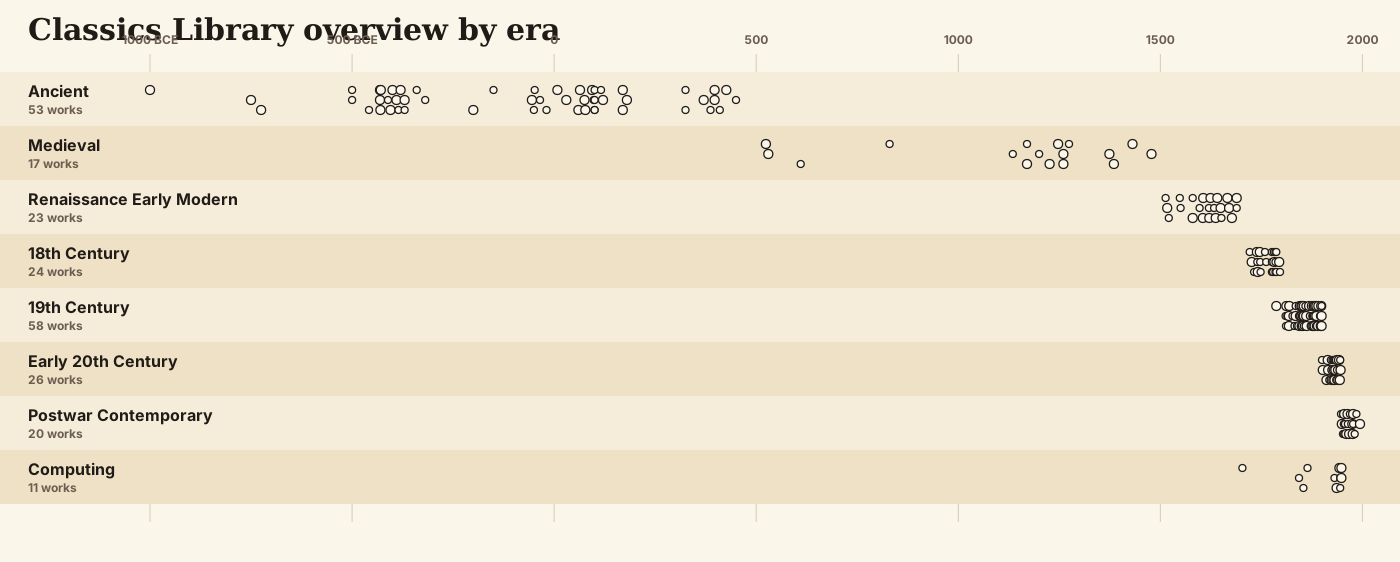
What the Library Eras Mean
The era labels are reading aids, not sealed boxes.
Ancient works help you hear medical, ethical, political, and religious language before modern institutions divide them into separate fields. Hippocratic and Galenic medicine, epic injury, plague, prophecy, divine punishment, philosophy as therapy, and civic health often overlap. Read symptoms inside cosmology and public order, not only inside the body.
Medieval works often bind illness to spiritual formation, pilgrimage, courtly identity, discipline, confession, providence, and exemplum. A sick body may be literal, symbolic, social, and sacramental at once. Do not rush to separate metaphor from medicine; the point may be that the culture does not divide them cleanly.
Renaissance and early modern works sit amid print expansion, religious conflict, humoral medicine, anatomy, natural philosophy, witchcraft anxiety, colonial encounter, and the theater of public bodies. Melancholy, madness, conscience, plague, and political disorder often speak through the same vocabulary.
18th-century works are useful for questions about reason, sensibility, satire, empiricism, evangelical medicine, revolution, and the public sphere. This is a strong period for watching older soul-body models meet reformist institutions, domestic medicine, colonial administration, and Enlightenment confidence.
19th-century works are dense with industrial cities, asylums, public health, addiction, nerves, heredity, grief, tuberculosis, realism, gothic medicine, and the professionalizing doctor. It is tempting to translate everything here into modern psychiatry. Resist that. The productive move is to ask what the text gains by treating distress as moral failure, social injury, nervous disease, spiritual trial, inheritance, poverty, gendered confinement, or all of these at once.
Early-20th-century works make modern psychology, war trauma, bureaucracy, alienation, sexuality, and mass violence harder to ignore. They also include older forms that survive inside modernity: sermons, myth, confession, classical reception, and moral philosophy.
Postwar-contemporary works in this library are not "the present" so much as late witnesses to empire, genocide, civil rights, Cold War politics, decolonization, addiction, and institutional medicine. Treat them as texts with their own historical distance.
Computing is separated because these works change the library's idea of mind. They bring calculation, cybernetics, information, cognition, feedback, memory, proof, and machine intelligence into conversation with older questions about soul, reason, agency, and embodiment. Some computing works have early publication dates because the category follows the history of the idea, not a neat century.
Comparing Without Flattening
Recurring themes are invitations to compare, not permission to declare sameness. A clean comparison usually has three moves:
- Name the local vocabulary. Is the work talking about melancholy, acedia, despair, spleen, nerves, madness, possession, fever, plague, shell shock, intoxication, sin, imagination, or conscience?
- Name the institution or authority around the suffering. Is the interpreter a physician, priest, philosopher, soldier, family member, narrator, court, asylum, state, or patient?
- Name what changes across time. Does the same distress move from theological language to humoral language, from household care to medical institution, from heroic wound to trauma, from moral weakness to pharmacologic problem?
That pattern keeps comparison honest. Burton and Rush can sit in the same melancholia thread, but Burton's encyclopedic melancholy is not Rush's medical reform project. Homeric battle wounds and twentieth-century shell shock both belong to war medicine, but they do not imagine injury through the same body, self, or state. Sermons and novels may both describe despair, but a sermon often asks how affliction forms the soul, while a novel may ask how society reads and misreads the sufferer.
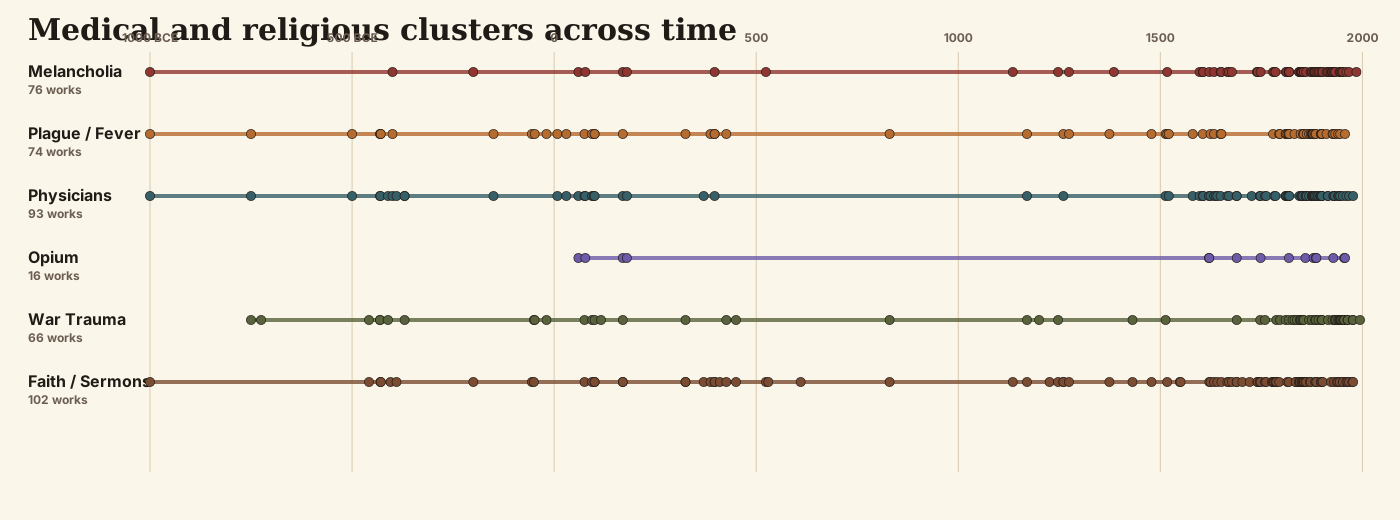
The most useful cross-time clusters in this library include melancholia and depression, plague and fever, physicians and healers, war wounds and trauma, opium and laudanum, madness and genius, and sermons on illness of body and soul. In each case, start by finding a shared problem, then protect the difference.
Tools Already in the Site
Use the era pages when you need a chronological shelf. /eras/19th-century/ is often a better starting point than a keyword search if the question depends on institutions, publication milieu, or genre.
Use medical tags when the question begins with a clinical or history-of-medicine problem. melancholia-depression, plague-epidemic, fever-infection, physicians-doctors, opium-laudanum, trauma-shell-shock, and war-wounds are especially good timeline filters. The tag page gives a focused corpus; the timeline shows whether the corpus is clustered in one period or spread across the library.
Use themes when the question is literary or moral before it is medical. faith-religion, madness-mind, death-mortality, science-knowledge, and memory-time often explain why a medical passage matters in the work.
Use comparisons when you already have two works in mind. Use Ask when you need a cited scouting report from summaries, lessons, quotes, medical-lens notes, full-text chunks, and other indexed notes available in the current build. Ask is a retrieval aid, not a publication source; follow its citations back to the work page, quote record, or public-domain text.
Use digests to remember the shape of a work before pulling a quote. Use the full-text reader for public-domain works when you need to check surrounding context. For copyrighted works, respect the library rule: short quotes only, and no outside long excerpts.
Worked Example: Melancholia From Burton to Rush to James
Start with Burton's The Anatomy of Melancholy. Its date and method matter. Burton is compiling authorities, anecdotes, theology, medicine, astrology, diet, study, love, solitude, and the scholar's self-mockery into one huge early modern machine. "Melancholy" here is not merely a symptom list. It is a condition of body, learning, sin, temperament, habit, and world.
Move to Rush's Medical Inquiries and Observations upon Diseases of the Mind. Now the authority has shifted. Rush writes as a physician in a reforming republic, with institutions, classification, and treatment closer to the center. He still inherits older assumptions, but the voice is medicalizing in a different way: it wants order, management, and professional jurisdiction.
Then bring in William James's The Varieties of Religious Experience or The Principles of Psychology. James does not simply replace religion with psychology. He studies experience, attention, habit, conversion, sick souls, and the stream of consciousness in a world where psychology is becoming a discipline. Compared with Burton and Rush, James lets you ask how first-person suffering, religious interpretation, and scientific description can coexist without collapsing into one another.