Work record
Cannery Row
1945 · Early 20th Century · Novel · English
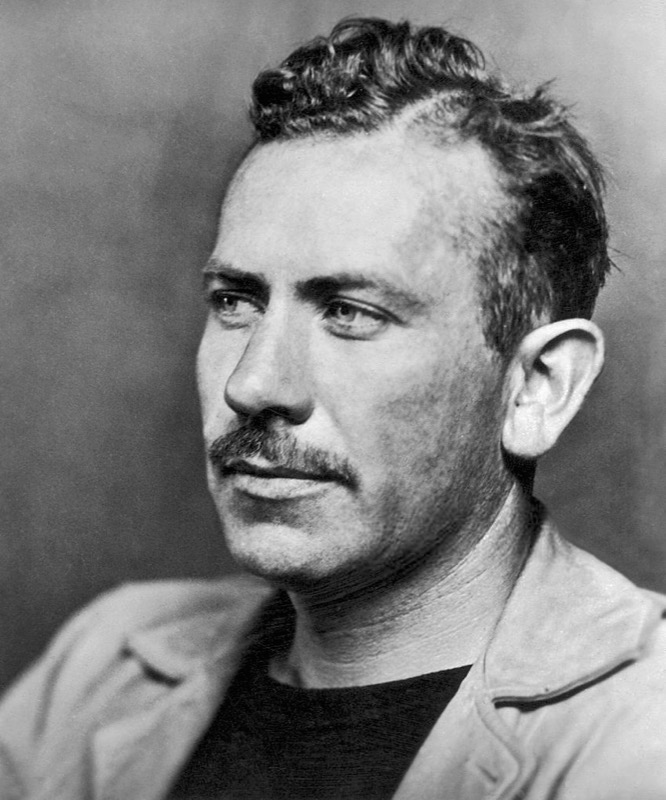
.jpg)
Summary
Cannery Row is a loosely plotted, affectionate portrait of the sardine-cannery district of Monterey, California, during the Depression, built from short narrative chapters alternating with self-contained vignettes or 'inter-chapters'. Its centre is Doc, a gentle, learned marine biologist who runs the Western Biological Laboratory, collects specimens from the tide pools, listens to Gregorian chant and Bach, reads poetry, and is trusted by everyone on the Row. Around him live Lee Chong, the shrewd Chinese grocer who extends credit and quietly does good; Dora Flood, who runs the Bear Flag Restaurant, a well-ordered brothel whose madam gives generously to the community; and Mack and the boys, a group of cheerful, unemployed men who live in a converted fishmeal shed they call the Palace Flophouse and Grill. The slender plot begins when Mack decides that the boys should throw Doc a party to thank him for his kindness. To raise money they go frog hunting for Doc in the Carmel Valley, where they trespass on a captain's land and win him over. But Doc is away collecting octopuses at La Jolla when the party begins, and the boys' celebration in his laboratory spirals out of control: the guests get drunk, records and glassware are smashed, and Doc returns to a wrecked lab. He punches Mack, then forgives him. The Row falls into a melancholy. Other episodes fill out the community: Frankie, a slow, damaged boy whom Doc takes in, steals a clock to give Doc as a present and is sent to an institution; the Malloys live in an abandoned boiler, and Mrs Malloy wants curtains for windows they do not have; Henri the painter builds a boat he never intends to finish; a dispirited man named Horace Abbeville signs over a debt and then shoots himself in the Palace; during an influenza epidemic, Dora's girls and Doc nurse the sick families of the Row. At La Jolla Doc finds a drowned girl's face in a tide pool and is haunted by it. Finally, learning that Doc's birthday is approaching, the Row plans a second, better party, and everyone contributes gifts. This time Doc knows and quietly prepares. The party is riotous and joyful, survives a brief fight, and ends with Doc alone in the morning, cleaning up and reading aloud from a Sanskrit love poem.
Plot or Argument
- The Row and its people
Introductions to Lee Chong, the Palace Flophouse, Dora's Bear Flag Restaurant and Doc's Western Biological Laboratory.
- The first party: the frog hunt
Mack and the boys decide to give Doc a party, raise money by collecting frogs, and befriend the captain whose land they hunt on.
- Disaster
While Doc is away at La Jolla the party gets out of hand and wrecks the laboratory; Doc returns, strikes Mack, and they reconcile.
- Interchapters and episodes
Vignettes of Frankie, Henri, the Malloys, the gopher, the influenza epidemic and other lives on the Row.
- The second party
The whole Row prepares for Doc's birthday; the party is a success, and Doc is left alone at dawn reading poetry.
Characters
- Doc, marine biologist
Owner of Western Biological, kind and contemplative centre of the Row, based on Ed Ricketts.
- Mack, leader of the boys
Charming, resourceful idler whose good intentions cause both parties.
- Lee Chong, grocer
Chinese shopkeeper who extends credit and owns the Palace Flophouse.
- Dora Flood, madam
Runs the Bear Flag Restaurant and quietly pays for much of the Row's welfare.
- Hazel, one of the boys
Simple, talkative young man who asks Doc endless questions.
- Frankie, boy
Intellectually disabled boy whose devotion to Doc ends in his institutionalisation.
- Henri, painter
Eccentric artist who builds a boat he is afraid to finish.
- Mr and Mrs Malloy, residents
A couple living in an old boiler who rent out pipes as lodging.
Lessons
A community can be judged by its kindness
The people of the Row are poor, idle or disreputable by conventional standards, yet they care for one another. Steinbeck invites readers to value generosity over respectability.
- What does the novel say about Dora's place in the community?
- Are Mack and the boys failures or philosophers?
Seeing like a naturalist
Steinbeck observes his characters the way Doc observes tide pools, with curiosity rather than judgment. The book models an ecological way of looking at human life.
- How do the tide-pool descriptions mirror the human community?
- Does non-judgment ever become indifference?
- What is Doc's loneliness?
Good intentions are not enough
The first party wrecks what it meant to honour, and Frankie's gift ends in disaster. The novel holds kindness and harm side by side without easy resolution.
- Why does the second party succeed?
- What does Frankie's story say about the limits of the Row's care?
Context
Monterey's Ocean View Avenue was a centre of the California sardine industry, which collapsed from overfishing around the late 1940s; the street was later renamed Cannery Row after the novel. Steinbeck's friend Ed Ricketts ran Pacific Biological Laboratories there, and the novel's Doc is modelled on him.
Composition
Steinbeck wrote the novel in 1944 after working as a war correspondent, describing it as a nostalgic book written for a group of soldiers who asked for something funny that was not about the war. It was published in January 1945.
Reception
Some reviewers found it slight or morally lax after The Grapes of Wrath, but it became popular and lasting. Steinbeck wrote a sequel, Sweet Thursday (1954). Cannery Row is now a tourist destination, and Ricketts is remembered as a pioneer of ecological thinking.
Comparisons
- of-mice-and-men
Both portray marginal working men in Depression California; Of Mice and Men's Lennie and Cannery Row's Frankie show Steinbeck's concern for the intellectually disabled and their fate.
- east-of-eden
Steinbeck's Salinas Valley epic is grand and moral where Cannery Row is loose and comic, but both centre on wise observers (Samuel Hamilton, Lee; Doc).
- on-the-road
Mack and the boys anticipate Kerouac's idealised drifters who reject work and conventional ambition.
- white-nights
Doc, like Dostoyevsky's Dreamer, is a solitary figure whose generosity masks loneliness.
Quotes
“Cannery Row in Monterey in California is a poem, a stink, a grating noise, a quality of light, a tone, a habit, a nostalgia, a dream.”
For Students
A reading companion for classical Christian high school students. See the student guide.
Reading Guide
Watch for
- The Prologue's comparison between writing this book and collecting delicate flatworms that break apart if grabbed. Steinbeck tells you how he intends to gather the Row, and the loose structure of the novel follows from it.
- The alternation between chapters that carry the story of the two parties and short interchapters that seem unrelated, such as the gopher looking for a home or the old Chinese man who walks down to the sea at dusk and the boy Andy who mocks him. Ask what each interchapter adds to the main story.
- The two parties for Doc. The first, while Doc is away at La Jolla, ends in a wrecked laboratory and Doc striking Mack; the second, for his birthday, is planned by the whole Row. Compare who gives, who receives, and what has changed in between.
- Doc's conversation with Richard Frost while watching Mack and the boys, in which he argues that the qualities people admire belong to those who fail and the qualities they despise belong to those who succeed.
- Frankie's story: his devotion to Doc, his attempt to serve beer at a party, and the onyx clock he steals as a gift, which ends with him sent away to an institution.
Key terms and names
- Western Biological Laboratory
- Doc's shop for collecting and selling marine specimens, the quiet center of the Row. People come to it for help, music, conversation, and loans, and its destruction in the first party is the low point of the book.
- Palace Flophouse and Grill
- The fishmeal storehouse Lee Chong acquires when Horace Abbeville pays his grocery debt with it and then takes his own life there. Mack and the boys rent it for a nominal sum, never pay, and furnish it into a real home.
- Bear Flag Restaurant
- Dora Flood's house on the Row, run with strict rules. Dora pays for many of the Row's needs in secret, and during the influenza epidemic her girls go out to nurse sick families.
- Interchapter
- A short chapter standing outside the main plot, a technique Steinbeck also used in The Grapes of Wrath. In Cannery Row the interchapters work like specimens in jars: small lives set side by side for the reader to examine.
- The Great Tide Pool
- The rocky pool at the tip of the Monterey peninsula where Doc and Hazel collect animals. Steinbeck describes its feeding, hiding, and killing in detail, giving a picture of a community of creatures that mirrors the human one on the Row.
- Non-teleological thinking
- Ed Ricketts's habit, shared with Steinbeck, of observing what is rather than asking what it is for or who is to blame. Doc looks at Mack and the boys this way, which is why he can like them without approving of everything they do.
Seminar Questions
- Comprehension How does Lee Chong come to own the Palace Flophouse, and how do Mack and the boys come to live there?
- Comprehension Why does Mack decide the boys should throw a party for Doc, and how do they set out to pay for it?
- Comprehension What does Doc find in the tide pool at La Jolla, and how does he respond to it?
- Interpretation Doc strikes Mack after the first party and then listens to Mack's account of how everything he touches goes wrong. Why does Doc forgive him, and what does the forgiveness cost each of them?
- Interpretation Doc tells Richard Frost that kindness, generosity, and honesty go with failure in their society, while sharpness and greed go with success. Does the rest of the novel bear out his claim, or do characters like Lee Chong and Dora complicate it?
- Interpretation Frankie wants nothing more than to please Doc, yet every attempt ends in disaster. What does his story show about the limits of good intentions on the Row, and why does Steinbeck place it just before the second party?
- Interpretation Steinbeck surrounds the human story with tide-pool creatures, a gopher, and a dog's ticks. Is he saying that the Row is no different from a tide pool, or is he showing something human that the tide pool lacks?
- Big Question Mack and the boys own nothing, work as little as possible, and seem happier than most respectable people. Is a life free of ambition a wise life, or does the novel show what it costs?
Faith Connections
- Luke 14:12-14 (Scripture)
Jesus tells his host to invite to a feast the poor, the crippled, and the blind, who cannot repay. The parties of Cannery Row reverse the usual pattern, with the poorest men on the Row trying to give a feast to the one man who has been generous to them.
- Matthew 6:25-34 (Scripture)
Jesus points to the birds and the lilies, which neither toil nor gather into barns. Mack and the boys live with something like that freedom from care, but Steinbeck's book raises the question whether their carelessness is trust or only drift, which the Gospel passage answers by directing the heart first to God's kingdom.
- Psalm 104 (Scripture)
The psalmist marvels at the sea teeming with creatures beyond number, all of which wait on God for their food. Doc's patient attention to the tide pools has the same wonder at the variety of living things, though the psalm sees them as creatures sustained by a Creator.
- Francis of Assisi, Canticle of the Creatures (Great Conversation)
Francis praises God through brother sun, sister water, and sister bodily death. Set beside Doc's tender, unsentimental love of animals and of the Row's outcasts, the Canticle shows a regard for creatures rooted in their shared Maker.
Logic and Rhetoric
Central argument: A community should be judged by how its people treat one another rather than by what they own or achieve; the Row's grocer, madam, and idle men, despised by respectable society, care for the sick, extend credit, and labor to honor a friend; therefore the Row, with all its disorder, holds goods that the successful world tends to lose, though the novel also admits that good will alone wrecks laboratories and cannot save Frankie.
Rhetorical device: asyndeton. The first sentence of the Prologue defines the street by a string of unlike nouns with no conjunctions, from a poem and a stink to a nostalgia and a dream. The list mixes the senses with the emotions and warns the reader that the Row cannot be reduced to a single description.
Debate: Resolved: Doc is right that the virtues people admire most tend to lead to failure in the world.
Writing Prompts
Essay: Doc is the person everyone on the Row turns to, yet Steinbeck shows him alone in his laboratory at the end, reading poetry after the party. Argue whether Doc belongs to the community of the Row or stands apart from it, using the frog-hunt party, the La Jolla trip, and the final morning.
Comparison with Of Mice and Men: Both of Steinbeck's books center on poor men without families who cling to friendship and a dream, and both include an innocent, Lennie and Frankie, whose love brings harm. Compare how each book treats these innocents and argue which offers the more hopeful view of the bonds among men who have nothing.
Medical Lens
Doc, though a biologist rather than a physician, functions as the Row's informal doctor and counsellor, and the novel contains several medically pertinent episodes. An influenza epidemic sweeps the Row and Dora's workers nurse sick families while Doc treats who he can, a portrait of informal community care. Frankie's story, ending in his removal to an institution, reflects mid-century treatment of intellectual disability. A dejected man's suicide, alcohol as social glue and occasional catastrophe, and Doc's encounter with a drowned girl's body all appear. The book's tone is gentle, so these strands are best read as part of its portrait of community rather than as clinical studies.
- Interchapter on the epidemic
Influenza hits the Row; Dora's girls and Doc care for sick families.
- Chapters on Frankie
Frankie's devotion to Doc, his theft of a clock as a gift and his commitment to an institution.
- Early chapter (Palace Flophouse)
Horace Abbeville settles his debt with Lee Chong and shoots himself in the building that becomes the Palace Flophouse.
- La Jolla chapter
Doc finds the body of a drowned girl in the rocks while collecting specimens.
- First and second parties
Drink fuels both parties, destructively and joyfully.
Creative Prompts
- Fiction
Write a new interchapter about a single resident of your own street, in Steinbeck's tide-pool manner.
- Essay
Read Doc alongside what is known of Ed Ricketts. What did Steinbeck take from his friend's 'non-teleological' thinking?
Further Reading
- Sweet Thursday, John Steinbeck
The 1954 sequel.
- The Log from the Sea of Cortez, John Steinbeck
Includes Steinbeck's memoir 'About Ed Ricketts'.
- Between Pacific Tides, Edward F. Ricketts and Jack Calvin
Ricketts's classic study of intertidal life.
- John Steinbeck, Writer, Jackson J. Benson
Verification notes
Characters, the two-party structure, the Ricketts background and publication facts are well established. Chapter numbers are not given because I am not certain of them. The single quote is the very well-known opening line.
- Chapter numbers of the flu epidemic, Frankie and Horace Abbeville episodes.
- Steinbeck's comment that the book was written for soldiers who wanted something not about the war (source and wording).
- That the poem Doc reads at the end is from the Sanskrit (Black Marigolds, trans. E. Powys Mathers).