Work record
Fear and Trembling
1843 · 19th Century · Philosophy · Danish
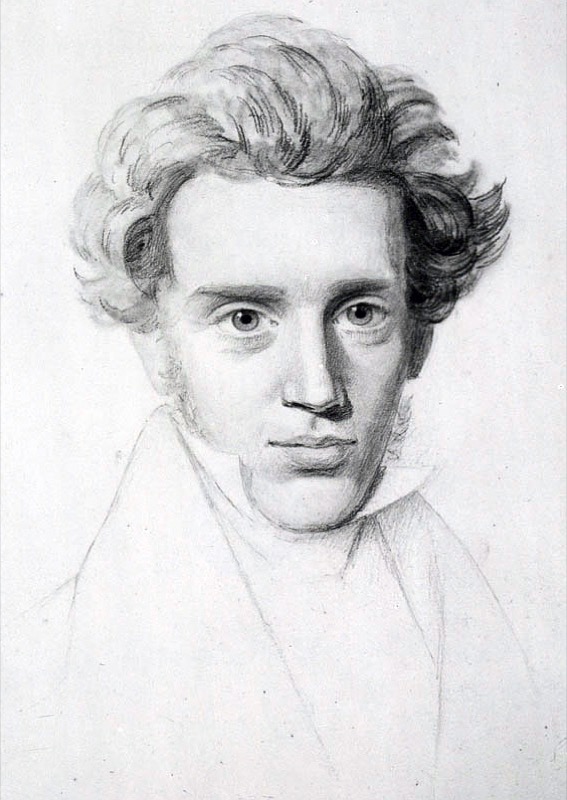
_-_(cropped).jpg)
Summary
Fear and Trembling: Dialectical Lyric appeared in Copenhagen on 16 October 1843 under the pseudonym Johannes de silentio, 'John of silence', the same day as Repetition. Its subject is Genesis 22, in which God commands Abraham to take his son Isaac to Mount Moriah and offer him as a burnt offering. Johannes is not a believer who can explain faith but an admirer who confesses he cannot understand it. He opens by complaining that his contemporaries want to 'go further' than faith, as though it were an elementary stage that Hegelian philosophy had surpassed, when in fact no one has even reached it. A section called 'Tuning Up' (Stemning, also translated 'Attunement' or 'Exordium') retells the story four times, each version describing an Abraham who fails in some way: one who pretends to be a monster so Isaac will keep faith in God, one who obeys but loses his joy, one who begs forgiveness for having been willing, one whose despair Isaac sees. Each is followed by an image of a mother weaning her child. The 'Speech in Praise of Abraham' then celebrates the patriarch's greatness: he believed, against all understanding, that he would sacrifice Isaac and still receive him back in this life. Johannes distinguishes two figures. The knight of infinite resignation, like a young man who gives up a princess he can never marry, renounces the finite and finds peace in eternal consciousness; Johannes can make this movement himself. The knight of faith makes a second movement, 'by virtue of the absurd', and receives the finite back, living in the world so ordinarily that he looks like a tax collector. The core of the book is three Problemata. Problema I asks whether there is a teleological suspension of the ethical: whether Abraham, as a single individual, stands in an absolute relation to God above the universal ethical demand that a father love his son. Unlike tragic heroes such as Agamemnon, Jephthah and Brutus, who sacrifice children for a higher ethical good the community can understand, Abraham has no such justification; either faith is a paradox or Abraham is a murderer. Problema II asks whether there is an absolute duty to God. Problema III asks whether Abraham was ethically defensible in concealing his purpose from Sarah, Eliezer and Isaac, and works through stories of silence and disclosure: Agnete and the merman, Tobias and Sarah, Faust, and the bridegroom who abandons his marriage on an augur's prophecy. Abraham cannot speak because nothing he could say would be understood. The epilogue repeats that faith is the highest passion and that each generation must begin it afresh.
Plot or Argument
- Preface: the bargain sale of faith
Johannes de silentio satirises a Copenhagen intellectual culture that treats doubt and faith as preliminaries to be surpassed by system, contrasting it with Descartes's modest doubt and the old Greeks' lifelong task.
- Tuning Up: four failed Abrahams
A man who has loved the Genesis story since childhood imagines four versions of the journey to Moriah, each with a broken Abraham, and after each a mother blackening her breast to wean her child.
- Speech in Praise of Abraham
A lyrical eulogy: Abraham was great by waiting for the promised son, greater by believing he would keep him while drawing the knife, and greatest because his faith was for this life, not a hereafter.
- Preamble from the Heart
Johannes contrasts the movements of infinite resignation and faith, using the lad in love with a princess and the knight of faith who looks like a tradesman going home to his dinner, and admits he can describe but not perform faith's second movement.
- Problema I: the ethical suspended
If the ethical is the universal and the highest, Abraham is lost. Faith is the paradox that the single individual is higher than the universal. The tragic hero stays within the ethical; Abraham oversteps it entirely.
- Problema II: duty to God
If every duty to God is just ethical duty described religiously, there is no absolute duty to God. The section reads Luke 14:26, 'hate father and mother', to argue that faith involves a relation the community cannot mediate.
- Problema III: Abraham's silence
Ethics demands disclosure; aesthetics prizes concealment that serves another's good. Through the merman, Sarah of Tobit, Faust and others, Johannes shows that Abraham's silence differs because he cannot make himself understood, and his one ambiguous word to Isaac is 'God will provide'.
- Epilogue
A brief return to the image of a market where prices are cut: faith is the highest passion, and no generation begins further on than the one before.
Characters
- Johannes de silentio, pseudonymous author
A self-described 'supplementary clerk' and poet of faith who admires Abraham, can perform infinite resignation, but insists he cannot make the movement of faith.
- Abraham, father of faith
The patriarch of Genesis 22, ordered to sacrifice Isaac, whose obedience Johannes treats as either the paradox of faith or murder.
- Isaac, the son
The child of promise, born in Abraham's old age, whose experience of the journey drives the four retellings.
- The knight of infinite resignation, contrast figure
Exemplified by a lad who renounces an unattainable princess and holds the love eternally; he gains peace but not the world back.
- The knight of faith, ideal figure
Outwardly indistinguishable from a bourgeois shopkeeper, he has renounced everything and received it back by virtue of the absurd.
- Agamemnon, Jephthah and Brutus, tragic heroes
Fathers who sacrificed children for a communal good and so remained inside the ethical, unlike Abraham.
- Agnete and the merman, folk-tale exemplars
A Danish legend Johannes rewrites to explore concealment, repentance and the demonic in Problema III.
Lessons
Faith is harder than its admirers admit
Johannes insists that people who praise Abraham on Sunday would be horrified by a parishioner who did the same thing on Monday. The book forces readers to face the terror of the story before claiming to understand it.
- Why does Johannes say that if Abraham is not a man of faith he is a murderer?
- What would it mean for a preacher to take Genesis 22 seriously?
- Is Johannes's refusal to understand faith a form of honesty or evasion?
Resignation and faith are two different movements
Infinite resignation renounces the finite for an eternal consolation; faith renounces and then receives the finite back with joy. The distinction separates detached spirituality from a faith that returns to ordinary life.
- Why does the knight of faith look like a tax collector rather than a saint?
- Can someone in grief recognise themselves in the knight of resignation?
When ethics cannot be spoken
Problema III asks whether a person can be justified in keeping silent about a decision others cannot understand. The question bears on confession, secrecy and the limits of explaining oneself to family or community.
- How does Abraham's silence differ from the merman's concealment?
- Is there an ethical duty to explain decisions to those they affect?
The tragic hero versus the single individual
Agamemnon can weep with the Greeks because his sacrifice serves the state; Abraham has no shared reason to offer. The contrast shows what a purely communal ethics can and cannot recognise.
- Does a teleological suspension of the ethical license fanaticism?
- How would a modern court or ethics committee read Abraham's case?
- What does the comparison with Jephthah reveal about the role of vows?
Context
Kierkegaard wrote against the Danish Hegelians, especially the theologian Hans Lassen Martensen and the critic J. L. Heiberg, who presented speculative philosophy as a completion of Christian faith. Copenhagen in the 1840s was a small, intensely literary capital with a state Lutheran church that Kierkegaard came to regard as Christianity without cost. His pseudonymous method, adopting voices he did not endorse, belongs to his strategy of 'indirect communication'.
Composition
Written mainly in Berlin in spring 1843, shortly after the publication of Either/Or and around the time Kierkegaard saw Regine Olsen in church and learned of her engagement to another man. It was published by C. A. Reitzel on 16 October 1843 alongside Repetition and Three Upbuilding Discourses under Kierkegaard's own name. Many readers see in Abraham's sacrifice of what he loves most an oblique reflection of Kierkegaard's broken engagement, a reading the journals support but do not settle.
Reception
Little noticed outside Denmark until German translations around 1900, the book was taken up by dialectical theologians (Barth), existentialists (Jaspers, Heidegger, Sartre, who discussed Abraham's anguish in Existentialism Is a Humanism) and Levinas and Derrida (The Gift of Death). Since 2001 it has been widely cited in debates over religiously motivated violence. Alastair Hannay's translation (1985) and the Hong translation (1983) remain standard.
Comparisons
- the-sickness-unto-death
The later pseudonym Anti-Climacus analyses despair as a sickness of the self; Fear and Trembling describes the movement of faith from outside, while The Sickness unto Death diagnoses the condition faith overcomes.
- the-bible
Genesis 22 is the text under examination, and Kierkegaard's four retellings imitate midrashic expansion; the reading of Luke 14:26 in Problema II shows how he sets the New Testament's demands against domestic ethics.
- pensees
Pascal's wager and his God of Abraham, Isaac and Jacob, not of the philosophers, anticipate Johannes's claim that faith begins where reason ends, though Pascal offers apologetic reasons that Kierkegaard deliberately withholds.
- groundwork-of-the-metaphysics-of-morals
Kant's universal moral law is close to what Johannes calls 'the ethical'; Kant himself wrote that Abraham should have doubted that the command came from God, the very conclusion Problema I refuses.
- the-oresteia
Agamemnon's sacrifice of Iphigenia, recalled in Aeschylus, is Johannes's model of the tragic hero who remains inside the ethical because his community can understand the cost.
- letters-and-papers-from-prison
Bonhoeffer, a close reader of Kierkegaard, faced his own conflict between obedience and conventional ethics in joining the conspiracy against Hitler, but rejected the solitary individual in favour of responsibility for others.
Quotes
For Students
A reading companion for classical Christian high school students. See the student guide.
Reading Guide
Watch for
- The pseudonym on the title page, Johannes de silentio, and his repeated claim that he admires Abraham but cannot understand him or make the movement of faith himself. Keep asking who is speaking and how far Kierkegaard stands behind him.
- The four retellings of the journey to Moriah in Tuning Up, each showing an Abraham who fails in a different way, and the image of a mother weaning her child that follows each one.
- The two knights in the Preamble from the Heart: the young man who renounces an unattainable princess, and the knight of faith who looks like a tax collector walking home to his dinner.
- The comparison in Problema I between Abraham and the tragic heroes Agamemnon, Jephthah and Brutus, who sacrificed children for a cause their communities could understand.
- Problema III's stories of silence and disclosure, especially Agnete and the merman, and the single ambiguous answer Abraham gives Isaac on the mountain.
Key terms and names
- Johannes de silentio
- Latin for John of silence, the pseudonymous author of the book. He presents himself as a poet of faith who can describe Abraham's greatness but not imitate it.
- The ethical (the universal)
- In the Problemata, the moral law that applies to everyone and can be explained to everyone, such as a father's duty to love his son. Johannes asks whether anything can stand higher than it.
- Teleological suspension of the ethical
- The question of Problema I: whether the ethical can be set aside for a higher end, namely obedience to God. Johannes argues that either such a suspension exists or Abraham is lost.
- Knight of infinite resignation
- The figure who gives up a finite good, such as the princess he loves, and finds peace in an eternal consciousness of it. Johannes says he can make this movement himself.
- Knight of faith
- The figure who renounces everything and then, by virtue of the absurd, receives the finite world back with joy. Outwardly he looks entirely ordinary.
- The absurd
- Johannes's term for what faith holds against all human calculation: that Abraham would sacrifice Isaac and still receive him back in this life.
- Tragic hero
- A figure such as Agamemnon who sacrifices a private good for a higher ethical cause the community recognises. He remains within the ethical and can be wept over and understood, unlike Abraham.
Seminar Questions
- Comprehension Who is Johannes de silentio, and what does he say he can and cannot do with respect to faith?
- Comprehension Briefly describe the four Abrahams of Tuning Up. In what way does each one fail?
- Comprehension How does Johannes distinguish Abraham from Agamemnon, Jephthah and Brutus in Problema I?
- Interpretation Why does Johannes insist that if Abraham is not a man of faith he is a murderer? What does this either-or force the reader to admit about the story?
- Interpretation Why does the knight of faith look like a tax collector or tradesman rather than a saint? What does this say about where faith is lived?
- Interpretation Abraham tells no one, not Sarah, not Eliezer, not Isaac, what he is going to do. In Problema III, why is his silence different from the merman's concealment?
- Big Question If faith can place a person in a relation to God that the community cannot understand, how can anyone tell true faith from fanaticism or delusion? Does Johannes give any answer, and does Scripture?
Faith Connections
- Genesis 22:1-19 (Scripture)
The binding of Isaac is the text the whole book circles. Read it slowly before Johannes's retellings and notice how little Genesis says about Abraham's thoughts during the three-day journey, which is exactly the space Johannes fills.
- Hebrews 11:17-19 (Scripture)
Hebrews says Abraham offered Isaac reasoning that God was able to raise him from the dead. This is close to Johannes's account of faith that expects to receive Isaac back, though Johannes stresses that Abraham believed for this life, not only for a resurrection.
- Luke 14:26 (Scripture)
Jesus says no one can be his disciple without hating father and mother, wife and children. Problema II reads this hard saying literally enough to show that a duty to God can stand above ordinary family obligation, while insisting that it does not cancel love.
- Augustine, City of God I.21 (Church Fathers)
Augustine lists the exceptions to the commandment against killing, including those who act at God's express command, and names Abraham as praised rather than condemned for his readiness. Johannes asks the harder question Augustine passes over: how Abraham could know the command was from God.
Logic and Rhetoric
Central argument: If the ethical, the universal law binding on all, is the highest thing, then Abraham's readiness to kill Isaac cannot be justified, and he is a murderer. Yet Abraham is honoured as the father of faith. Therefore either faith is a paradox in which the single individual stands in an absolute relation to God higher than the universal, or Abraham is lost and the praise given him is empty. Johannes chooses the first, while confessing he cannot understand it and that it cannot be explained to anyone.
Rhetorical device: refrain. In Tuning Up each of the four retellings of the journey to Moriah is followed by a short image of a mother weaning her child, so that the repeated pattern links the separation of parent and child to Abraham's ordeal and gives the section the shape of a lyric with stanzas.
Debate: Resolved: Abraham's willingness to sacrifice Isaac was an act of faith, not a violation of morality.
Writing Prompts
Essay: Johannes de silentio says he can make the movement of infinite resignation but not the movement of faith. Explain the difference between the two knights and argue why faith, as Johannes describes it, requires a second movement that returns to the finite world.
Comparison with The Oresteia: Johannes holds up Agamemnon's sacrifice of Iphigenia as the model of the tragic hero who stays within the ethical. Compare how Aeschylus presents Agamemnon's choice at Aulis and its consequences with how Johannes presents Abraham at Moriah, and argue whether Johannes's distinction between the tragic hero and the knight of faith holds up.
Medical Lens
The book matters to psychiatry chiefly through the vocabulary of anguish, dread and inwardness that Kierkegaard developed here and in The Concept of Anxiety (1844), later absorbed by existential psychotherapy (Binswanger, May, Yalom) and by Sartre. Abraham's three-day journey is an extended study of anticipatory dread and of a decision that cannot be shared. The repeated weaning images in 'Tuning Up' have attracted psychoanalytic readings about separation. Infinite resignation can be read alongside grief work: holding a lost love eternally while renouncing it in time. Biographical readings that connect the book to Kierkegaard's 'melancholy', inherited in his own account from his father, are common but interpretive. From the side of medical ethics and forensic psychiatry, the obvious modern question, whether someone who hears a command to kill a child is psychotic, is precisely the reduction the book anticipates and resists; it should be discussed as a philosophical problem, not settled by diagnosis.
- Tuning Up (Exordium/Attunement)
Four retellings of the journey to Moriah, each followed by an image of a mother weaning her child by blackening her breast.
- Speech in Praise of Abraham
Abraham's long waiting for a child in old age and the three-day ride to Moriah described as an ordeal of expectation and dread.
- Preamble from the Heart
The lad who renounces the princess and transforms lost love into eternal remembrance, a model of resignation set beside grief.
- Problema III
Studies of concealment, the demonic, and the relief or impossibility of disclosure, including the merman's repentance and Sarah of Tobit's dread on her wedding night.
Creative Prompts
- Fiction
Write a fifth version of the journey to Moriah to add to Johannes's four, told from Isaac's point of view on the second night of the journey.
- Dialogue
Stage a consultation in which a psychiatrist, a rabbi and Johannes de silentio each interview Abraham on the morning he saddles his donkey, and disagree about what they are hearing.
- Essay
Compare Kierkegaard's knight of infinite resignation with modern models of grief that speak of 'continuing bonds' with the dead. Where do they converge, and where does faith's second movement exceed them?
- Classroom
Divide a class into Agamemnon, Jephthah, Brutus and Abraham groups; each defends their father's sacrifice before a jury, then the class decides which defences remain within 'the ethical'.
Further Reading
- The Concept of Anxiety, Søren Kierkegaard
Published in 1844 under the pseudonym Vigilius Haufniensis.
- Repetition, Søren Kierkegaard
Companion volume published the same day in 1843.
- Kierkegaard: A Biography, Alastair Hannay
- The Gift of Death, Jacques Derrida
Reads Abraham's secrecy and sacrifice as the structure of responsibility.
- Existential Psychotherapy, Irvin D. Yalom
Shows how Kierkegaard's themes entered clinical practice.
Verification notes
Publication details, structure and main arguments are standard. No quotations are included: the work is marked copyrighted in this library, no public-domain English text is stored, and the translations most readers use (Hannay 1985; Hong 1983) are under copyright. Section titles vary by translation ('Tuning Up', 'Exordium', 'Attunement'); those given follow Hannay. Biographical links to Regine Olsen are interpretive.
- That the 'Speech in Praise of Abraham' is titled as such in Hannay's translation (Hong: 'Eulogy on Abraham').
- Kant's remark that Abraham should have doubted the divine voice (The Conflict of the Faculties, 1798) and its exact wording.
- That most of the book was drafted in Berlin in spring 1843.
- Sartre's discussion of Abraham's anguish in Existentialism Is a Humanism (1946).