Work record
A Mathematical Theory of Communication
1938 / 1948 · Computing · Computing · English
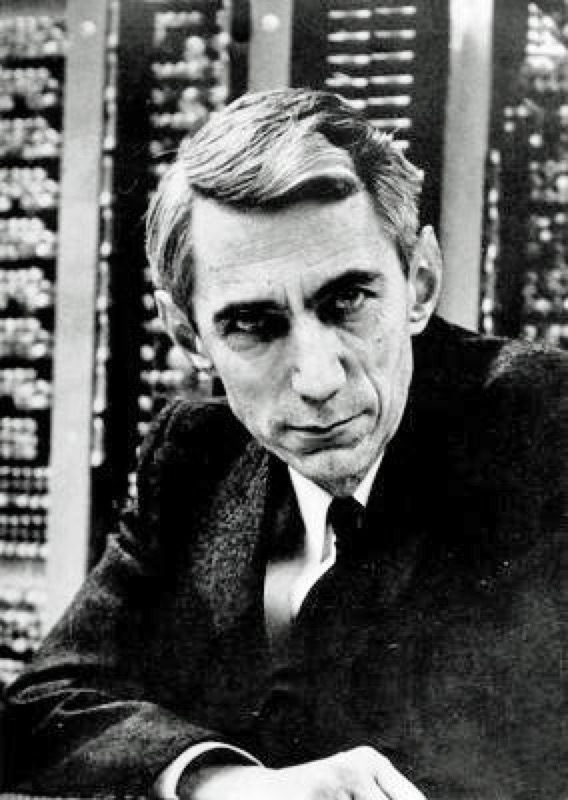

Summary
This entry joins Claude Shannon's 1938 master's thesis on relay and switching circuits with his 1948 paper A Mathematical Theory of Communication. The thesis made a decisive engineering move: it showed that Boolean algebra could describe and simplify relay circuits. Logical operations were no longer merely philosophical or mathematical abstractions; they could be built from switches. That connection made digital circuit design more systematic and gave Boole's nineteenth-century logic a twentieth-century electrical body. A decade later, Shannon's communication paper defined information not as meaning, wisdom, or truth, but as measurable uncertainty in the selection of messages from a set of possibilities. He described sources, transmitters, channels, noise, receivers, and destinations, then gave mathematical tools for entropy, redundancy, channel capacity, and coding. The paper's genius lies in its disciplined narrowing. By bracketing semantics, Shannon made communication technically tractable across telephones, telegraphs, radio, cryptography, and eventually computers. Messages could be encoded, compressed, protected against noise, and analyzed without first asking what they meant to human beings. This abstraction made it possible to compare media that otherwise looked unlike one another: speech on a wire, typed symbols, radio signals, secret messages, and later digital files. The result is a founding grammar of the information age. It influenced electrical engineering, computer science, linguistics, genetics, psychology, neuroscience, and cybernetics, sometimes productively and sometimes by tempting readers to confuse information with meaning. Its intellectual style is cool, spare, and deliberately anti-romantic. Read together, the thesis and the 1948 paper show Shannon's characteristic gift: converting messy practical problems into formal structures that engineers could calculate with. Switching, noise, and communication become domains of exact relation. For medical and psychiatric readers, the work also explains why later sciences of brain, signal, diagnosis, and feedback so often borrowed the language of information, and why that borrowing must be handled with care.
Plot or Argument
- Logic becomes circuitry
The 1938 thesis applies Boolean algebra to relay and switching circuits, showing how logical expressions can guide the design and simplification of electrical networks.
- Communication is modeled as a system
The 1948 paper abstracts communication into source, transmitter, channel, noise, receiver, and destination, deliberately separating the engineering problem from semantic interpretation.
- Entropy measures uncertainty
Shannon introduces entropy as a measure of choice or uncertainty in a message source, making information quantifiable in bits.
- Coding answers noise
The theory explains redundancy, channel capacity, and coding strategies that allow messages to move reliably despite interference.
Lessons
Meaning can be bracketed for a purpose
Shannon's theory succeeds by refusing to solve every problem of communication at once. By setting meaning aside, it gains extraordinary power over signal, uncertainty, and noise.
- What does Shannon gain by excluding semantics?
- When does the exclusion of meaning become misleading?
- How do clinicians use measurements that deliberately bracket lived meaning?
Noise is part of the model
The communication paper treats interference not as an accident outside theory but as a central condition to be measured and overcome. Reliable systems are designed by assuming distortion will occur.
- How does planning for noise change engineering ethics?
- What counts as noise in human conversation?
- Can redundancy be protective in clinical communication?
A formal language can migrate
Information theory began with engineering but traveled into biology, psychology, and culture. Its history teaches both the value and danger of portable metaphors.
- Why did Shannon's vocabulary spread so widely?
- Where is the information metaphor strongest outside engineering?
- Where does it flatten the thing it describes?
Context
Shannon's work arose from Bell Labs, wartime communications, relay engineering, and the mathematical atmosphere of early computing. Telephony and cryptography demanded exact analysis of signals under constraints.
Composition
The switching-circuit thesis was completed at MIT in 1938. A Mathematical Theory of Communication appeared in the Bell System Technical Journal in 1948 and was soon republished with Warren Weaver's interpretive essay.
Reception
The 1948 paper rapidly became foundational for information theory. Its concepts of bits, entropy, redundancy, and channel capacity shaped engineering first and then became metaphors across the human and life sciences.
Comparisons
- laws-of-thought
Shannon gives Boole's algebra an engineering application by showing how logical relations can be embodied in relay and switching circuits.
- cybernetics
Wiener shares Shannon's mathematical world but emphasizes control and feedback, especially in animals, machines, and nervous systems.
- as-we-may-think
Bush imagines tools for associative knowledge work, while Shannon formalizes the transmission and coding of messages through noisy channels.
- destruction-and-creation-and-the-ooda-loop
Boyd later uses information, uncertainty, and adaptation in strategic thought, extending communication theory into conflict and decision tempo.
Quotes
For Students
A reading companion for classical Christian high school students. See the student guide.
Reading Guide
Watch for
- The opening pages of the 1948 paper, where Shannon defines the engineering problem as recreating at the receiving end, exactly or nearly, the message chosen at the sending end, and sets the meaning of messages aside as irrelevant to that problem. Every later result depends on this narrowing.
- The schematic diagram (Fig. 1) of a general communication system: information source, transmitter, channel with a noise source, receiver, destination. Try drawing it for a telephone call, a telegram, and a conversation across a noisy room.
- The series of approximations to English in Part I, Section 3, where random letters, then letters chosen by frequency, then pairs and triples, then words, produce text that looks more and more like English without anyone meaning anything by it.
- Section 6, where Shannon lists the properties a measure of uncertainty ought to have and shows that only one formula, which he calls entropy, satisfies them all.
- Part II on the noisy channel, where Shannon proves that below a certain rate, the channel capacity, messages can be sent with as few errors as desired by clever coding.
Key terms and names
- Bit
- Short for binary digit, a word Shannon credits to J. W. Tukey. It is the unit of information: the amount needed to settle a choice between two equally likely possibilities.
- Entropy
- Shannon's measure of the uncertainty of a source, or how much choice it has in what it sends next. He borrowed the name because his formula has the same form as entropy in statistical mechanics.
- Redundancy
- The part of a message fixed by the rules and habits of the language and not freely chosen. Shannon estimates English at roughly fifty percent redundant, which is why a reader can often fill in a missing letter.
- Noise
- Any disturbance in the channel that makes the received signal differ from the one sent. Shannon builds noise into the model from the start instead of treating it as an accident.
- Channel capacity
- The greatest rate at which information can be sent reliably through a given noisy channel. Shannon's theorem says that rates below capacity can be made nearly error-free and rates above it cannot.
- Boolean algebra in switching circuits
- The insight of Shannon's 1938 thesis that relays in series and in parallel behave like the logical operations and and or. It let engineers simplify circuits by simplifying logical expressions.
Seminar Questions
- Comprehension What are the five parts of Shannon's general communication system, and where does noise enter it?
- Comprehension What did Shannon's 1938 thesis show about relays and Boolean algebra, and why did that matter to people designing telephone exchanges?
- Comprehension What does redundancy mean in the 1948 paper, and why does Shannon think a language with no redundancy at all would be impractical?
- Interpretation Shannon defines information as a measure of choice among possible messages rather than as what a message means. What does he gain by this definition, and what does the word information lose when used this way?
- Interpretation The approximations to English in Part I grow more English-like with no author intending anything. What do they suggest about the difference between the form of language and its sense?
- Interpretation Shannon treats noise as a permanent condition to be designed around. How does assuming imperfection from the start change what counts as a good system?
- Big Question If a message can be measured, compressed, and transmitted perfectly without reference to its meaning, is meaning something added by minds to signals, or something signals carry from one mind to another?
Faith Connections
- 1 Corinthians 14:7-11 (Scripture)
Paul asks how anyone will prepare for battle if the trumpet gives an uncertain sound, and says that words not easy to understand are spoken into the air. He is describing what Shannon would call a signal lost in noise, but Paul's concern is that the hearer understand, the very thing Shannon brackets.
- John 1:1-14 (Scripture)
John names Christ the Word, the Logos, through whom all things were made and who became flesh. Shannon's theory deliberately treats words as selections from a set without regard to sense, which sets up a useful contrast with a tradition in which the Word is first of all meaning and person.
- Augustine, On Christian Doctrine (De Doctrina Christiana), Book II (Church Fathers)
Augustine defines a sign as a thing that brings something other than itself to mind, and distinguishes natural signs from signs given by intention. Shannon's signal is a sign stripped of what Augustine thought made it a sign, which makes the two a good pairing for asking what communication is.
Logic and Rhetoric
Central argument: The engineering task of communication is to recreate at the destination whatever message the source chose, regardless of its meaning. A message is therefore one choice out of a set of possible messages, and the amount of information is the amount of uncertainty that choice removes, measured in bits. Real channels add noise, but because messages contain redundancy, and because coding can add redundancy deliberately, errors can be corrected. Therefore every channel has a definite capacity, and below that capacity messages can be sent with as small an error as desired.
Rhetorical device: stipulative definition. In the introduction and Section 6 of the 1948 paper, Shannon takes the ordinary word information and gives it a narrow technical sense: the uncertainty in a choice among possible messages. The force of the paper comes from holding the reader to that definition, while the familiar word keeps tempting readers to hear more in it.
Debate: Resolved: Shannon's decision to set meaning aside was a gain for science and a loss for how people understand human communication.
Writing Prompts
Essay: Shannon set the meaning of messages aside to make communication measurable. Using his communication diagram, his approximations to English, and his account of redundancy, argue whether a theory that ignores meaning can still teach us something true about human speech.
Comparison with On Computable Numbers and Computing Machinery: Turing asks whether a machine that manipulates symbols could be said to think; Shannon shows how symbols can be transmitted without anyone asking what they mean. Compare how each paper separates symbols from understanding, and argue which separation raises the harder question about the human mind.
Medical Lens
Shannon matters for medicine because information theory became one of the core metaphors for nervous systems, genetics, diagnosis, and clinical communication. It can clarify signal, noise, uncertainty, and redundancy, but it can also encourage category mistakes when human meaning is treated as mere message selection. That tension is useful for psychiatry, where measurement and interpretation must coexist.
- 1938 thesis, relay circuit analysis
Boolean logic becomes an electrical design method, a key step toward machines that later model cognitive processes.
- 1948 paper, communication system model
The source-channel-receiver model supplies language later borrowed by neuroscience, psychology, and clinical communication theory.
- 1948 paper, treatment of noise and redundancy
The formal handling of uncertainty and error has clear implications for diagnostic systems and medical decision support.
Creative Prompts
- Essay
Write about what psychiatry gains and loses when a patient's story is treated as signal moving through noise.
- Dialogue
Stage Shannon explaining entropy to a clinician trying to distinguish uncertainty from ambiguity.
Further Reading
- The Mathematical Theory of Communication, Claude E. Shannon and Warren Weaver
Book version that paired Shannon's paper with Weaver's broader essay.
- The Information, James Gleick
Readable cultural history of information theory and its wider influence.
- Claude Shannon: A Biography, Jimmy Soni and Rob Goodman
Modern biography of Shannon's life and work.
Verification notes
Publication dates, Bell Labs context, core information-theory concepts, and the Boolean switching-circuit connection are secure. No quotations are included because copyright status is treated conservatively.
- If quotes are later added, verify exact wording in authorized sources and keep within the copyrighted quote limit.
- Confirm whether any public-domain government or author-permitted copy can be attached before adding fullText.