Work record
Sts. Cosmas and Damian: Physician Saints
late antique cult; medieval miracle collections · Medieval · Hagiography · Greek, Latin, and Middle English

Summary
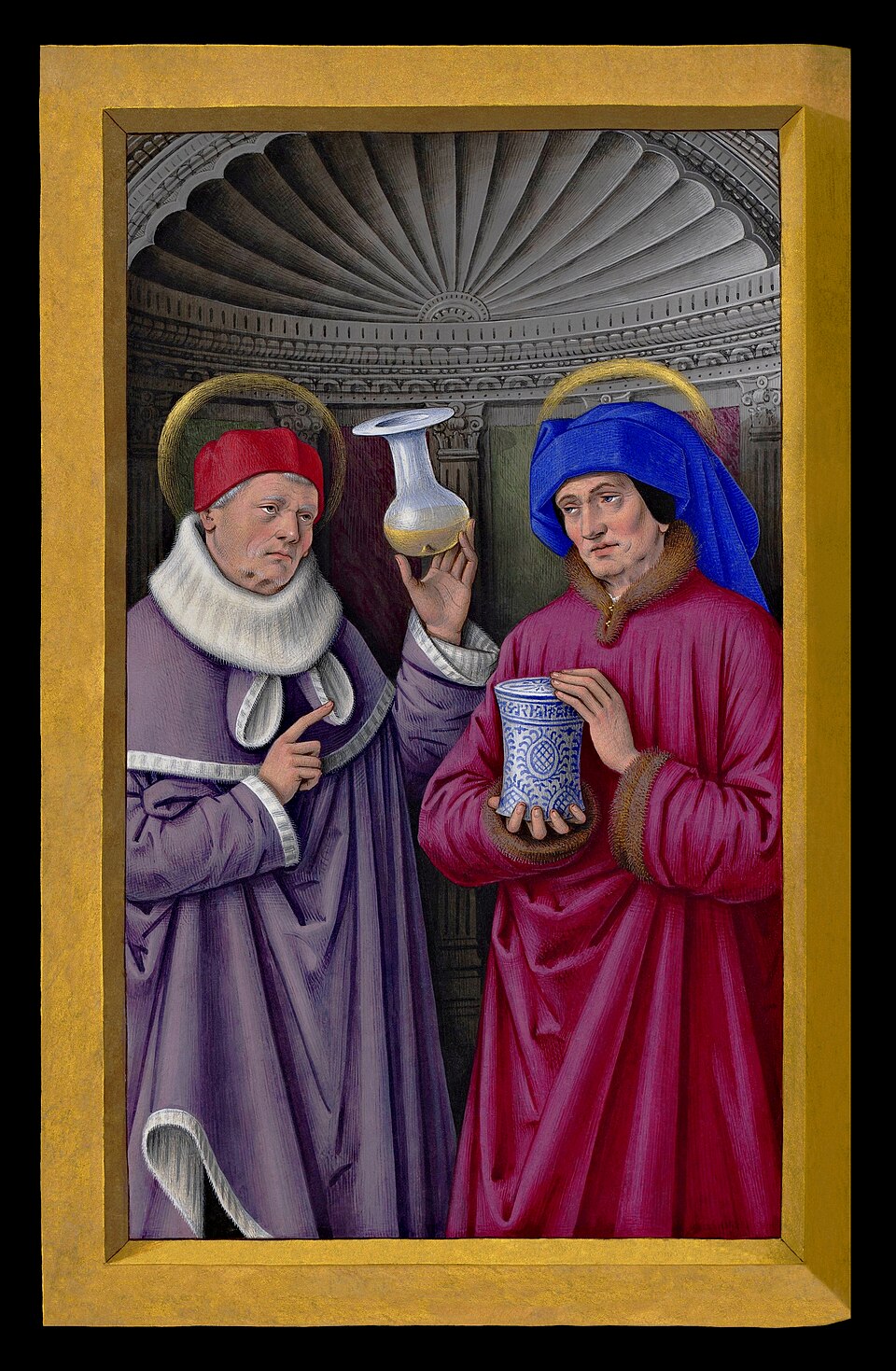
Sts. Cosmas and Damian are the physician saints par excellence: twin or paired martyrs, healers without payment, patrons of doctors and surgeons, and subjects of one of medieval art's strangest surgical miracles. The historical core is modest. The Catholic Encyclopedia places them under the Diocletian persecution, with the prefect Lysias ordering them to recant and with martyrdom by the sword after miraculous endurance of tortures. The cult, however, became enormous. In the Greek East they belong to the anargyroi, the unmercenary healers who offer medical help without fees. Their shrines attracted sufferers who slept near the saints, prayed, dreamed, received instructions, and reported cures. This incubation pattern Christianized older healing-shrine habits while relocating authority from Asclepius to martyr physicians. In the Latin West the Golden Legend and visual art emphasized their medical identity, their charity, and their patronage of surgery. The famous miracle of the black leg, known through medieval and Renaissance images, imagines Cosmas and Damian appearing at night with surgical instruments to amputate a diseased limb and replace it with the healthy leg of a dead Black man. It is not a transplant record in the modern sense. It is miracle, racialized iconography, and surgical fantasy. Yet it matters for medical history because it is among the most vivid premodern images of operative replacement, donor body, anesthesia-like sleep, infection or cancerous disease, and postoperative recognition. Their cult also raises questions about medical ethics. Free medicine is praised, but miracle stories can blur consent, professional responsibility, and the patient's own voice. The saints' popularity among surgeons, barber-surgeons, physicians' guilds, and the Paris College de Saint-Come shows how hagiography gave medical trades a sacred genealogy. Cosmas and Damian therefore bridge clinic and chapel: not because medieval surgery was modern, but because bodies, instruments, fees, dreams, and wounds all entered the moral imagination of healing.
Plot or Argument
- Physicians without fees
The saints are remembered as healers who refused payment, making charity part of their medical identity. This anargyroi tradition matters as much as the martyr plot.
- Martyrdom under Lysias
The Latin summary presents arrest, refusal to recant, miraculous survival of torture, and beheading with their brothers, giving the physician saints a standard martyr frame.
- Shrines and incubation
Byzantine and later traditions remember sufferers sleeping near the saints, dreaming of treatment, and waking cured or instructed, adapting older healing-shrine practices.
- The black-leg operation
The saints appear by night with surgical instruments and replace a diseased leg with a dead man's healthy leg. The episode is miracle literature, not clinical evidence, but it became central to surgical iconography.
- Medical guild patronage
Physicians, surgeons, pharmacists, and the Paris surgical guild of Saint-Come claimed the saints as patrons, using hagiography to dignify medical labor.
Characters
- Cosmas, physician martyr
One of the paired unmercenary saints, associated with free healing, martyrdom, and surgical patronage.
- Damian, physician martyr
Cosmas's companion and co-patron of physicians, surgeons, and healing shrines.
- Prefect Lysias, persecutor
The official in the martyr tradition who orders the saints to recant and tortures them.
- The sleeping patient, recipient of the leg miracle
A church servant or verger with a diseased leg who receives the miraculous transplant in medieval legend.
- The donor body, racialized corpse in the black-leg miracle
The dead Black man whose healthy leg is taken in the legend, requiring modern readers to notice both surgical fantasy and racialized imagery.
Lessons
Free care becomes a sacred ideal
The anargyroi tradition imagines medical skill freed from commercial exchange. That ideal does not solve the economics of care, but it reveals a deep moral suspicion of profiting from another person's vulnerability.
- What does the no-fee ideal praise in a physician?
- Where might free care become symbolic rather than sustainable?
Miracle surgery is still medical evidence of a kind
The black-leg miracle is not evidence that transplantation occurred. It is evidence that medieval viewers could imagine diseased tissue, operative instruments, donor bodies, and postoperative bodily identity in surgical terms.
- What medical concepts are visible inside the miracle story?
- How should modern transplant history use a miraculous image?
Healing shrines organize patient expectation
Incubation at Cosmas and Damian shrines made sleep, dreams, vows, and bodily cure part of a repeatable therapeutic script. The patient came seeking both medical action and sacred interpretation.
- How does sleeping at a shrine differ from consulting a physician?
- What role do dreams play in legitimating treatment?
Surgical patronage dignifies manual medicine
Surgeons and barber-surgeons could claim Cosmas and Damian as holy predecessors. That patronage mattered in a culture where learned physicians, manual operators, and guilds competed for status.
- Why would surgeons need saints of their own?
- How does patronage shape the identity of a profession?
Context
Cosmas and Damian's cult appears in late antiquity and flourished across the Byzantine and Latin worlds. Their healing shrines, miracle collections, and relic cult linked martyr devotion to practical concerns about illness, fees, and surgery.
Composition
The martyr acts and miracle traditions developed in Greek, Syriac, and Latin settings. Jacobus integrated the saints into the Golden Legend, while later western art amplified the black-leg miracle for viewers familiar with surgical instruments and guild patronage.
Reception
The saints became patrons of physicians, surgeons, pharmacists, and medical guilds. Their images appear in churches, hospitals, surgical colleges, and Renaissance panels, often showing the miracle of the leg as a sacred operating room.
Comparisons
- galen-selected-works
Galen represents learned anatomy, prognosis, and therapeutics; Cosmas and Damian show medicine reframed as charity, miracle, and professional patronage.
- hippocratic-writings
The Hippocratic corpus gives medicine an ethical and observational foundation, while the unmercenary saints give healers a sacred model of no-fee service.
- golden-legend-popular-saints
The popular-saints entry shows patronage in broad form; Cosmas and Damian concentrate that mechanism on physicians, surgeons, shrines, and instruments.
- wesley-sermons-and-primitive-physick
Wesley's practical remedies and religious exhortation echo the desire to make healing accessible, though he writes as a Protestant compiler rather than a hagiographer.
- frankenstein
Shelley's anatomy rooms and animation anxiety make a modern counterpoint to the black-leg miracle, where bodily replacement is sanctified rather than horrifying.
Quotes
“Cosmas and Damian are regarded as the patrons of physicians and surgeons and are sometimes represented with medical emblems”
“Having been cured of a dangerous illness by the intercession of Cosmas and Damian, Justinian, in gratitude for their aid, rebuilt and adorned their church at Constantinople, and it became a celebrated place of pilgrimage”
“The physician saints were called anargyroi, unmercenaries, because their legends remember them as healers who did not take payment for medicine”
For Students
A reading companion for classical Christian high school students. See the student guide.
Reading Guide
Watch for
- The Golden Legend's opening portrait of the brothers, born in the city of Aegea and raised by their devout mother Theodora, who learned the art of medicine and healed both people and animals without taking payment.
- The episode of Palladia, the woman they heal, who presses a small gift of three eggs on Damian. Watch Cosmas's anger, his request not to be buried beside his brother, and the strange way the dispute is settled after their deaths.
- The martyrdom under the prefect Lysias: the brothers refuse to sacrifice, survive being cast into the sea and into fire, see stones and arrows turn back on those who threw them, and are at last beheaded with their brothers.
- The miracle of the leg in the church of Cosmas and Damian at Rome, where the saints appear at night to a sleeping servant of the church whose leg is consumed by disease and replace it with the leg of a man buried that day.
- The Catholic Encyclopedia's notice that the Emperor Justinian, cured of a dangerous illness by their intercession, rebuilt their church at Constantinople, which became a great place of pilgrimage. Notice how an emperor and a church servant both appear as their patients.
Key terms and names
- Anargyroi
- Greek for without silver, the name given in the Eastern Church to physician saints who healed without fees. Cosmas and Damian are the most famous of them.
- Lysias
- The prefect who, in the martyr tradition, orders the brothers to sacrifice to the gods and, when they refuse, subjects them to a series of tortures that fail before he has them beheaded.
- Diocletian's persecution
- The last and most severe Roman persecution of Christians, beginning in 303. The Catholic Encyclopedia places the martyrdom of Cosmas and Damian in this period.
- Incubation
- The practice of sleeping in a holy place in hope of healing or guidance through a dream. Pilgrims at the shrines of Cosmas and Damian slept near their relics, as the leg miracle shows the sick servant sleeping in their church.
- Palladia
- The woman healed by the brothers in the Golden Legend, whose insistent gift to Damian becomes a test of their rule of healing freely.
- Patron of physicians
- A saint believed to intercede for a particular profession. Physicians, surgeons, and apothecaries took Cosmas and Damian as patrons, and the surgeons of Paris named their brotherhood after Saint Cosmas.
Seminar Questions
- Comprehension According to the Golden Legend, where were Cosmas and Damian born, who raised them, and what did they do with their medical skill?
- Comprehension What gift did Palladia give Damian, why was Cosmas troubled by it, and how was the question of their burial resolved?
- Comprehension Describe the miracle of the leg: who was the patient, where was he sleeping, and what did the saints do?
- Interpretation Cosmas treats a gift of three eggs as a serious breach of their way of life. Why would so small a payment matter so much, and what does the story's ending suggest about how the brothers' rule should be judged?
- Interpretation In the martyrdom, sea, fire, stones, and arrows all fail to harm the brothers, but the sword does. What is the legend teaching through this pattern of failed tortures followed by death?
- Interpretation The saints heal an emperor at Constantinople and a church servant at Rome. What does the tradition say about who deserves a physician's care and how it should be given?
- Big Question Is medicine best understood as a trade, a profession, or a work of charity, and can it be all three at once?
- Big Question When a Christian is healed through the ordinary skill of a physician, is that any less a gift of God than a miraculous cure?
Faith Connections
- Matthew 10:5-8 (Scripture)
Sending out the Twelve to heal the sick, Jesus tells them that they received freely and must give freely. The anargyroi tradition reads this command as the rule of the Christian physician, and Cosmas's distress over Palladia's gift shows how seriously the brothers were remembered as keeping it.
- Luke 10:30-37 (Scripture)
The Samaritan binds the wounded man's injuries with oil and wine and pays for his care from his own purse. Cosmas and Damian were honored for the same pattern of mercy: practical treatment given to a stranger at the healer's own cost.
- Colossians 4:14 (Scripture)
Paul sends greetings from Luke, the beloved physician. The New Testament's quiet mention of a physician among the apostle's companions stands behind the long Christian tradition, of which Cosmas and Damian became the chief saints, of honoring medicine as a calling.
- Basil the Great, The Longer Rules, Question 55 (Church Fathers)
Basil asks whether using the medical art is consistent with trust in God and answers that medicine is a gift of God to be used with gratitude, so long as health is not put before God. The legend of Cosmas and Damian joins exactly these two things: skilled medicine and holy dependence on God.
Logic and Rhetoric
Central argument: The legend argues: Cosmas and Damian possessed real medical skill; they gave it freely to all, people and beasts, rich and poor, as Christ commanded his disciples to give what they had freely received; they held fast to Christ even under torture and death; God confirmed their holiness both in their martyrdom and in healings after their deaths; therefore the practice of medicine can be a path of holiness, and the brothers are fit patrons and models for every physician and surgeon.
Rhetorical device: exemplum. The Golden Legend's story of Palladia and the three eggs works as a moral example within the life: a single small payment provokes Cosmas's refusal to share a grave with Damian, and the resolution after their deaths teaches the reader how to weigh strictness and charity in a healer's conduct.
Debate: Resolved: A Christian physician should be willing to treat patients who cannot pay, even at real cost to his own livelihood.
Writing Prompts
Essay: Cosmas and Damian are remembered both as skilled physicians and as martyrs who healed without fees. Using the Palladia episode, the martyrdom under Lysias, and the miracle of the leg, argue what the legend teaches about the relation between medical skill, charity, and holiness.
Comparison with Hippocratic Writings: The Hippocratic Oath binds the physician to his teacher, his patients, and the gods, while the legend of Cosmas and Damian binds the physician to Christ's command to give freely. Compare the picture of the good physician in the Oath and in the legend, and argue which offers the firmer foundation for a physician's duty to the sick who cannot pay.
Medical Lens
Cosmas and Damian are core figures for medical humanities: saints of no-fee care, shrine incubation, surgeon identity, and transplant imagery. The black-leg miracle should be presented as iconographic and theological evidence, not as an actual surgical precedent. Its racialized donor body also requires ethical attention.
- Anargyroi title
The saints are remembered as healers who do not take payment, making fees and charity central to the moral image of medicine.
- Byzantine shrine incubation
Patients sleep at or near shrines, receive dream instructions, and report cures, blending ritual, expectation, and therapeutic authority.
- Miracle of the black leg
The saints perform a miraculous limb replacement, making medieval viewers imagine diseased tissue, surgical instruments, donor bodies, and postoperative identity.
Creative Prompts
- Essay
Compare the Hippocratic oath's professional ethics with the unmercenary saints' refusal of fees.
- Dialogue
Stage a conversation between a medieval surgeon of the College de Saint-Come and a modern transplant ethicist about consent, charity, and bodies.
Further Reading
- Sts. Cosmas and Damian, Gabriel Meier
Catholic Encyclopedia article on the saints' cult and patronage.
- The Golden Legend, Jacobus de Voragine
Medieval Latin source tradition for western readers of the saints.
- Kosmas und Damian, Ludwig Deubner
Classic early twentieth-century study of the saints and miracle traditions.
- One Leg in the Grave, E. H. Majno and collaborators
Modern study of the black-leg miracle's iconography and surgical implications.
Verification notes
The patronage and public-domain Catholic Encyclopedia details are secure. The black-leg miracle is widespread in art and secondary literature, but this packet does not attach a complete medieval miracle text. The source-packet note is labelled as such.
No verification flags recorded.