Work record
Hippocratic Writings
c. 5th–4th century BCE · Ancient · Collection · Greek
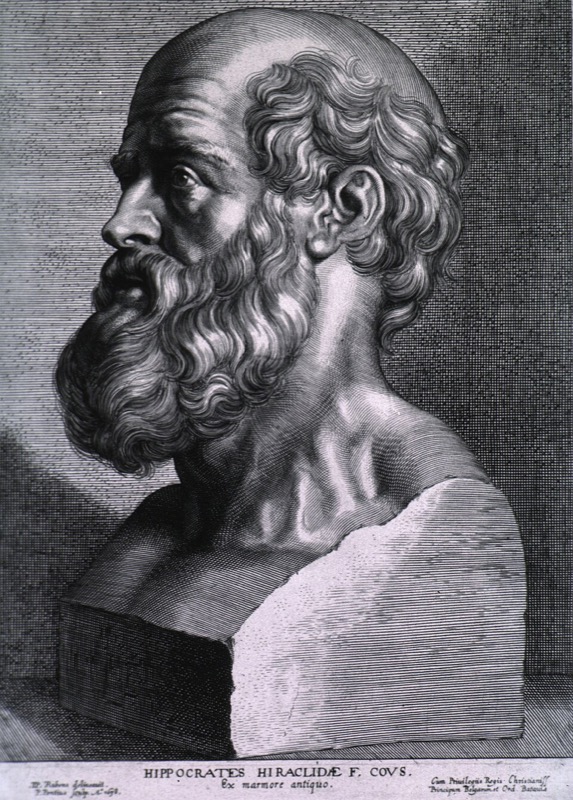

Summary
Hippocratic Writings is not a single book but a library of early Greek medicine: case histories, ethical rules, theoretical essays, surgical manuals, dietetic advice, aphorisms and polemics against rival healers. Its strongest works begin from the sickbed. Epidemics records named patients by place, season, symptoms, evacuations, crises and outcome; Prognostic teaches the physician to read faces, breathing, sleep, stools, urine and posture in order to foresee death or recovery; Airs, Waters, Places connects diseases and temperaments to environment, water, winds and political customs. Other treatises argue that disease has natural causes, not divine caprice. On the Sacred Disease attacks the idea that epilepsy is uniquely sacred, insisting that the brain is involved in perception, intelligence and madness. Regimen and related works explain health as a balance of diet, exercise, sleep, sex and evacuation. Surgical treatises on fractures, joints and wounds are practical, tactile and cautious, concerned with splints, bandages, traction and the limits of intervention. The Oath and Law define a professional ideal: restraint, confidentiality, apprenticeship, avoidance of deadly drugs and respect for households entered by the physician. The collection can feel contradictory because it is; some texts distrust theory, others lean on humoral explanations and the balancing of hot, cold, wet and dry. Together they show medicine becoming a craft of careful attention, probabilistic judgment and social trust. For modern readers the Corpus matters less as a set of correct treatments than as a record of how clinicians learned to observe patterns, acknowledge prognosis, describe mental disturbance without pure moralism, and ask what a healer owes to the vulnerable body before him. The collection also preserves medicine in a competitive social world: physicians must win trust, defend their craft against wonder-workers, and speak honestly when cure is unlikely. Its greatest modern value is that it records a transition from ritual authority to accountable practice, where prognosis, bedside manner and the narrative of a case become as important as any remedy.
Plot or Argument
- Bedside observation
The clinical treatises follow patients through fever, pain, discharges, sleep, delirium, crisis and death, making medicine an art of serial observation.
- Natural causes
Essays such as On the Sacred Disease reject supernatural explanations for illness and argue that diseases of mind and body belong to nature.
- Regimen and balance
Diet, exercise, season, water, evacuation and humoral balance become the main levers of prevention and treatment.
- Manual medicine
Surgical writings describe fractures, dislocations, wounds and bandaging with a sober sense of what intervention can and cannot do.
- Ethical profession
The Oath, Law and Decorum imagine medicine as a disciplined calling governed by trust, secrecy, restraint and responsibility.
Lessons
Observation precedes theory
The Corpus repeatedly values the disciplined noticing of symptoms over showy speculation. It teaches that clinical knowledge begins in repeated attention to individual bodies, seasons and outcomes.
- What counts as evidence in the case histories?
- Where do the writers admit uncertainty?
Natural explanation can be humane
Treating epilepsy, fever or delirium as natural does not make suffering less serious. It can reduce blame and ritual fear while increasing the physician’s obligation to understand.
- How does On the Sacred Disease change the moral status of illness?
- What modern stigmas still depend on supernatural or moral explanations?
Ethics is part of technique
The Oath makes trust, confidentiality and restraint integral to healing, not decorative virtues added afterward. Professional power enters private houses and must be governed.
- Which parts of the Oath still feel recognizable?
- Where does ancient medical ethics differ from modern autonomy?
Context
The Hippocratic Corpus arose in classical Greece, when itinerant physicians competed with temple healing, household remedies and philosophical theories of nature. It preserves several traditions rather than one doctrine, but later medicine treated it as a foundation.
Composition
The treatises were probably composed by several authors between the late fifth and fourth centuries BCE and collected under Hippocrates’ name in antiquity. Their dates and school affiliations remain debated.
Reception
Hellenistic, Roman, Arabic and European medicine made Hippocrates the father of medicine. Galen commented on the corpus extensively, and the Oath became a lasting emblem of medical professionalism.
Comparisons
- galen-selected-works
Galen inherits Hippocratic observation but systematizes it into a more elaborate anatomy, physiology and humoral therapeutics.
- the-histories
Herodotus preserves ethnographic anecdotes about physicians and illness, while the Hippocratic texts show medicine speaking in its own professional voice.
- meditations
Marcus invokes Hippocrates as a dead physician, reminding readers that even healers cannot master mortality.
Quotes
For Students
A reading companion for classical Christian high school students. See the student guide.
Reading Guide
Watch for
- The opening of On the Sacred Disease, where the author argues that epilepsy is no more divine than any other disease and blames the purifiers and charm-sellers for calling it sacred to hide their ignorance. Notice how he locates the disorder in the brain.
- The case histories in Epidemics I and III, which follow named patients day by day through fever, sleeplessness, delirium and crisis, and often end with the report that the patient died.
- The face of the dying patient described in Prognostic: sharp nose, hollow eyes, sunken temples, cold ears. Watch how prognosis, not cure, is presented as the physician's first claim to trust.
- The first of the Aphorisms, which sets the shortness of life against the length of the art and the difficulty of judgment. It is a fair summary of the collection's humility.
- The Oath's sequence of promises: honour to the teacher, regimen for the benefit of the sick, refusal to give a deadly drug or an abortive pessary, purity of life, and silence about what is seen in the household.
Key terms and names
- Hippocratic Corpus
- The collection of some sixty Greek medical treatises gathered under Hippocrates' name. They come from different authors and schools and do not always agree with one another.
- On the Sacred Disease
- The treatise arguing that epilepsy has a natural cause like other diseases. It also makes the brain the seat of thought, joy, grief and madness.
- Prognosis
- Foreknowledge of the course of a disease. Prognostic argues that a physician who can foretell outcomes will be trusted, can plan treatment, and will not be blamed for deaths he predicted.
- Crisis
- The turning point of an acute illness, often expected on particular days, after which the patient recovers or declines. The Epidemics record on which days the crisis came.
- Humours
- The bodily fluids, in On the Nature of Man blood, phlegm, yellow bile and black bile, whose balance some treatises treat as health. Not every author in the Corpus uses this scheme.
- Regimen
- The ordering of diet, exercise, sleep and bathing to preserve or restore health. Much Hippocratic treatment consists of adjusting regimen rather than giving drugs.
- Airs, Waters, Places
- The treatise teaching that a physician arriving in a new city should study its winds, water supply, seasons and situation, because these shape the diseases and even the character of its people.
- The Oath
- The physician's sworn promise to the healing gods to honour his teacher, help the sick, refrain from deadly drugs and misconduct, and keep the secrets of the household.
Seminar Questions
- Comprehension What reasons does the author of On the Sacred Disease give for denying that epilepsy is sent by a god, and whom does he blame for the belief?
- Comprehension What does a physician promise in the Oath about his teacher, about deadly drugs, and about what he sees and hears in a patient's house?
- Comprehension What signs in the patient's face, breathing and posture does Prognostic say point toward death?
- Interpretation Why does Prognostic treat foreknowledge of an illness as the physician's chief source of credibility, even when he cannot cure?
- Interpretation The case histories in Epidemics record many deaths without comment. What does this honesty about failure show about the kind of knowledge the authors were trying to build?
- Interpretation Airs, Waters, Places explains both disease and the character of peoples by climate and water. How persuasive is the argument within the treatise, and where does it move from observation to generalization?
- Big Question On the Sacred Disease argues that calling a disease divine is a way of hiding ignorance. Does explaining an illness by natural causes leave any place for God, and how would a Christian physician answer the treatise?
Faith Connections
- Sirach 38:1-15 (Scripture)
Ben Sira tells the sick to honour the physician, because the Lord created medicines out of the earth, and also to pray and repent. It is a biblical answer to the question On the Sacred Disease raises, holding natural remedy and divine providence together.
- Luke 5:31 (Scripture)
Jesus says that those who are well have no need of a physician, but those who are sick. The saying assumes the Hippocratic picture of the physician who goes to the patient, and turns it into a picture of his own mission.
- Basil the Great, Long Rules, Question 55 (Church Fathers)
Basil asks whether using the medical art is consistent with piety and answers that medicine is a gift of God to be used with gratitude, without putting all hope in it. He reads the Hippocratic craft as part of creation's order, not as a rival to prayer.
- Galen, On the Natural Faculties (Great Conversation)
Galen, writing in the second century, treated Hippocrates as the founder of true medicine and built his own physiology on Hippocratic foundations. Reading him shows how the scattered treatises were turned into a single authority for centuries of later medicine.
Logic and Rhetoric
Central argument: Diseases, including those of the mind such as epilepsy and madness, arise from natural causes in the body and its environment. What arises from natural causes can be observed, compared and to some extent foreseen. Therefore the physician's art should rest on careful observation of patients, seasons and places rather than on charms and purifications, and his trustworthiness depends both on honest prognosis and on the ethical restraint sworn in the Oath.
Rhetorical device: aphorism. The Aphorisms open with a single compressed sentence setting the brevity of life against the length of the art, and then add that opportunity is fleeting, experiment perilous and judgment difficult. The whole treatise teaches by such short, memorable rules rather than by extended argument.
Debate: Resolved: A physician's first duty is to foretell the course of an illness honestly, even when he cannot cure it.
Writing Prompts
Essay: On the Sacred Disease and the Oath seem to point in different directions: one removes the gods from disease, the other is sworn by Apollo and Asclepius. Using both treatises and Prognostic, argue what place the Hippocratic writers give to religion in the physician's work.
Comparison with Galen: Selected Works: Galen admired Hippocrates above all physicians but replaced the Corpus's scattered observations with a unified system of anatomy and humoral physiology. Compare how each author establishes medical authority, and argue whether Galen's system preserved or lost the Hippocratic habit of bedside observation.
Medical Lens
This is a cornerstone for psychiatry and medical history. On the Sacred Disease naturalizes epilepsy and locates perception, intelligence, joy, sorrow and madness in the brain. Epidemics records phrenitis, lethargy, delirium and fever courses. Humoral language later supports melancholia as black bile, while regimen connects diet, sleep, exercise and emotion. The surgical treatises show premodern manual skill before anesthesia or antisepsis. The Oath raises enduring issues: lethal drugs, abortion, sexual boundaries, confidentiality, teacher-student obligations and the physician’s identity as a moral agent.
- On the Sacred Disease 1–2
The writer rejects divine special status for epilepsy and argues that it has a natural cause like other diseases.
- On the Sacred Disease 14–17
The brain is presented as the organ through which people think, perceive, rejoice, grieve, become mad and suffer terrors.
- Epidemics, Books 1 and 3
Case notes track fever, delirium, sleep, stools, urine, crisis days and death or recovery across seasons.
- Aphorisms, Book 6
Aphoristic remarks classify melancholic and phrenitic states within bodily illness and prognosis.
- On Fractures and On Joints
Manuals give practical instructions for traction, splints and bandages in injuries and dislocations.
- The Oath
The physician promises restraint with deadly drugs, confidentiality and disciplined conduct in the houses of patients.
Creative Prompts
- Essay
Trace how Hippocratic observation turns an ancient text into a practical argument rather than a museum piece.
- Classroom
Ask students to map the work's central conflict onto one modern institution without flattening the historical difference.
Further Reading
- The Hippocratic Writings, G. E. R. Lloyd (ed.)
- Greek Medicine from the Heroic to the Hellenistic Age, James Longrigg
- The Healing Hand, Guido Majno
Verification notes
The broad account, treatise names and medical themes are solid; exact wording is intentionally not quoted pending primary-text verification.
- Select and verify public-domain quotations from Adams or other approved translations before publication.
- Check section numbering for On the Sacred Disease passages across editions.