Work record
On Medicine
c. 30 CE · Ancient · Collection · Latin
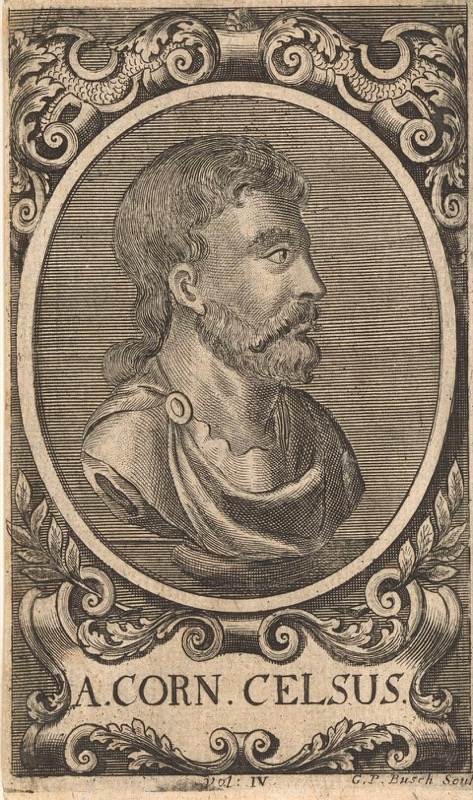

Summary
On Medicine, or De Medicina, is the most important surviving Latin medical work before late antiquity. Celsus organizes medicine into diet, drugs and surgery, giving Roman readers a lucid account of Greek medical learning without the dense polemic of specialist schools. The opening books survey the history of medicine and the debate between rationalists, empiricists and methodists, then move into preservation of health through regimen: food, exercise, bathing, sleep, sex and seasonal adjustment. The middle books classify acute and chronic diseases by symptoms, course and treatment. Fevers, inflammations, wasting illnesses, digestive problems, bladder stones, wounds and ulcers all receive practical attention. Celsus is famous for describing the cardinal signs of inflammation: redness, swelling, heat and pain. His pharmacology includes purges, emetics, poultices, plasters, narcotic and sedative preparations, and poisonous substances to be handled carefully. The surgical books are especially vivid. They describe instruments, ligatures, treatment of wounds, extraction of weapons, operations for cataract and bladder stone, amputations or excisions, and plastic procedures for damaged ears, lips and noses. Celsus admires boldness but repeatedly values timing, anatomy, cleanliness, aftercare and knowledge of when not to operate. The book is also a moral document. The physician must judge patients, promises, risks, pain and prognosis; surgery requires courage from both operator and sufferer in a world without anesthesia. For modern readers, Celsus offers a compact map of Roman medicine at the meeting point of household regimen, pharmacology and operative craft. It is indispensable for the history of surgery and for the long tradition in which pain relief, wound care and medical risk were negotiated through prudence rather than technological mastery. The prose is unusually clear, which helps explain the book’s long afterlife. Celsus is not merely listing cures; he is teaching judgment under uncertainty. His pages repeatedly ask whether the patient is strong enough, whether the disease has declared itself, whether an operation will help or only display the surgeon’s nerve, and how a household should participate in care.
Plot or Argument
- Medical history and method
Celsus opens with competing Greek schools and the problem of whether medicine should reason from hidden causes or accumulated experience.
- Regimen and prevention
Health is maintained by diet, exercise, bathing, sleep, climate and moderation adapted to age, body and season.
- Diseases and symptoms
The central books classify fevers, inflammations, chronic illnesses and local diseases through signs, course and treatment.
- Drugs and applications
Celsus records purges, emetics, plasters, poultices, narcotics and cautions about poisonous materials.
- Surgery
The final books describe wounds, fractures, tumors, cataracts, bladder stones and operations with instruments and aftercare.
Lessons
Classification guides action
Celsus turns symptoms into practical categories for regimen, drugs or surgery. The book teaches that diagnosis matters because it chooses a form of intervention and a level of risk.
- How does Celsus decide between diet, drugs and surgery?
- Where does classification simplify messy illness?
Surgery is courage plus restraint
The surgical books are daring but not reckless. Their recurring lesson is that technical boldness must be governed by anatomy, timing and prognosis.
- What makes an operation justified in Celsus?
- How does pain shape ancient surgical ethics?
Regimen is medicine
Food, bathing, motion and sleep are not lifestyle decoration in Celsus; they are core therapeutics. The ancient model broadens treatment beyond discrete drugs.
- Which regimen advice still sounds plausible?
- Where is regimen limited by class or gender?
Context
Celsus writes in the early Roman Empire, translating Greek medical traditions into elegant Latin for educated readers. His work preserves much Hellenistic practice otherwise lost.
Composition
De Medicina was probably part of a larger encyclopedia composed in the reigns of Augustus and Tiberius. The medical section survived independently in manuscript tradition.
Reception
Rediscovered and printed in the Renaissance, Celsus became a key source for ancient surgery and Latin medical terminology. His signs of inflammation remain famous in medical teaching.
Comparisons
- hippocratic-writings
Both value prognosis and regimen, but Celsus gives a more orderly Latin synthesis with unusually detailed surgery.
- galen-selected-works
Galen is theoretical and polemical; Celsus is compact, practical and especially valuable on Roman surgical technique.
- de-materia-medica
Dioscorides catalogs medicinal substances, while Celsus embeds drugs within disease management and operative care.
Quotes
For Students
A reading companion for classical Christian high school students. See the student guide.
Reading Guide
Watch for
- The Preface to Book 1, where Celsus sets out the quarrel between the Rationalists, who seek hidden causes, and the Empiricists, who trust only experience, before giving his own middle judgment.
- Celsus's verdict in the Preface on Herophilus and Erasistratus, who are reported to have cut open living criminals. Notice how he separates that practice from the dissection of the dead.
- The advice for the healthy man at the start of Book 1, and how much of medicine Celsus places in food, exercise, bathing, sleep and moderation rather than in drugs.
- The four signs of inflammation, redness and swelling with heat and pain, and the descriptions of fever in Books 2 and 3. Watch how Celsus reads the course of a disease before choosing a treatment.
- The preface to Book 7, which describes the character a surgeon must have, followed by operations such as couching a cataract, cutting for the bladder stone, and repairing damaged ears, lips and noses.
Key terms and names
- Rationalists
- The physicians Celsus describes as seeking the hidden causes of disease and the workings of the body before treating it. He grants that reasoning matters but doubts that hidden causes can be known with certainty.
- Empiricists
- The rival school that rejected the search for hidden causes and relied on remedies proven by experience. Celsus takes their caution seriously but refuses to give up reasoning entirely.
- Methodists
- A school that reduced diseases to a few common states of the body. Celsus discusses them as a third option and finds their system too simple for the variety of patients.
- Regimen
- The management of diet, exercise, bathing, sleep and daily habit. For Celsus it is the first branch of medicine, both for keeping the healthy well and for treating the sick.
- Four signs of inflammation
- Celsus's formula for inflammation: redness, swelling, heat and pain. Medical students still learn the four signs, which makes this one of the longest-lived lines in medical writing.
- Couching
- The operation for cataract described in Book 7, in which a needle is used to push the clouded matter down out of the line of sight. Celsus gives careful guidance on the patient's position and aftercare.
- Lithotomy
- Cutting into the body to remove a stone from the bladder, described in Book 7. Done without anesthesia, it shows why Celsus insists on speed, anatomy and the right season and patient.
Seminar Questions
- Comprehension What are the three branches of medicine Celsus names, and which kinds of illness does he assign to each?
- Comprehension How does Celsus describe the dispute between Rationalists and Empiricists in the Preface, and where does he finally stand?
- Comprehension What qualities does Celsus require of a surgeon in the preface to Book 7?
- Interpretation Celsus reports that some Alexandrian physicians cut open living criminals, and he judges this cruel and unnecessary while still approving study of the dead. What reasons does he give, and what do they show about the limits he places on the pursuit of knowledge?
- Interpretation Celsus asks the surgeon to wish to cure the patient and yet not be moved by the patient's cries. Are these two demands in conflict, or does each require the other?
- Interpretation Why does Celsus give so much space to regimen for the healthy before turning to disease? What view of the body and of the physician's task does that order express?
- Big Question When the outcome is uncertain and the remedy is painful, how should a physician decide whether to act or to wait, and who should share in that decision?
Faith Connections
- Sirach 38:1-15 (Scripture)
Ben Sira tells his readers to honor the physician, for the Lord created him, and to use the medicines the earth provides while also praying. Written about two centuries before Celsus, it gives a Jewish account of the physician's craft that agrees with Celsus's respect for skill and judgment.
- Luke 10:33-35 (Scripture)
The Samaritan binds the wounded man's injuries, pouring on oil and wine, and pays for his continued care at the inn. These are the same kinds of remedies and the same concern for aftercare that Celsus describes in his books on wounds.
- Mark 5:25-34 (Scripture)
The woman with the flow of blood had suffered many things from many physicians and grown worse. Her story, set in the century of Celsus, shows both the reach and the limits of the medicine he records.
- Basil the Great, Longer Rules, Question 55 (Church Fathers)
Basil asks whether using the medical art is consistent with piety and answers that medicine is a gift of God to be used with gratitude, though without placing all hope in it. His answer gives Christians a way to receive the practical wisdom collected by pagan writers such as Celsus.
Logic and Rhetoric
Central argument: Medicine must reason, because remedies must fit the particular patient, but it cannot claim certainty about hidden causes, so it must also attend to experience. Since health is kept and lost largely through daily habit, regimen is the first part of medicine; since some diseases yield only to remedies, drugs come second; and since some conditions can be helped only by the hand, surgery comes last. In every branch the physician must judge the patient's strength, the course of the disease and the risks of acting. Therefore good medicine is a discipline of prudent judgment more than a fixed system of theory or a store of cures.
Rhetorical device: antithesis. In the preface to Book 7 Celsus describes the ideal surgeon through paired opposites: merciful in wishing to cure the patient, yet unmoved by his cries, so that he neither hurries more than the case requires nor cuts less than is needed. The pairs show that surgical virtue lies in holding opposed qualities together.
Debate: Resolved: A physician should attempt a doubtful remedy rather than attempt none.
Writing Prompts
Essay: Celsus judges that cutting into living criminals for anatomical knowledge was cruel, even if it taught something. Using the Preface and his account of surgery in Books 7 and 8, argue what Celsus thinks makes the pursuit of medical knowledge legitimate and where he draws its limits.
Comparison with Hippocratic Writings: Celsus credits Hippocrates with first separating medicine from philosophy. Compare the Hippocratic Oath and the treatises on regimen or prognosis with Celsus's Preface and Book 7, and argue whether Celsus's Roman physician is a different kind of figure from the Hippocratic one or a continuation of it.
Medical Lens
Celsus is one of the richest ancient sources for surgery before anesthesia. He covers wound care, extraction, cautery, ligature, lithotomy, cataract couching and reconstructive procedures. His pharmacology includes sedatives, purges and topical compounds, and he discusses venesection and inflammation. The physician’s ethical judgment appears in prognosis, promises, triage and the decision whether the patient can bear pain and risk. For psychiatry, the relevance is less direct but regimen, sleep, fear, delirium in fever and pain management all matter.
- Book 1, Preface
The history of medical schools frames medicine as a debate between reason, experience and practical method.
- Book 2
Fever, crisis, prognosis and evacuations structure the management of acute illness.
- Book 3
Inflammation is described through redness, swelling, heat and pain, a durable clinical formula.
- Books 5–6
Drug preparations include purges, plasters, narcotic applications and substances that can heal or poison.
- Book 7
Operations for cataract, fistula, bladder stone and damaged body parts show technical Roman surgery.
- Book 8
Fractures, dislocations and bone injuries require traction, setting, splints and careful aftercare.
Creative Prompts
- Essay
Trace how Roman surgical prudence turns an ancient text into a practical argument rather than a museum piece.
- Classroom
Ask students to map the work's central conflict onto one modern institution without flattening the historical difference.
Further Reading
- De Medicina, Aulus Cornelius Celsus
- The Healing Hand, Guido Majno
- Medicine and Society in the Ancient Greek World, Helen King
Verification notes
Major structure and medical significance are secure. Exact operation descriptions and book/chapter references should be checked against the intended edition.
- Verify public-domain Spencer wording before adding quotes.
- Check specific chapter numbers for inflammation, cataract and lithotomy passages.