Work record
Democracy in America
1835 / 1840 · 19th Century · Political Theory · French
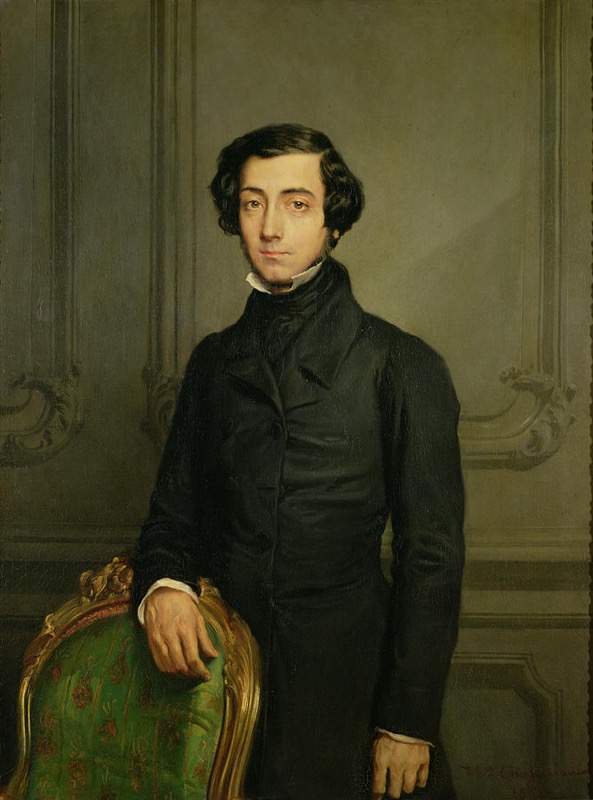
.jpg)
Summary
Democracy in America is Tocqueville's great comparative study of democratic society. The first volume examines American political institutions: township government, federalism, courts, associations, parties, newspapers, religion, and the habits that sustain self-government. Tocqueville argues that democracy is not merely a form of government but a social condition defined by equality of conditions. The second volume moves deeper into culture and psychology: individualism, materialism, restlessness, majority power, intellectual conformity, family life, ambition, and the danger of soft despotism. Tocqueville admires American energy, association, local liberty, and religious moderation, but he is never simple booster. In his long chapter on the three races of the United States, he calls slavery the most formidable evil threatening the Union's future, predicts the destruction of the Indian nations under American expansion, and fears that democratic equality may produce isolation and dependence if citizens withdraw into private comfort. The medical lens is indirect but suggestive. Tocqueville repeatedly analyzes democratic restlessness, anxiety, conformity, isolation, and civic habits in language close to social psychology. His original prison-study mission also links the book to penal reform, institutional discipline, and moral treatment debates. Historically, the work belongs to post-Revolutionary France's attempt to understand democracy's future by studying the United States. Tocqueville writes as an aristocrat who knows equality is irreversible but wants liberty preserved within it. Read beside the Federalist and Anti-Federalist writings, he studies how American institutions work in practice; read beside Douglass, his visitor's account of slavery meets a witness from inside it. The book's enduring power lies in diagnosing democracy as a way of life. It asks not only how citizens vote, but what equality does to imagination, ambition, loneliness, faith, and the desire to be led. Tocqueville's achievement is to make political institutions and inner life part of one analysis. His warnings still matter because democratic illness may appear as comfort, not collapse. The book remains unsettling because it praises democracy while anatomizing its temptations clearly.
Plot or Argument
- Equality defines the democratic condition
Tocqueville begins from equality of conditions as the central fact reshaping law, manners, politics, and imagination.
- Associations protect liberty
Local government, voluntary associations, religion, and civic habits counterbalance centralization and individual isolation.
- Democracy reshapes inward life
The later volume studies individualism, restlessness, conformity, materialism, family, and soft despotism.
Lessons
Democracy is a social psychology
Tocqueville treats democracy as habits, desires, fears, associations, and forms of attention. Voting is only one part of democratic life.
- How does equality shape personality?
- What democratic habits protect liberty?
Private comfort can invite soft rule
Tocqueville fears citizens may trade active liberty for security and convenience. Despotism may become gentle, administrative, and welcomed.
- What is soft despotism?
- Where does comfort weaken citizenship?
Association is democratic medicine
Associations train citizens out of isolation. They preserve agency by making people practice cooperation and public responsibility.
- Why are associations so important to Tocqueville?
- What institutions serve that role now?
Context
Tocqueville visited the United States in 1831 during Jacksonian democracy and wrote for a France still struggling with revolution, aristocracy, and democratic change.
Composition
The first volume appeared in 1835 and the second in 1840, drawing on travel observations, interviews, documents, and political reflection.
Reception
The book became one of the classic analyses of democracy, praised for insight and cited by readers across the political spectrum on equality, association, religion, and centralized power.
Comparisons
- the-federalist-papers
The Federalist Papers defend constitutional design before ratification; Tocqueville observes democratic institutions and habits in operation.
- narrative-and-fourth-of-july
Douglass argues against slavery as a formerly enslaved American; Tocqueville examines it as a French visitor who judged it the gravest danger to the Union.
- the-social-contract
Rousseau theorizes popular sovereignty; Tocqueville studies how democratic equality forms citizens' habits and fears.
Quotes
For Students
A reading companion for classical Christian high school students. See the student guide.
Reading Guide
Watch for
- Tocqueville's Introduction to the first volume, where he traces the steady advance of equality of conditions across seven centuries of European history and treats it as a providential fact that no one can reverse.
- The chapter on the origin of the Anglo-Americans, where he argues that the Puritan founders of New England supplied the point of departure for the whole nation, joining a spirit of religion to a spirit of liberty.
- The New England township in the first volume, which Tocqueville describes as the school of liberty where citizens learn self-government by practicing it in small things.
- The chapters on the omnipotence of the majority, where he warns that in America opinion can enclose thought within a formidable circle even where law leaves it free.
- The second volume's chapters on individualism, on associations, on restlessness amid prosperity, and finally on the kind of despotism democratic nations have to fear: a mild, tutelary power that keeps citizens in perpetual childhood.
Key terms and names
- Equality of conditions
- Tocqueville's name for the basic social fact of democracy: the absence of fixed ranks and hereditary orders. He treats it as the generating cause from which American laws, manners, and opinions flow.
- Township
- The local unit of New England government, with its town meeting and elected officers. Tocqueville holds that liberty learned in the township is what keeps Americans capable of governing a large republic.
- Tyranny of the majority
- Tocqueville's warning in the first volume that a democratic majority, holding both power and opinion, can oppress minorities and silence dissent without any formal persecution.
- Individualism
- In the second volume, a calm feeling that disposes each citizen to withdraw into a small circle of family and friends and leave the larger society to itself. Tocqueville distinguishes it from selfishness, which is a passion, and fears it more.
- Associations
- The voluntary groups Americans form for every purpose, from building churches to founding hospitals and temperance societies. Tocqueville treats the art of association as the democratic substitute for the old aristocracy's power to act.
- Self-interest rightly understood
- The American doctrine, as Tocqueville reports it, that serving others serves oneself. He judges it a modest but effective morality suited to democratic times, short of virtue but able to train citizens toward it.
- Tutelary power
- The immense and mild governing authority Tocqueville imagines near the end of the second volume, which provides for citizens' needs and pleasures while relieving them of the trouble of thinking and acting. Later readers called it soft despotism.
Seminar Questions
- Comprehension What does Tocqueville mean by equality of conditions, and why does he call its progress providential in the Introduction?
- Comprehension How does a New England township govern itself, and what does Tocqueville think citizens learn from it?
- Comprehension What kinds of associations does Tocqueville find Americans forming, and how does he say they make up for the absence of an aristocracy?
- Interpretation Tocqueville says religion in America takes no direct part in government yet must be regarded as the first of its political institutions. What does he mean, and why does he think separation of church and state strengthened religion there?
- Interpretation Why does Tocqueville think that a majority can do more harm to freedom of thought than an absolute king? What evidence from American life does he give?
- Interpretation Tocqueville distinguishes individualism from selfishness. Why does he consider the quieter vice more dangerous to a democracy?
- Interpretation In the chapter on why Americans are so restless amid their prosperity, what does Tocqueville say equality does to human desire? How does this connect to his fear of a tutelary power?
- Big Question Tocqueville fears a people that would trade liberty for comfort and security. What habits, institutions, and beliefs keep a free people from wanting to be cared for like children?
Faith Connections
- 1 Samuel 8 (Scripture)
Israel asks Samuel for a king to judge them like all the nations, and Samuel warns that the king will take their sons, fields, and servants. Tocqueville's tutelary power is a gentler version of the same bargain: a people that asks to be governed in everything ends by losing the capacity to govern itself.
- Galatians 5:13-14 (Scripture)
Paul tells the Galatians that they were called to liberty but must not use it as an occasion for the flesh, and must serve one another by love. Tocqueville makes a parallel political argument: liberty survives in America because religion and association turn free citizens toward one another rather than into private comfort.
- Augustine, Confessions I.1 (Church Fathers)
Augustine says the heart is restless until it rests in God. Tocqueville's chapter on American restlessness in prosperity describes the same unquiet heart in a democratic people, chasing goods that equality always places just out of reach.
- Pascal, Pensees (Great Conversation)
Tocqueville wrote that he lived daily with Pascal, Montesquieu, and Rousseau. Pascal's portrait of man diverting himself from his condition stands behind Tocqueville's analysis of democratic citizens absorbed in small, constant pursuits of material well-being.
Logic and Rhetoric
Central argument: Equality of conditions is advancing everywhere and cannot be stopped. Equality by itself may lead either to liberty or to a new kind of servitude, depending on the habits and institutions that accompany it. In America, local self-government, voluntary associations, free courts and press, and religion that tempers private desire have kept equality joined to liberty. Therefore democratic nations elsewhere, including France, should not resist equality but should cultivate the institutions and mores that make free citizens, lest they fall into a mild despotism that keeps them comfortable and dependent.
Rhetorical device: antithesis. Tocqueville's whole method sets aristocratic and democratic societies against each other point by point, especially in the second volume, where chapter after chapter contrasts how each kind of society shapes ideas, feelings, family life, and ambition. The paired contrast lets him show what democracy gains and what it risks losing without simply praising or condemning it.
Debate: Resolved: The greatest danger to a democratic people is not tyranny imposed from above but the citizens' own preference for comfort over self-government.
Writing Prompts
Essay: Tocqueville claims that associations and religion are the chief safeguards against individualism and the tutelary state. Using his chapters on the township, on associations in civil life, and on religion, argue whether his remedies are adequate to the dangers he identifies.
Comparison with The Federalist Papers: Publius designs a constitution to control majority faction through representation, federalism, and the separation of powers; Tocqueville, studying that constitution in operation, finds that the majority's power over opinion still escapes these checks. Compare the two accounts of majority power and argue whether institutions or mores do more to protect a free people.
Medical Lens
Tocqueville matters medically through democratic anxiety, isolation, conformity, prison reform origins, and social conditions that affect mental life. His analysis is social psychology rather than clinical medicine.
- Volume II, individualism and restlessness
Democratic equality is linked to anxiety, ambition, isolation, and private withdrawal.
- Prison-study background and institutional observations
The journey began with penal reform, connecting democracy to institutions of discipline and moral management.
Creative Prompts
- Essay
Read Tocqueville's individualism as a nineteenth-century diagnosis of democratic loneliness.
- Dialogue
Let Tocqueville and Douglass debate whether American democracy can be understood apart from slavery.
Further Reading
Verification notes
The date, two-volume structure, prison mission, and major arguments are secure. No translated quotations are used.
- If quotes are added, use and cite a public-domain Reeve translation passage precisely.