Work record
The Lais of Marie de France
c. 1170s · Medieval · Poetry · Anglo-Norman French

Summary
The Lais of Marie de France are twelve short narrative poems in octosyllabic rhyming couplets, preserved together in one manuscript (British Library, Harley 978) with a general prologue in which Marie dedicates them to a 'noble king', probably Henry II. She says she has heard Breton lais, songs commemorating adventures, and has put them into verse so they will not be forgotten. The tales mix courtly love, magic and Celtic folklore, and many concern lovers trapped in unhappy marriages or separated by social barriers. In 'Guigemar', a young knight indifferent to love shoots a white hind; the arrow rebounds and wounds him in the thigh, and the dying hind declares that he will be healed only by a woman who will suffer for love of him. A magic ship carries him to a lady imprisoned by her jealous old husband; they fall in love, are separated, and are reunited after tests of fidelity. 'Equitan' tells of a king and his seneschal's wife who plot to kill the husband in a scalding bath but die in it themselves. 'Le Fresne' concerns a twin girl abandoned in an ash tree, raised in an abbey, whose patience is rewarded when her identity is revealed on her lover's wedding day. 'Bisclavret' is the story of a baron who becomes a werewolf three days a week; his wife steals his clothes so he cannot return to human form, but the king's kindness and the wolf's gentle nature reveal the truth. 'Lanval', a neglected knight of Arthur's court, is loved by a fairy mistress on condition of secrecy; he breaks it when Guinevere accuses him, and is saved at his trial when the fairy appears. In 'Les Deus Amanz' a king will marry his daughter only to a man who can carry her up a mountain without resting; her lover refuses a strengthening potion and dies at the top, and she dies beside him. In 'Yonec' an imprisoned wife is visited by a knight in the form of a hawk; her husband sets spikes at the window, and the bird-knight is mortally wounded, but their son later avenges him. 'Laüstic' tells of lovers who talk at their windows at night until the husband kills the nightingale she claims to be listening to. 'Milun' follows lovers who communicate for twenty years by a swan carrying letters. In 'Chaitivel' a lady's four suitors fight in a tournament; three are killed and the fourth is wounded in a way that leaves him alive but unable to love. 'Chevrefoil' is a brief episode of Tristan and Iseult. 'Eliduc', the longest, concerns a knight torn between his wife and a princess; when the princess falls into a deathlike swoon, the wife revives her with a flower and retires to a convent so the lovers can marry.
Plot or Argument
- Prologue and 'Guigemar'
Marie's statement of purpose; the wounded knight healed only by love, the magic ship and the imprisoned lady.
- 'Equitan', 'Le Fresne', 'Bisclavret'
A murderous adulterous plot that backfires; an abandoned twin's patient virtue; a werewolf betrayed by his wife.
- 'Lanval' and 'Les Deus Amanz'
A fairy lover who rescues a knight at his trial; a lover who dies carrying his beloved up a mountain, refusing a potion.
- 'Yonec', 'Laüstic', 'Milun'
Hawk-knight lover and avenging son; the slain nightingale; twenty years of letters carried by a swan.
- 'Chaitivel' and 'Chevrefoil'
The 'unhappy one', a wounded survivor of a tournament; a fleeting meeting of Tristan and Iseult.
- 'Eliduc'
A knight's double love, a deathlike trance cured by a red flower, and the wife's generous renunciation.
Characters
- Guigemar, knight
Young knight wounded by his own arrow and healed through love.
- Bisclavret, baron and werewolf
Noble who becomes a wolf and is betrayed by his wife.
- Lanval, knight of Arthur's court
Neglected knight loved by a fairy mistress.
- Le Fresne, foundling
Abandoned twin whose patience wins her lover.
- Eliduc, knight
Loyal vassal torn between his wife Guildeluec and the princess Guilliadun.
- Guildeluec, Eliduc's wife
Wife who revives her rival and becomes a nun.
- Guilliadun, princess
Eliduc's beloved, who falls into a deathlike swoon.
- Muldumarec, hawk-knight in 'Yonec'
Shape-shifting lover mortally wounded by the jealous husband's trap.
Lessons
Love against confinement
Many lais feature wives imprisoned by jealous husbands. Marie sympathizes with the lovers and shows love as a force that resists control.
- How does Marie judge adultery in different lais?
- Why do the guilty lovers of 'Equitan' die while others are rewarded?
Humanity in the beast
In 'Bisclavret' the werewolf behaves more nobly than his human wife. Animals across the lais, hind, hawk, nightingale, swan, weasel, carry meaning and moral weight.
- Who is the real monster in 'Bisclavret'?
- What role do animals play in transmitting love and knowledge?
Preserving stories
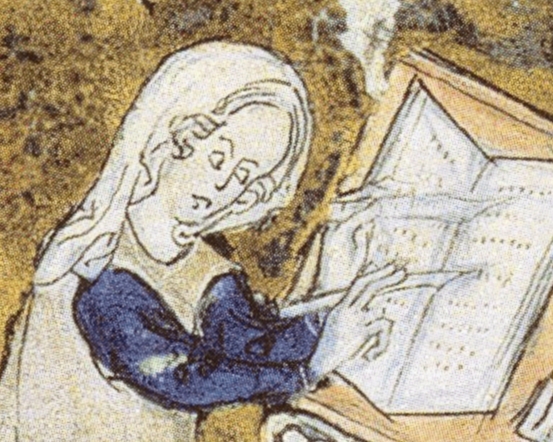
Marie presents herself as rescuing oral tales from oblivion and asserts her own authority as a woman writer. The lais are early meditations on authorship and memory.
- How does Marie describe her task in the Prologue?
- Why does she defend herself against envious critics?
Context
The lais belong to the flowering of courtly literature in the Angevin world of Henry II and Eleanor of Aquitaine, alongside Chrétien de Troyes' romances and the Tristan legends, and draw on Breton (Celtic) oral traditions.
Composition
Composed in Anglo-Norman around the 1160s–1180s. All twelve appear together only in Harley MS 978 (13th century); several survive in other manuscripts and in an Old Norse translation made for King Haakon of Norway.
Reception
Popular in the Middle Ages, they influenced Middle English Breton lais such as Sir Launfal and Sir Orfeo. Modern scholarship values Marie as a major medieval poet and a pioneering female author.
Comparisons
- troilus-and-criseyde
Chaucer's courtly romance and Marie's lais both explore secret love, fidelity and the pressures of society; Chaucer's 'Franklin's Tale' is itself presented as a Breton lai.
- metamorphoses
Marie's transformations, the werewolf and the hawk-knight, and her tragic lovers echo Ovid; 'Laüstic' recalls the nightingale of Philomela.
- the-nibelungenlied
Contemporary medieval narratives of courtly society, one lyrical and magical, the other epic and violent.
- the-misanthrope-and-other-plays
Molière's jealous husbands and guardians, like Marie's, try to imprison women and are outwitted.
Quotes
For Students
A reading companion for classical Christian high school students. See the student guide.
Reading Guide
Watch for
- The general Prologue, where Marie says the ancients wrote obscurely so that later readers could gloss the letter and add their own understanding, and explains why she chose to put Breton lais into verse rather than translate a Latin work.
- In 'Guigemar', the painted walls of the lady's chamber showing Venus throwing Ovid's book on the remedies of love into the fire, and the knot and belt the lovers exchange as tokens no one else can undo.
- In 'Bisclavret', the wolf who kneels and kisses the king's foot, lives gently at court, and attacks only his wife and her lover.
- In 'Yonec', the hawk-knight Muldumarec asking to receive communion to prove that he believes in God before the lady will accept him.
- In 'Eliduc', the storm at sea, the weasel and the red flower in the hermit's chapel, and Guildeluec's decision to found an abbey and take the veil, followed by Eliduc and Guilliadun also entering religious life.
Key terms and names
- Lai
- A short narrative poem. Marie says the Bretons composed lais to remember adventures they had heard, and she sets them in octosyllabic couplets so they will not be forgotten.
- Breton
- From Brittany in northwest France, whose Celtic storytellers Marie names as her sources. Several lais keep a Breton title beside a French or English one, as with Bisclavret and Laüstic.
- Bisclavret
- The Breton word for werewolf, which Marie says the Normans call garwaf. It is also the name of the baron in the lai, who becomes a wolf for part of each week and needs his clothes to return to human form.
- Seneschal
- The steward who managed a lord's household and lands. In 'Equitan' the king plots with his seneschal's wife to kill her husband in a scalding bath and dies in it himself.
- Salerno
- The southern Italian city famous for its school of medicine. In 'Les Deus Amanz' the young lover travels there to obtain a strengthening potion from his beloved's kinswoman and then refuses to drink it on the climb.
- Chevrefoil
- Honeysuckle, the plant in the lai of Tristan and Iseult. Marie compares the lovers to honeysuckle wound around a hazel, which cannot live once they are separated.
- Gloss
- A commentary or interpretation added to a text. Marie's Prologue invites readers to supply the meaning the ancients left implicit, which makes interpretation part of the work she offers.
Seminar Questions
- Comprehension In 'Bisclavret', how does the wife learn her husband's secret, what does she do with it, and how is the truth finally discovered?
- Comprehension In 'Lanval', what condition does the fairy lady set on her love, how does Lanval break it, and how is he saved at his trial?
- Interpretation Marie sympathizes with the lovers in 'Guigemar' and 'Yonec' but lets the lovers in 'Equitan' die in their own trap. What distinguishes the loves she rewards from the love she punishes?
- Interpretation In 'Bisclavret' the beast behaves with courtesy and loyalty while the human wife betrays him. Who is the true monster of the lai, and what does Marie suggest makes a person noble?
- Interpretation In 'Les Deus Amanz' the young man refuses the potion from Salerno and dies at the summit. Is his refusal a sign of love, of pride, or of both?
- Interpretation 'Eliduc' ends with all three of its lovers in religious houses. Does this ending resolve the knight's divided loyalty, or does it show that earthly love could not resolve it?
- Big Question Several lais set true love against marriages arranged for property or held together by jealousy. Can love ever be in the right against a marriage vow? Use 'Guigemar', 'Laüstic', and 'Eliduc' to test your answer.
Faith Connections
- Song of Solomon 8:6-7 (Scripture)
The Song says love is strong as death and many waters cannot quench it. 'Les Deus Amanz' and 'Chevrefoil' both test that claim, the first with lovers who die together on the mountain and the second with lovers who cannot live apart.
- Proverbs 12:10 (Scripture)
A righteous man regards the life of his beast, but the tender mercies of the wicked are cruel. The king who protects the wolf and the wife who betrays her husband in 'Bisclavret' divide along exactly this line.
- 1 Corinthians 13:4-7 (Scripture)
Paul's love does not seek its own and bears all things. Guildeluec in 'Eliduc', who revives her rival with the weasel's flower and gives up her husband to enter a convent, is the lai's clearest picture of a love that seeks not its own.
- Augustine, City of God XV.22 (Church Fathers)
Augustine defines virtue briefly as the order of love, meaning that each thing is loved in its proper place. The lais are full of disordered and ordered loves, and Augustine's definition gives students a way to judge them without reducing them to rules.
Logic and Rhetoric
Central argument: Stories of true adventure deserve to be remembered and interpreted, as the ancients themselves intended. In these stories, love that is faithful, patient, and generous is stronger than confinement, jealousy, and treachery, and is often aided by marvels from beyond the ordinary world. Love that turns to murder or betrayal destroys itself. Therefore the lais teach, by example rather than precept, that nobility is shown in loyalty and generosity, whether in a knight, a lady, or a beast.
Rhetorical device: ecphrasis. In 'Guigemar' Marie describes the paintings in the imprisoned lady's chamber, where Venus casts Ovid's book on curing love into the fire and excommunicates anyone who reads it. The described artwork announces the lai's theme before the lovers meet: in this world, love will not be cured by learning.
Debate: Resolved: In 'Bisclavret', the wife's punishment is just.
Writing Prompts
Essay: Animals carry meaning throughout the lais: the white hind in 'Guigemar', the wolf in 'Bisclavret', the hawk in 'Yonec', the nightingale in 'Laüstic', the swan in 'Milun', and the weasel in 'Eliduc'. Choose three and argue what role Marie gives animals in revealing truth, carrying love, or judging human beings.
Comparison with The Golden Ass: Bisclavret and Lucius are both men trapped in animal form who keep human minds, and both are restored only through a higher power, a just king in Marie and the goddess Isis in Apuleius. Compare the two transformations and argue what each work suggests about what makes a person human when the body is no longer human.
Medical Lens
The lais reflect twelfth-century medical ideas within a magical frame. In 'Les Deus Amanz' the young man obtains a strengthening potion from a learned relative at Salerno, the most famous medical school of the age, but proudly refuses to drink it and dies of exhaustion, which makes the poem a rare literary allusion to Salernitan medicine. Guigemar's thigh wound, which no physician can heal, joins love-sickness and physical injury, and the thigh wound in 'Chaitivel' is generally read as leaving the knight unable to love physically. In 'Eliduc' Guilliadun's deathlike swoon, apparently from grief and shock, lasts for days without decay before she is revived with a red flower used by a weasel to revive its mate, a striking resuscitation motif. 'Bisclavret' belongs to the history of lycanthropy, which medieval physicians also discussed as a melancholic disease, though Marie presents it as a literal transformation.
- 'Guigemar'
The rebounding arrow wounds Guigemar in the thigh; the hind prophesies that only a woman's love can heal him.
- 'Bisclavret'
The baron's periodic transformation into a werewolf and his confession to his wife.
- 'Les Deus Amanz'
A strengthening potion from a relative at Salerno; the lover refuses it and dies of exhaustion at the summit.
- 'Yonec'
The hawk-knight is impaled on the spikes at the window and bleeds to death.
- 'Chaitivel'
The surviving suitor is wounded in the thigh, alive but unable to enjoy love.
- 'Eliduc'
Guilliadun falls into a deathlike swoon and is revived with a red flower used by a weasel to restore its mate.
Creative Prompts
- Fiction
Retell 'Bisclavret' from the wife's perspective.
- Poetry
Write a short lai in octosyllabic couplets about a modern pair of lovers separated by circumstance.
- Essay
Compare the treatment of the werewolf in 'Bisclavret' with medieval medical accounts of lycanthropy as a disease.
Further Reading
- Arthurian Romances, Chrétien de Troyes
- Sir Orfeo, Anonymous
A Middle English Breton lai.
- The Lais of Marie de France, Eugene Mason (trans.)
Public-domain prose translation of 1911.
- Medieval Medicine: A Reader, Faith Wallis (ed.)
Verification notes
The twelve lais, their order in Harley 978 and their plots are well established. No quotations are included because I cannot reproduce Eugene Mason's 1911 prose translation verbatim with confidence.
- Whether the potion in 'Les Deus Amanz' comes from the girl's aunt at Salerno (recalled so).
- Marie's dedication to a 'noble king' and the identification with Henry II.
- Names of the hawk-knight (Muldumarec) and Eliduc's wife (Guildeluec) as spelled in Mason's translation.