Work record
East of Eden
1952 · Postwar Contemporary · Novel · English
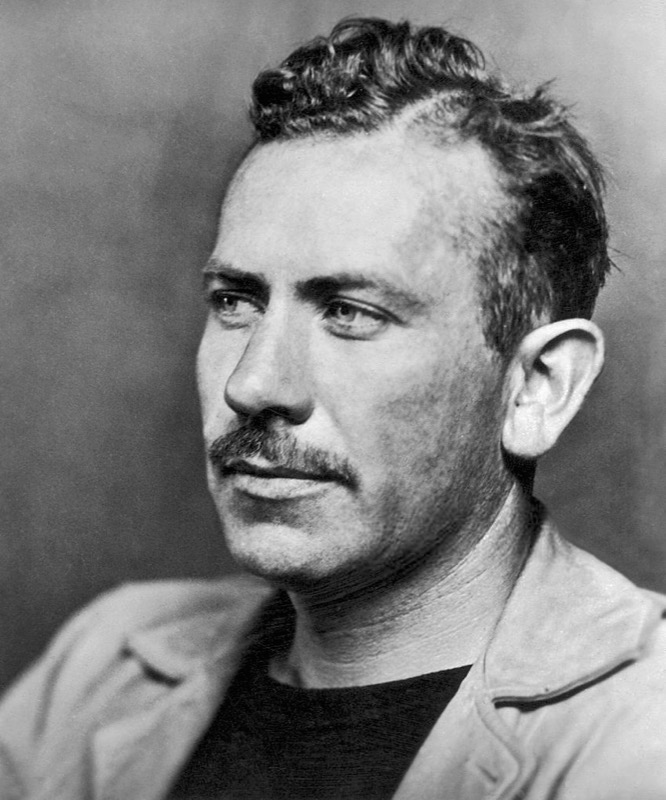
.jpg)
Summary
East of Eden is a multigenerational saga set mainly in the Salinas Valley of California from the Civil War to the First World War, which retells the story of Cain and Abel through two families: the Trasks and the Hamiltons, the latter being the narrator's own maternal ancestors. Samuel Hamilton, a poor, inventive, generous Irish immigrant farmer and blacksmith, raises a large family on barren land. In Connecticut, Cyrus Trask, a fraudulent veteran, favours his son Adam over the jealous Charles, who nearly beats Adam to death after Cyrus rejects his gift. Adam is sent into the cavalry and later wanders. Into the Trask story comes Cathy Ames, a beautiful, manipulative young woman without conscience, who as a girl burned down her parents' house with them inside. Beaten nearly to death by a brothel-keeper, she is found on the Trasks' doorstep; Adam nurses her and marries her, though she sleeps with Charles on the wedding night. Adam takes her to the Salinas Valley to build an Eden. Cathy gives birth to twins, delivered with the help of Samuel Hamilton and Adam's Chinese servant Lee, then shoots Adam in the shoulder and leaves for a Salinas brothel, where, as Kate, she poisons the madam, Faye, inherits the business and runs it by blackmail. Adam sinks into a long numbness until Samuel shocks him back to life by telling him where Cathy is. The twins are named Caleb and Aron after Lee, Samuel and Adam discuss the Genesis story; Lee, who has studied the Hebrew with Chinese scholars, explains that God's words to Cain contain the word timshel, 'thou mayest', meaning that people can choose to overcome sin. Aron grows up fair, gentle and loved; Cal is dark, cunning and jealous, aware of his own capacity for evil. Cal discovers that their mother is alive and is the notorious Kate. To win his father's love he makes money by speculating in beans during the First World War and offers it to Adam as a gift to replace a fortune Adam lost in a refrigerated lettuce venture. Adam rejects it as profiteering. In jealous rage Cal takes Aron to meet their mother. Shattered, Aron enlists and is killed in France. Kate, ill with arthritis and threatened with exposure, takes her own life. Adam suffers a stroke on hearing of Aron's death. As he lies dying, Lee urges him to bless Cal, and Adam whispers 'timshel', granting his son freedom to choose.
Plot or Argument
- Part One
The Hamiltons arrive in the Salinas Valley; Cyrus Trask, Adam and Charles in Connecticut; the early life and crimes of Cathy Ames; Cathy's arrival at the Trask farm and marriage to Adam.
- Part Two
Adam brings Cathy to California; the twins are born; Cathy shoots Adam and leaves for a brothel, where she takes control as Kate.
- Part Three
Samuel Hamilton rouses Adam from his torpor; the naming of the twins and the timshel discussion; Samuel's death and the passing of an era.
- Part Four
Cal and Aron grow up in Salinas; Cal discovers his mother; the bean scheme, Adam's rejection of the gift, Aron's enlistment and death, Kate's suicide and Adam's dying blessing.
Characters
- Adam Trask, protagonist
Idealistic, trusting man who seeks to build an Eden and is wounded by Cathy and later by his sons' rivalry.
- Cathy Ames / Kate, antagonist
Adam's wife, a remorseless manipulator who becomes a brothel madam in Salinas.
- Samuel Hamilton, Irish farmer and inventor
Wise, generous patriarch, the narrator's grandfather, who befriends Adam.
- Lee, Adam's servant and friend
Chinese-American scholar who raises the twins and explains timshel.
- Cal Trask, son
Dark, troubled twin who struggles with jealousy and his own capacity for evil.
- Aron Trask, son
Gentle, idealistic twin who cannot bear the truth about his mother.
- Charles Trask, Adam's half-brother
Violent, jealous brother whose rivalry with Adam prefigures the twins'.
- Cyrus Trask, Adam's father
Military fraud who favours Adam over Charles.
- Abra Bacon, Aron's girlfriend
Strong-minded young woman who comes to love Cal.
Lessons
Thou mayest
Lee's reading of timshel insists that people are not condemned to repeat inherited sin. The novel argues for moral choice against fatalism and heredity.
- Why is the difference between 'thou shalt' and 'thou mayest' so important?
- Does Cal finally have a free choice?
- Is Cathy an exception to the novel's belief in choice?
Rejection breeds rivalry
From Cain to Charles to Cal, a father's rejected gift ignites violence. The novel shows how parental favouritism wounds children across generations.
- Why does Adam reject Cal's money?
- How might Adam have responded differently?
Truth can wound
Aron cannot survive the truth about his mother, while Cal must learn to live with it. The novel weighs protective illusion against painful knowledge.
- Was Adam wrong to tell the boys their mother was dead?
- Who in the novel bears the truth best?
Context
The novel spans the settlement of California's Salinas Valley, the growth of agribusiness and refrigeration (Adam's lettuce shipment) and America's entry into the First World War. It draws on Steinbeck's family history: Samuel Hamilton was his maternal grandfather, and the narrator briefly appears as a child.
Composition
Steinbeck wrote the novel in 1951 as a book for his young sons, keeping a parallel journal of letters to his editor Pascal Covici, later published as Journal of a Novel (1969). It was published in 1952.
Reception
The novel was a bestseller, though critics were divided. Elia Kazan's 1955 film, starring James Dean as Cal, adapted only the final part. A 2003 selection for Oprah's Book Club renewed its popularity.
Comparisons
- the-bible
The novel's structure and title come from Genesis 4, and Lee's discussion of the Hebrew of Genesis 4:7 is its moral centre.
- cannery-row
Both Steinbeck books feature a wise observer (Lee and Samuel; Doc) at the centre of a community.
- wuthering-heights
Both are multigenerational family sagas of rivalry, revenge and inheritance, with a dark figure (Heathcliff, Cathy) at their heart.
- fathers-and-sons
Both examine the tensions between fathers and sons and the gap between generations' values.
- macbeth
Cathy, like Lady Macbeth, is a figure of ruthless will who is undone at last by physical and psychological decline.
Quotes
“But the Hebrew word, the word timshel—'Thou mayest'—that gives a choice.”
For Students
A reading companion for classical Christian high school students. See the student guide.
Reading Guide
Watch for
- The names that begin with C and A: Charles and Adam, Cathy, Caleb and Aron, and Abra. Steinbeck repeats the pattern of Cain and Abel across two generations, and the reader should watch whether the second generation must repeat the first.
- The rejected gift in Part One, when Cyrus Trask prefers Adam's present to Charles's and Charles responds by beating Adam nearly to death. Watch for the same pattern returning in Part Four when Adam refuses Cal's money.
- The conversation in Part Three among Lee, Samuel Hamilton, and Adam while naming the twins, in which Lee explains what he and his elders found in the Hebrew of Genesis 4:7 and the word timshel.
- Samuel Hamilton's visit to Adam in Part Three, when he tells Adam the truth about Cathy in order to wake him from years of numbness.
- Adam's deathbed at the end of Part Four, where Lee pleads with him to give Cal his blessing and Adam's final word answers the timshel discussion.
Key terms and names
- Timshel
- The Hebrew word that Lee says is used in God's words to Cain in Genesis 4:7, which he interprets as you may rule over sin rather than you must or you will. For Lee it means that people truly choose between good and evil.
- Salinas Valley
- The California valley, Steinbeck's own birthplace, where Samuel Hamilton farms poor hill land and Adam Trask tries to build an Eden on rich bottom land. The contrast of the two farms runs through the book.
- Cathy Ames / Kate
- Adam's wife, whom the narrator describes as born without conscience. She leaves her husband and infant sons for a Salinas brothel, takes it over as Kate, and becomes the secret that haunts her sons.
- Lee
- Adam's Chinese-American servant, a scholar who uses broken English with strangers and speaks plainly with friends. He raises the twins and supplies the book's reading of Genesis 4.
- Samuel Hamilton
- The narrator's grandfather, an Irish immigrant blacksmith, inventor, and farmer, poor in land but rich in ideas and generosity. He delivers the twins and helps name them.
- The bean venture
- Cal's scheme in Part Four to buy beans cheaply and sell them at a profit as prices rise during the First World War, so that he can repay his father's losses. Adam's refusal of the money as war profiteering sets off the novel's catastrophe.
- Land of Nod
- The land east of Eden where Cain settles after killing Abel in Genesis 4:16, and the source of the novel's title. The Salinas Valley becomes a modern version of that place of exile and new beginnings.
Seminar Questions
- Comprehension How does Cyrus Trask treat his two sons, and what happens after he chooses Adam's gift over Charles's?
- Comprehension What do Lee, Samuel, and Adam discuss when they name the twins, and what did Lee's elders conclude about Genesis 4:7?
- Comprehension Why does Cal give his father money, how does Adam respond, and what does Cal do next?
- Interpretation Cal fears that he has inherited his mother's evil. How does Lee answer that fear, and does the rest of the novel support Lee?
- Interpretation Adam rejects Cal's gift because the money was made from the war. Is Adam right? How does Steinbeck make this scene echo the rejected gift in Part One?
- Interpretation The narrator calls Cathy a kind of monster born without conscience. If that is true, can she choose otherwise? How does her character test the novel's claims about timshel?
- Interpretation Aron is fair, gentle, and loved, but cannot bear to learn the truth about his mother. What does the novel suggest about goodness that has never been tested?
- Big Question Lee's reading of Genesis 4:7 claims that every person may rule over sin. Is human freedom real, and what in this novel, such as heredity, upbringing, or the favouritism of fathers, seems to limit it?
Faith Connections
- Genesis 4:1-16 (Scripture)
The story of Cain and Abel supplies the novel's structure, its title from Cain's exile east of Eden, and its moral centre in God's words to Cain about sin crouching at the door. Students should read the chapter before discussing the timshel scene.
- Luke 15:11-32 (Scripture)
The parable of the prodigal son and the resentful elder brother is another story of a father's love and a son who feels unloved. Cal's longing for Adam's approval and Adam's final blessing can be read against the father in the parable who goes out to both sons.
- Augustine, City of God XV.1 (Church Fathers)
Augustine reads Cain and Abel as the founders of two cities, Cain building an earthly city and Abel living as a pilgrim. Steinbeck too treats the brothers as a pattern repeated in every generation, though he places the struggle within each person rather than between two societies.
Logic and Rhetoric
Central argument: The story of Cain and Abel repeats in every family and every life, because every person faces the choice between good and evil. If God had said that Cain must or will overcome sin, the outcome would be fixed by command or by fate. But Lee's reading of timshel holds that God said Cain may overcome it. Therefore no one is condemned by heredity or by a father's rejection, and each person, including Cal, bears both the burden and the dignity of choosing.
Rhetorical device: typological naming. Steinbeck gives his paired brothers names beginning with C and A, Charles and Adam in Part One and Caleb and Aron in Parts Three and Four, so that every scene between them silently recalls Cain and Abel. The pattern lets the reader feel the pull of the old story and watch for whether the characters will break it.
Debate: Resolved: Cal Trask bears the chief moral responsibility for Aron's death.
Writing Prompts
Essay: Lee's interpretation of timshel is the moral centre of East of Eden. Trace how the novel tests that interpretation through Charles, Cathy, Cal, and Adam, and argue whether the ending, with Adam's final word to Cal, confirms or complicates Lee's claim about human freedom.
Comparison with The Brothers Karamazov: Both East of Eden and The Brothers Karamazov follow brothers shaped by a flawed father and confront a death for which more than one brother feels guilty. Compare how Steinbeck and Dostoevsky understand moral responsibility and freedom, and argue which novel offers the more convincing account of how a guilty person can be restored.
Medical Lens
Medically interesting in several strands. The narrator famously describes Cathy as born with a malformed soul, a 'monster' lacking conscience; readers often discuss her in terms of psychopathy, though the novel itself presents her as a moral mystery and the question of innate evil versus choice is its theme. Samuel Hamilton, untrained, serves as the valley's midwife and delivers the twins. Kate poisons Faye slowly with drugs, then later, crippled by painful arthritis in her hands, ends her own life by poison. Adam's months-long torpor after Cathy leaves reads as profound depression, from which Samuel's confrontation rouses him. Aron's death in the war and Adam's stroke close the novel, and the debate over heredity versus choice engages early 20th-century ideas about inherited character.
- Part One (Cathy's early chapters)
The narrator's reflections on Cathy as a 'monster' born without conscience, and her killing of her parents.
- Part Two
Samuel Hamilton and Lee deliver Cathy's twins; Cathy shoots Adam and leaves.
- Part Two
Kate poisons the brothel-keeper Faye gradually with medicines.
- Parts Two–Three
Adam's prolonged numbness and neglect of his sons until Samuel confronts him.
- Part Four
Kate, suffering from arthritis and fearing exposure, takes poison.
- Part Four (final chapters)
News of Aron's death in France; Adam's stroke and deathbed blessing.
Creative Prompts
- Essay
Is Cathy a counter-example to the novel's argument about free will, or its proof?
- Fiction
Write the night Samuel Hamilton and Lee deliver the twins from Lee's point of view.
- Classroom
Trace the pattern of the rejected gift through Cain, Charles and Cal.
Further Reading
- Journal of a Novel: The East of Eden Letters, John Steinbeck
- The Grapes of Wrath, John Steinbeck
- John Steinbeck, Writer, Jackson J. Benson
- East of Eden (film), Elia Kazan (director)
Verification notes
Plot, structure in four parts and the Hamilton background are well established. The timshel quote is believed close to verbatim but punctuation should be checked; chapter number given is believed correct. Details of Kate's poisoning methods and suicide are given without specifics because I am not certain of them.
- Exact wording and chapter of the timshel quote (given as Ch. 24).
- What drug Kate uses to poison Faye and to kill herself.
- Whether Samuel delivers the twins alone or with Lee's help.
- Whether Cathy's parents die in a fire she sets (as stated).