Work record
St. Dymphna and the Geel Colony
c. 1247; Geel colony tradition from the Middle Ages · Medieval · Hagiography · Latin and English

Summary
St. Dymphna and the Geel Colony is less a single book than a layered dossier: a thirteenth-century Latin Vita by Pierre of Cambrai, a medieval shrine in the Brabant town of Geel, and a centuries-long practice of boarding mentally ill people with local families. The legend tells of an Irish princess whose widowed father, deranged by grief and desire, attempts to marry his daughter because she resembles her dead mother. Dymphna flees with the priest Gerebernus, reaches Geel, refuses the incestuous demand, and is killed by her father. The Catholic Encyclopedia is blunt that this narrative has no firm historical foundation and resembles a widespread folktale motif. That caution is crucial. The value of the Dymphna tradition is not that it lets a modern reader reconstruct a seventh-century Irish biography. Its value is that a story of threatened sexual violence, flight, martyrdom, and healing became attached to one of Europe's most remarkable forms of psychiatric care. Pilgrims came to Geel seeking help for insanity, epilepsy, melancholy, possession, and other afflictions that premodern communities did not divide into modern diagnostic categories. When the shrine and infirmary could not house everyone, townspeople took sufferers into ordinary households. Over time this became a regulated family-care colony in which boarders lived, worked, ate, worshipped, and were watched without being reduced entirely to inmates. Nineteenth-century alienists visited Geel as an alternative to asylum confinement; later historians of psychiatry saw it as an early example of community care. The record must be handled with sympathy and skepticism together. Geel was not a utopia, and retrospective diagnoses of medieval pilgrims are unstable. Yet Dymphna's cult created a social space where mental affliction could be met by proximity, routine, and household belonging rather than only chains, cells, or expulsion. For a medical reader, that makes the legend a doorway into the history of deinstitutionalization before the word existed.
Plot or Argument
- Pierre names an oral legend
The earliest account known to modern readers is Pierre of Cambrai's thirteenth-century Vita, written from oral tradition about a cult already established at Geel. That makes the text evidence for devotion before it is evidence for Dymphna's life.
- Flight from incestuous power
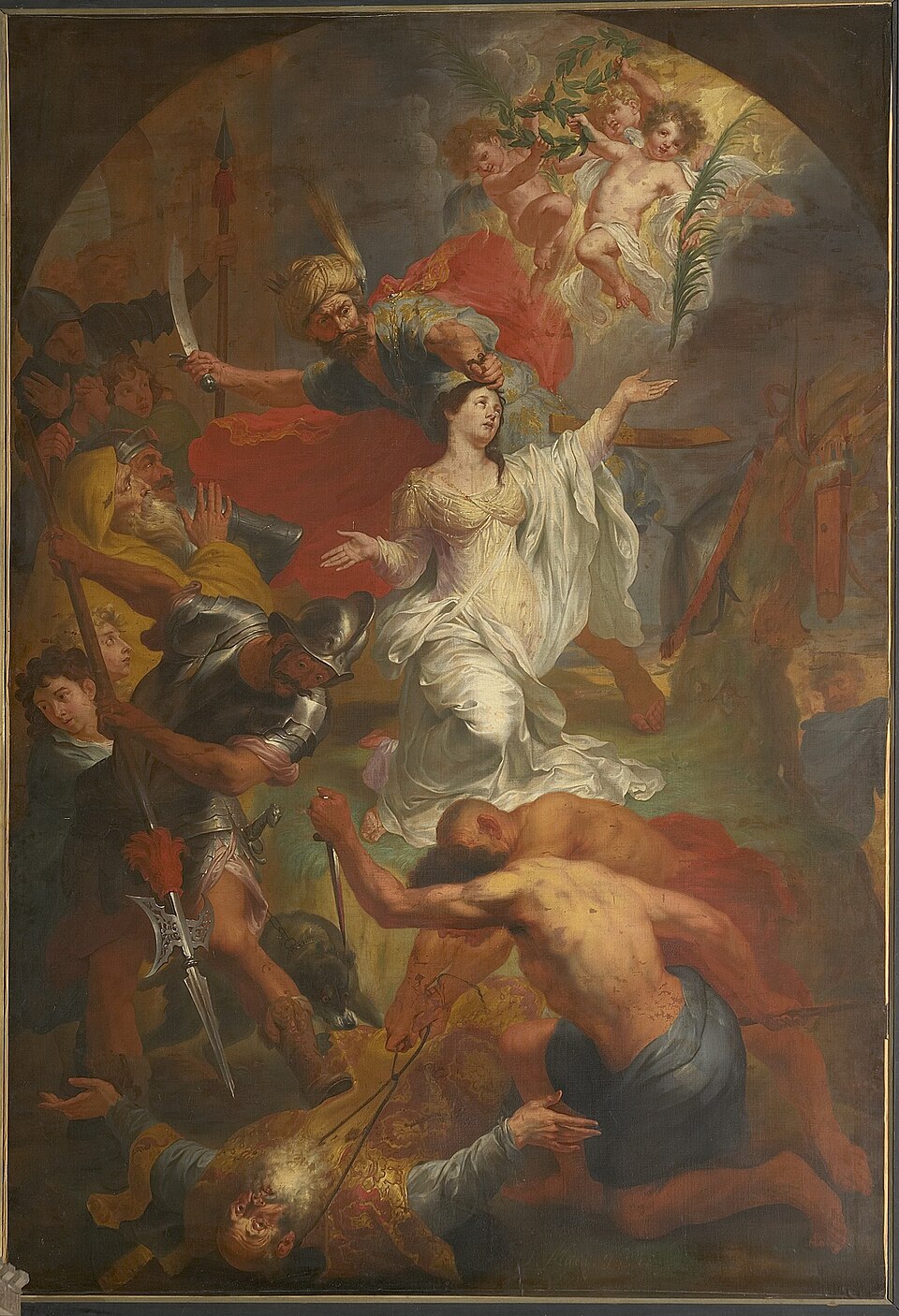
The legend presents Dymphna as a Christian daughter escaping a pagan father who wants to marry her after her mother's death. Gerebernus accompanies her, and their flight ends at Geel.
- Martyrdom and shrine memory
Dymphna refuses her father's renewed demand and is beheaded; Gerebernus is also killed. The bodies, relics, and church at Geel become the physical center of the cult.
- Pilgrims become boarders
People seeking cures for mental affliction come to the shrine. As local facilities prove insufficient, families in Geel begin taking sufferers into their homes, turning devotion into a social system.
- A model for community psychiatry
Physicians and reformers later interpret Geel as evidence that some people with serious mental illness can live outside asylums when ordinary community structures accept responsibility for care.
Characters
- Dymphna, virgin martyr and patron of mental affliction
Legendary Irish princess whose flight and death became attached to Geel's shrine and later psychiatric boarding system.
- Gerebernus, priest and companion
Dymphna's priest protector in the legend, killed with her and venerated in related traditions.
- Dymphna's father, persecutor in the legend
The grieving king whose incestuous demand and violence give the legend its traumatic force.
- Families of Geel, caregivers
Households that received mentally ill boarders and made the cult into a durable practice of family foster care.
Lessons
Legend can found a real institution
The story of Dymphna is historically fragile, but Geel's household-care tradition is historically consequential. A doubtful biography can still generate durable practices of mercy, identity, and care.
- How can a historian respect the Geel tradition without treating the legend as fact?
- What parts of Dymphna's story made it powerful for families caring for mental illness?
Community care predates modern slogans
Geel complicates the story that psychiatric community care begins only after modern asylum reform. Its model was devotional and local, but it raised questions that remain modern: housing, stigma, autonomy, supervision, and belonging.
- What advantages might a household model have over an institution?
- Where could romanticizing Geel hide risks or burdens?
Trauma should not be softened into charm
Dymphna's legend involves coercion, incestuous threat, flight, and murder. Its modern use as patronage for mental illness and abuse survivors is strongest when those violences are named rather than made decorative.
- Why might Dymphna appeal to people harmed inside families?
- How does patronage change when the saint is read through trauma?
Diagnosis is not the only historical question
Medieval sources speak of insanity, epilepsy, possession, and nervous affliction in shifting terms. The better question is often not what DSM label applies, but what forms of care and exclusion the label enabled.
- What gets lost when every pilgrim is translated into a modern diagnosis?
- How does Geel compare with asylum-based reform?
Context
Dymphna's cult is documented in the thirteenth century at Geel, now in Belgium. The legend probably draws on common hagiographic and folktale motifs, but the shrine's association with mental affliction became socially concrete through family boarding.
Composition
Pierre of Cambrai wrote the Vita under Bishop Guy I, explicitly drawing on oral tradition. Later summaries, liturgical notices, Bollandist miracle accounts, and medical visitors added layers to the Dymphna dossier.
Reception
Geel became famous among nineteenth-century alienists and reformers as a family colony for the mentally ill. Modern discussions of community psychiatry, deinstitutionalization, and anti-stigma care still return to it, though usually with more caution than older celebratory accounts.
Comparisons
- golden-legend-popular-saints
Both entries show how medieval saint stories turn bodily peril into patronage, but Dymphna's importance lies less in iconography than in the social institution that gathered around her shrine.
- the-anatomy-of-melancholy
Burton catalogs melancholy through learned medicine and theology; Geel shows a lay devotional community handling mental affliction through household placement and routine.
- medical-inquiries-and-observations-upon-diseases-of-the-mind
Rush belongs to asylum-era medical reform, while Geel offered an older counterexample in which some sufferers lived dispersed among families rather than confined as patients.
- the-varieties-of-religious-experience
James helps frame the psychological force of religious experience, but Dymphna's cult reminds readers that devotion can become an actual care infrastructure, not only an inward state.
- st-patricks-writings
Patrick's own writings preserve a rare early voice from Ireland; Dymphna's supposed Irishness is legendary and must be separated from the documented Geel cult.
Quotes
“The earliest historical account of the veneration of St. Dymphna dates from the middle of the thirteenth century”
“This narrative is without any historical foundation, being merely a variation of the story of the king who wanted to marry his own daughter, a motif which appears frequently in popular legends”
“The insane are treated in a peculiar manner; it is only in the beginning that they are placed in an institution for observation; later they are given shelter in the homes of the inhabitants, take part in their agricultural labours, and are treated very kindly”
For Students
A reading companion for classical Christian high school students. See the student guide.
Reading Guide
Watch for
- The opening of the Catholic Encyclopedia article, which separates what is historically documented (veneration at Geel by the middle of the thirteenth century) from the legend it then retells. Keep those two layers apart as you read everything else.
- Pierre of Cambrai's statement that he wrote his Vita from oral tradition at the request of Bishop Guy of Cambrai. Ask what kind of evidence a saint's life written centuries after her death can and cannot give.
- The shape of the legend itself: a grieving king, a daughter who resembles her dead mother, a flight across the sea with the priest Gerebernus, discovery at Geel, and martyrdom. Notice which details belong to a common folktale pattern and which belong only to Geel.
- The turn from shrine to town: pilgrims afflicted in mind come to Dymphna's church, the space near the shrine cannot hold them, and families of Geel begin to take them into their homes and fields.
- The later visitors, nineteenth-century physicians such as John Sibbald and Pliny Earle, who came to Geel to see whether people with serious mental affliction could live among families rather than behind asylum walls.
Key terms and names
- Vita
- Latin for life, the usual title of a saint's biography. Pierre of Cambrai's Vita of Dymphna, written around the middle of the thirteenth century, is the earliest written account of her legend.
- Gerebernus
- The aged priest who, in the legend, helps Dymphna flee her father and is killed with her at Geel. He was venerated alongside her, and his relics had their own history.
- Geel
- A town in the Campine region of Brabant, now in Belgium, where Dymphna's cult was centered. It gave its name to the family-care system that grew up around the shrine.
- Relics
- The bodily remains of a saint, venerated as signs of holiness and the presence of the saint's intercession. Pilgrims came to Dymphna's relics at Geel seeking healing from mental affliction.
- Patronage
- The belief that a particular saint intercedes especially for certain people or needs. Dymphna became the patron of those afflicted in mind, a role that grew from the pilgrims who came to her shrine.
- Family care (boarding)
- The Geel practice in which people with mental affliction live as boarders in ordinary households, eat at the family table, and share in farm and household work. The Catholic Encyclopedia describes it as already well established by 1909.
Seminar Questions
- Comprehension According to the Catholic Encyclopedia, when does the earliest historical evidence for Dymphna's veneration appear, and on what source did Pierre of Cambrai base his Vita?
- Comprehension Retell the legend of Dymphna in order: why does she flee, who goes with her, how is she found, and how does she die?
- Comprehension How did the households of Geel come to receive afflicted pilgrims, and what part did the boarders play in the life of the family and town?
- Interpretation The 1909 Catholic Encyclopedia, a Catholic reference work, says plainly that the legend has no historical foundation. Why might a believing scholar insist on that, and does it weaken or strengthen the honor given to Dymphna?
- Interpretation In the legend Dymphna's father is driven by grief into a kind of madness. Why might it be fitting that the saint who suffered at the hands of a disordered mind became the patron of the mentally afflicted?
- Interpretation Nineteenth-century physicians came to Geel to compare it with the asylums of their own countries. What did the household system offer that an institution could not, and what would it demand of the families?
- Big Question Can a legend whose historical details are uncertain still give rise to true and lasting works of charity? What does that say about how tradition works?
- Big Question What do ordinary families and towns owe to neighbors who suffer from serious affliction of mind?
Faith Connections
- Mark 5:1-20 (Scripture)
The man of the Gerasenes lives among the tombs, bound with chains that he breaks, until Jesus heals him and sends him home to his own people. Geel's practice of bringing afflicted people out of isolation and into households answers the same contrast between the tombs and the home.
- Matthew 25:31-46 (Scripture)
Christ identifies himself with the stranger who is taken in and the sick who are visited. The families of Geel who received unknown pilgrims at their tables lived out this passage as a town over many generations.
- Gregory of Nazianzus, Oration 43 (Funeral Oration on Basil the Great) (Church Fathers)
Gregory praises the new city Basil built outside Caesarea for the sick, the poor, and strangers, where suffering was met with lodging and care. Geel offers a later, humbler version of the same Christian instinct, spread out among homes rather than gathered in one foundation.
- The Rule of St. Benedict, Chapter 53 (Great Conversation)
Benedict commands that all guests be received as Christ, with particular care for the poor and pilgrims. The Geel tradition turned this monastic rule of hospitality into the ordinary practice of lay households.
Logic and Rhetoric
Central argument: The dossier makes a two-part argument. First, the historical case: Dymphna's legend cannot be confirmed and follows a widespread folktale pattern, so it should not be read as biography. Second, the case from practice: the cult at Geel drew mentally afflicted pilgrims, the shrine could not hold them, and families took them in, creating a lasting system of household care. Therefore the importance of Dymphna lies less in what can be proven about her life than in the community of mercy that formed around her memory.
Rhetorical device: concession. The Catholic Encyclopedia concedes at once that the narrative is without any historical foundation and a variation of a common legend, and only then describes the Geel colony, so that its praise of the town's kindness rests on solid ground rather than on the legend.
Debate: Resolved: The households of Geel offered better care for the mentally afflicted than the asylums of the nineteenth century.
Writing Prompts
Essay: The Catholic Encyclopedia calls Dymphna's legend unhistorical, yet describes the Geel colony with admiration. Using the article's account of the legend, Pierre of Cambrai's reliance on oral tradition, and the description of boarders living with families, argue what makes a saint's cult valuable when the saint's biography cannot be confirmed.
Comparison with Medical Inquiries and Observations upon the Diseases of the Mind: Benjamin Rush sought to treat mental illness through physicians and hospitals, while Geel cared for the afflicted in ordinary households under the patronage of a saint. Compare the assumptions about the mind, the body, and community in each approach, and argue which better honors the dignity of the person who suffers.
Medical Lens
Dymphna and Geel are central to the history of community psychiatry because the cult produced a durable non-asylum model of family foster care for people described as insane, epileptic, possessed, nervous, or melancholic. Retrospective diagnosis should be avoided; the stronger medical point is institutional and ethical: Geel shows how stigma, housing, supervision, work, and household belonging shaped care long before modern deinstitutionalization.
- Vita tradition: flight from the father
The legendary incestuous threat and flight invite trauma-informed reading, while remaining a folktale-shaped hagiographic motif rather than secure biography.
- Geel shrine and colony
Mentally afflicted pilgrims and boarders are lodged first near the shrine and later in family homes, creating a premodern alternative to confinement.
- Nineteenth-century psychiatric visits to Geel
Alienists and reformers used Geel as evidence in debates over asylum limits, moral treatment, and whether chronic mental illness required institutional segregation.
Creative Prompts
- Essay
Compare Dymphna's legend with the actual household practices of Geel, asking how historical uncertainty can still produce ethical clarity.
- Dialogue
Write a conversation between a nineteenth-century alienist visiting Geel and a host family explaining why they call residents boarders rather than patients.
Further Reading
- St. Dymphna, Johann Peter Kirsch
Catholic Encyclopedia article, useful for both the legend and the critical warning.
- Gheel, Pliny Earle
Nineteenth-century American psychiatric discussion of the Geel colony.
- The Colony of Gheel, John Sibbald
A classic asylum-era account of Geel's family-care system.
- St. Dymphna and the Lunatics, Miri Rubin
Modern historical essay on the saint and moral community psychiatry.
Verification notes
The existence of Pierre's Vita, Dymphna's cult at Geel, and the later family-care colony are secure. The legendary biography is not secure and is explicitly treated as hagiographic motif. No complete safe public-domain English Vita was attached.
- A future pass should attach or cite a complete public-domain Latin Vita if a usable edition is located.