Work record
Memoirs
1875 · 19th Century · Memoir · English
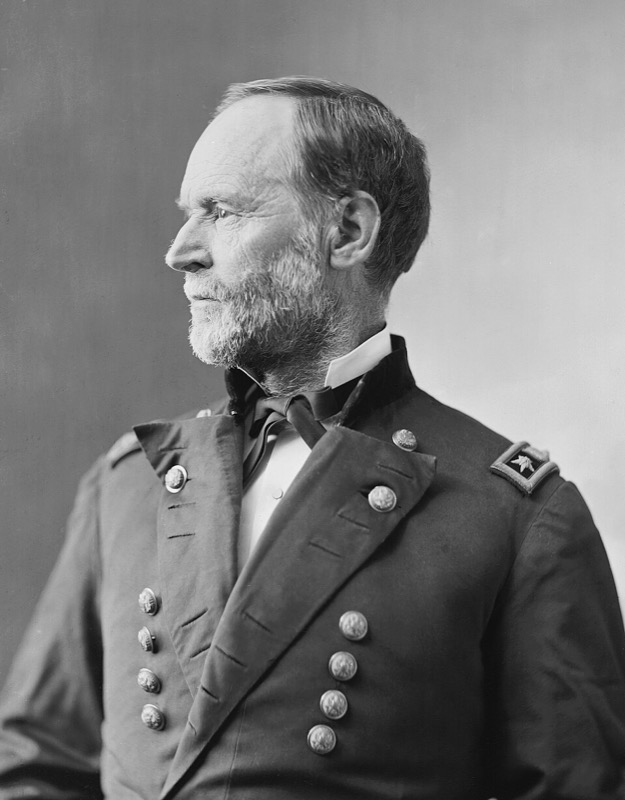

Summary
Sherman's Memoirs, published in two volumes in 1875 and revised in 1886, present themselves less as history than as testimony; in the preface to the second edition he says he writes as a witness before the tribunal of history, supplying material for some future historian. The first volume, the text stored in this library, runs from his Ohio boyhood to the Meridian campaign of February 1864. The early chapters are unexpectedly picaresque. A young lieutenant arrives in Monterey by sea in 1847, watches the gold rush empty the army of its soldiers, and helps carry the first official reports of the discovery east. In the 1850s he returns to San Francisco as a banker, survives the panic of 1855 and the Vigilance Committee crisis, and quits finance in exhaustion, later failing again at law in Leavenworth, Kansas. In 1859 he takes charge of the new military seminary at Alexandria, Louisiana, and the chapter on Louisiana records his growing certainty that secession means a long and bloody war and his resignation when the state seizes the federal arsenal. The war chapters move from the brigade he led at Bull Run, where he watched a retreat happen without any order to retreat, to his command in Kentucky in the autumn of 1861. There his estimate that two hundred thousand men would be needed to clear the Mississippi valley was leaked, and newspapers declared him insane. He was relieved and sent home, and the memoir treats the episode in a tone of bruised self-defence. Shiloh restores him: surprised in camp on 6 April 1862 and wounded in the hand, he holds his division together, and he later writes that the battle gave him new life. The chapters on Memphis, Chickasaw Bayou and Arkansas Post show him as a military governor wrestling with guerrillas, cotton speculators, fugitive slaves and civilian complaints, while the Vicksburg chapter records his initial objections to Grant's plan and his loyalty once it succeeded. The book reprints long official letters, including the September 1863 letter to Halleck that sets out the logic of making war on the will of a hostile population. In the Chattanooga chapter his nine-year-old son Willie, visiting camp near Vicksburg, falls ill with typhoid on the river journey north and dies at Memphis; Sherman reproaches himself in a letter written at midnight. The volume closes with the Meridian expedition, a rehearsal for the destruction of railroads and stores that the second volume carries to Atlanta, Savannah and the Carolinas. Throughout, Sherman argues with critics, quotes his own dispatches at length, and makes supply, rail lines and river transport as vivid as battle.
Plot or Argument
- Lancaster, West Point and the Pacific coast (Ch. I–III)
Family origins, adoption into the Ewing household, West Point, service in Florida and South Carolina, then the voyage around Cape Horn to Mexican-era California, the discovery of gold at Sutter's mill and the desertion of soldiers to the diggings.
- Banking, panic and the Vigilance Committee (Ch. IV–VI)
Sherman resigns his commission to run a branch bank in San Francisco, weathers the 1855 run and the 1856 vigilante crisis as a reluctant militia general, then drifts to New York and Kansas as banker and lawyer, a sequence of near-failures he narrates with dry humour.
- The Louisiana Seminary and secession (Ch. VII)
As superintendent of the state military academy he builds an institution and befriends Southern colleagues, then resigns when Louisiana seizes the Baton Rouge arsenal, insisting he will not take up arms against the United States.
- St. Louis, Bull Run and the Kentucky breakdown (Ch. VIII–IX)
He witnesses the Camp Jackson affair in St. Louis with his son Willie, leads a brigade at First Bull Run, and takes over the Department of the Cumberland. His demand for far larger armies is ridiculed, the press calls him crazy, and he is relieved, a passage he answers with documents.
- Shiloh and its aftermath (Ch. X–XI)
His division bears the first Confederate assault at Pittsburg Landing; his official report credits surgeons and staff. Afterwards he persuades a sidelined Grant not to leave the army, reflecting that one battle had undone the label of insanity.
- Memphis, Chickasaw Bayou and Vicksburg (Ch. XII–XIII)
Military government of occupied Memphis, the repulse at Chickasaw Bayou, Arkansas Post, and the long Vicksburg campaign. Letters to citizens and to Halleck lay out his doctrine that the costs of war belong to those who began it.
- Chattanooga, Knoxville and the death of Willie (Ch. XIV)
Willie Sherman dies of typhoid at Memphis in October 1863; Sherman then marches his corps east to relieve Chattanooga, fights at Missionary Ridge, and pushes on to raise the siege of Knoxville.
- Meridian (Ch. XV)
A February 1864 raid across Mississippi destroys railways, depots and supplies without seeking pitched battle, foreshadowing the methods of the Atlanta campaign and the March to the Sea treated in Volume II.
Characters
- William Tecumseh Sherman, narrator and memoirist
Restless, combative, intensely observant; writes as a self-declared witness and defends his record line by line.
- Ulysses S. Grant, superior and ally
The commander Sherman serves under from Shiloh to Chattanooga; the memoir records their mutual loyalty, including Sherman talking Grant out of quitting in 1862.
- Henry W. Halleck, department commander, later general-in-chief
Sherman's superior in the West and recipient of his most important letter on war policy toward the Southern population.
- Simon Cameron, Secretary of War
Whose memorandum of Sherman's 'insane request for two hundred thousand men' fed the newspaper campaign against him.
- Thomas Ewing, foster father and father-in-law
Ohio senator and cabinet officer who raised Sherman and whose daughter Ellen he married.
- Ellen Ewing Sherman, wife
Present at Willie's deathbed at Memphis; a recurring offstage presence in the domestic passages.
- Willie Sherman, son
Nine-year-old who adopts the Thirteenth Regulars as his own, catches typhoid on a visit to camp, and dies in October 1863.
- John Sherman, brother, Ohio senator
Political ally whose correspondence threads through the Kentucky and Louisiana chapters.
- James B. McPherson, corps commander
Trusted subordinate in the Vicksburg and Meridian chapters.
Lessons
A public label of insanity can outlast its evidence
The Kentucky chapter shows a commander whose strategic estimate later proved roughly right being branded insane in print and removed. Sherman's anger decades later shows how a newspaper diagnosis wounds reputation, self-trust and career, and how recovery came through action rather than vindication.
- Why did a large troop estimate get read as a symptom rather than a judgment?
- What does Sherman's insistence on reprinting documents reveal about how the episode still felt to him in 1875?
- How should historians weigh his private letters of despair from late 1861 against his public account?
Logistics is the hidden plot of war
Sherman narrates rivers, railroads, forage and hospital boats with as much care as combat. His war is a problem of moving and feeding men, and the Meridian raid shows that destroying an enemy's means of supply can matter more than defeating its army in battle.
- Which logistical decision in Volume I has the largest consequences?
- Why does Sherman resist floating hospitals before Shiloh, and what does that say about his priorities?
Assigning the costs of war to those who began it
In letters from Memphis and to Halleck, Sherman argues that waste and destruction are chargeable to those who chose secession, and that war should be 'pure and simple' toward belligerents. The memoir lets readers watch a moral rationale for hard war being built before it was carried out in Georgia.
- Where does Sherman distinguish between soldiers' theft and legitimate destruction?
- Is his argument about responsibility for war's costs persuasive, or a licence for excess?
- How do the Memphis letters complicate his later reputation?
Private grief inside a public command
Willie's death is told in a few paragraphs and a midnight letter, then the narrative moves on to Chattanooga. The compression is itself the evidence: a father blames himself for bringing his family to a sickly river camp, yet writes that duty leaves no time to mourn.
- What does Sherman's self-reproach suggest about how nineteenth-century families understood the risk of typhoid in summer camps?
- How does the letter to Captain Smith turn grief into regimental loyalty?
Context
The Memoirs appeared ten years after Appomattox, amid fierce postwar argument over who had won the war and how. Sherman was Commanding General of the Army and a target of Southern bitterness over the burning of Atlanta and Columbia, and of Northern rivals who resented his judgments. The book belongs to the first great wave of Civil War command memoirs and preceded Grant's Personal Memoirs by a decade.
Composition
Sherman drafted the work largely from his own letter books, orders and official reports, many reprinted in full. It was published by D. Appleton in 1875 in two volumes. A second edition of 1886 corrected errors and added an opening chapter on his life before the Mexican War, a closing chapter on military lessons, and an appendix of letters from critics.
Reception
The first edition provoked immediate controversy. Former colleagues objected to his portraits of them, and Henry Van Ness Boynton published a hostile critique in 1875. The book nonetheless sold well and became a basic source for the Western theatre. Military theorists such as B. H. Liddell Hart later treated Sherman as a forerunner of the 'indirect approach' and of modern war against an enemy's economic base.
Comparisons
- personal-memoirs
Grant's memoir covers the same campaigns from Shiloh to Chattanooga with cool understatement, while Sherman's is argumentative and documentary; reading them together shows two friends quietly correcting each other's accounts of Shiloh's surprise and the Vicksburg plan.
- the-conquest-of-gaul
Caesar and Sherman both write campaign narrative to shape their reputations while ostensibly reporting, and both justify devastation of a hostile countryside; Caesar's third-person detachment contrasts with Sherman's first-person quarrelling.
- on-war
Clausewitz's claim that war aims at the enemy's will finds a practical American expression in Sherman's letter to Halleck, which treats the Southern population's resolve as the real target of operations.
- the-history-of-the-peloponnesian-war
Thucydides' Melian Dialogue and Sherman's Memphis letters both state, without apology, the logic by which a stronger power assigns the suffering of war to those who resisted it.
- whitman-complete-poems
Whitman's Drum-Taps and his hospital poems show the wounded of the same war from the ward rather than headquarters, a useful corrective to Sherman's staff-level view of the cost of battle.
- the-river-war
Churchill's account of Kitchener's Nile campaign shares Sherman's fascination with rail lines and river supply as the true instruments of conquest.
Quotes
“I wish my friends and enemies to understand that I disclaim the character of historian, but assume to be a witness on the stand before the great tribunal of history”
“There was no positive order to retreat, although for an hour it had been going on by the operation of the men themselves”
“the report that I was "crazy, insane, and mad," that "I had demanded two hundred thousand men for the defense of Kentucky”
“Before the battle of Shiloh, I had been cast down by a mere newspaper assertion of "crazy;" but that single battle had given me new life, and now I was in high feather”
“They worked day and night, and did not rest till all the wounded of our own troops as well as of the enemy were in safe and comfortable shelter”
“This is waste, but is the natural consequence of war, chargeable on those who caused the war”
“generally war is destruction and nothing else”
“We accepted the issue, and now they begin to realize that war is a two-edged sword, and it may be that many of the inhabitants cry for peace”
“In accepting war, it should be "pure and simple" as applied to the belligerents”
“I could not help reproaching myself for having consented to his visit in that sickly region in the summer-time”
“Being in the very midst of an important military enterprise, I had hardly time to pause and think of my personal loss”
“The child that bore my name, and in whose future I reposed with more confidence than I did in my own plan of life, now floats a mere corpse, seeking a grave in a distant land, with a weeping mother, brother, and sisters, clustered about him”
For Students
A reading companion for classical Christian high school students. See the student guide.
Reading Guide
Watch for
- The preface to the second edition, where Sherman refuses the title of historian and calls himself a witness on the stand. Ask throughout what he is testifying to and against whom.
- The California and banking chapters, where a young officer watches the gold rush empty the army and later quits finance after the panic of 1855. They show a man who failed repeatedly before the war made him.
- Chapter IX, where newspapers call Sherman insane after his estimate that two hundred thousand men were needed in the West, and the way he answers the charge with documents.
- Shiloh in Chapters X and XI, where he is surprised in camp, holds his division together, and later says the battle gave him new life.
- The letters from Memphis and to Halleck in Chapters XII and XIII, which lay out his view that the destruction of war is chargeable to those who began it, followed in Chapter XIV by the death of his son Willie.
Key terms and names
- Shiloh (Pittsburg Landing)
- The battle of 6 and 7 April 1862 in Tennessee, where Sherman's division took the first Confederate assault. His conduct there restored the reputation the Kentucky episode had damaged.
- Louisiana State Seminary
- The military academy at Alexandria, Louisiana, that Sherman led as superintendent from 1859. He resigned when the state seized the federal arsenal at Baton Rouge, refusing to take up arms against the United States.
- Vigilance Committee
- The citizens' organization that took over law enforcement in San Francisco in 1856. Sherman, as a reluctant militia general, opposed it and resigned when promised support failed to arrive.
- Department of the Cumberland
- The Kentucky command Sherman took over in the autumn of 1861. His demand there for far larger armies led the press to call him crazy and led to his removal.
- Letter to Halleck (September 1863)
- The long letter, reprinted in Chapter XIII, in which Sherman sets out how the war should be waged against a hostile population and its will to resist. It is the clearest statement of his thinking before the March to the Sea.
- Meridian expedition
- The February 1864 raid across Mississippi that closes the first volume. Sherman destroyed railroads, depots, and supplies without seeking a pitched battle, rehearsing the methods of the Atlanta and Carolina campaigns.
- Willie Sherman
- Sherman's nine-year-old son, who fell ill with typhoid after visiting camp near Vicksburg and died at Memphis in October 1863. Sherman's letter about his death is reprinted in Chapter XIV.
Seminar Questions
- Comprehension What does Sherman claim to be in the preface to the second edition, and what does he say he is not?
- Comprehension Why did newspapers call Sherman insane in the autumn of 1861, and what happened to his command?
- Comprehension How did Willie Sherman fall ill, and what does Sherman blame himself for in Chapter XIV?
- Interpretation Sherman reprints long official letters and reports instead of simply telling his story. What does he gain as a witness by quoting his own documents, and what might he lose?
- Interpretation In his Memphis letter Sherman writes that the waste of war is chargeable on those who caused it. Is this a moral argument, a military one, or both?
- Interpretation Sherman says he had hardly time to pause for his personal loss when Willie died. What does the juxtaposition of grief and campaign in Chapter XIV reveal about the man and about command?
- Big Question If war is destruction and nothing else, as Sherman writes, is a commander right to make it as terrible as possible so that it will end sooner?
- Big Question Can anyone be a fair witness in his own case?
Faith Connections
- 2 Samuel 18:33 (Scripture)
David, at the moment of military victory, weeps for his dead son Absalom and wishes he had died in his place. Sherman's midnight letter on Willie's death, written in the middle of moving his corps to Chattanooga, sets the same grief of a father inside the duties of a commander.
- Ecclesiastes 3:1-8 (Scripture)
The Preacher names a time to kill and a time to heal, a time of war and a time of peace. Sherman's memoir argues that war must be fought as war, without half-measures, so that the time of peace may come, and the passage invites students to ask whether the times can be kept so cleanly apart.
- Augustine, Letter 189 (to Boniface) (Church Fathers)
Augustine told the Roman general Boniface that war is waged so that peace may be obtained, and urged him to remain a peacemaker even in fighting. Sherman also insisted that his hard war aimed at a lasting peace, and the letter gives students a standard by which to measure his methods.
- Thomas Aquinas, Summa Theologiae II-II, q. 40 (Great Conversation)
Aquinas holds that a just war requires lawful authority, a just cause, and a right intention aimed at good and the avoidance of evil. Sherman's claim that the costs of war fall on those who started it is an argument about just cause, and his letters to Halleck can be tested against all three conditions.
Logic and Rhetoric
Central argument: The secessionist states chose war against the United States. War is by nature destruction, and the costs it imposes fall rightly on those who caused it. A war fought with half-measures only prolongs suffering, while a war that breaks the enemy's resources and will to fight brings peace sooner. Therefore the hard methods Sherman used, from the Memphis occupation to the Meridian raid, were justified, and his record, documented in his own reports and letters, should be judged by history on that basis.
Rhetorical device: metaphor with biblical echo. In the September 1863 letter to Halleck in Chapter XIII, Sherman calls war a two-edged sword, borrowing an image familiar from Scripture to warn that a population that accepted war must now feel its cutting edge turned back upon itself.
Debate: Resolved: Sherman's principle that the costs of war are chargeable to those who caused it justifies the destruction of civilian property.
Memory Work
generally war is destruction and nothing else
I wish my friends and enemies to understand that I disclaim the character of historian, but assume to be a witness on the stand before the great tribunal of history
Writing Prompts
Essay: Sherman presents himself as a witness before the tribunal of history. Using his self-defence over the Kentucky insanity charge, his letters on the costs of war in Chapters XII and XIII, and his letter on Willie's death, argue what kind of witness Sherman is and how far his testimony should be trusted.
Comparison with Personal Memoirs: Grant and Sherman fought together at Shiloh, Vicksburg, and Chattanooga, and each wrote a memoir of the war. Compare the two men's accounts of themselves and of each other, and argue which memoir gives the truer picture of what command in the Civil War required.
Medical Lens
Three threads matter for a medical reader. First, the Kentucky breakdown of late 1861: the press called Sherman insane, he was sent home on leave, and his family letters (outside this book) describe despair and thoughts of suicide. Biographers have read the episode variously as acute stress, a depressive episode or an exhausted man's realism caricatured by the press; these are interpretations, and the memoir itself offers only anger and documentation. Second, disease and military medicine: typhoid kills Willie, river camps are described as 'sickly', and the Shiloh chapters show regimental surgeons, field hospitals and the evacuation of sick men by steamboat. Third, the moral psychology of hard war, which links to modern discussions of the civilian costs of total war and of command stress.
- Vol. I, Ch. IX (Kentucky, autumn 1861)
Cameron's memorandum, newspaper reports that Sherman was insane, his relief from command and his sense that his position was unbearable.
- Vol. I, Ch. IX (Bull Run report)
Close-range fire breaks the brigade; wounded stream toward buildings used as hospitals and the retreat becomes a spontaneous rout.
- Vol. I, Ch. X (Pittsburg Landing, March–April 1862)
Sick soldiers shipped to Savannah for want of any building for a hospital; Sherman's postscript rejects floating hospitals in favour of regimental surgeons; his Shiloh report praises surgeons who treated wounded of both armies.
- Vol. I, Ch. XI
Sherman describes Shiloh as having given him new life after being cast down by the 'crazy' label, and counsels a demoralised Grant.
- Vol. I, Ch. XII (Memphis)
Letters on regimental and general hospitals, the use of freed people as hospital attendants and nurses, and requisition of buildings for patients.
- Vol. I, Ch. XIV (October 1863)
Willie's typhoid on the steamer Atlantic, the attending army surgeon's warning, death at the Gayoso Hotel, and Sherman's self-reproach and midnight letter.
Creative Prompts
- Fiction
Write the night of Sherman's arrival home in Lancaster in December 1861, relieved of command and branded insane in the papers, from Ellen Ewing Sherman's point of view.
- Dialogue
Script the conversation in Grant's tent after Shiloh in which Sherman persuades him not to go home, using Sherman's own account in Ch. XI as the frame.
- Essay
Compare the 'insane' label applied to Sherman in 1861 with modern controversies over leaders' mental fitness. What made the label stick, and what dissolved it?
- Classroom
Have students read the September 1863 letter to Halleck alongside the Lieber Code (1863) and debate whether Sherman's 'pure and simple' war stays within its rules.
Further Reading
- Personal Memoirs of U. S. Grant, Ulysses S. Grant
The companion memoir of the same campaigns.
- Sherman: Soldier, Realist, American, B. H. Liddell Hart
1929 study that recast Sherman as a strategic innovator.
- Sherman: A Soldier's Passion for Order, John F. Marszalek
Standard modern biography, with close attention to the 1861 breakdown.
- The Destructive War, Charles Royster
Sherman, Stonewall Jackson and the American idea of total war.
- This Republic of Suffering, Drew Gilpin Faust
Death, mourning and the dead in the Civil War.
Verification notes
The stored full text is Volume I only (to the Meridian campaign, early 1864), so all quotations come from that volume; the Atlanta campaign and the March to the Sea are summarized from general knowledge of Volume II. The quotations were copied from the stored Gutenberg text, with line breaks normalized, and have not yet been run through scripts/verify-quotes.mjs. Chapter assignments follow the chapter headings in the stored text.
- Willie Sherman's age at death (commonly given as nine) is not stated in the quoted passage.
- Recipient of the 1862 Memphis letter containing 'war is destruction and nothing else' (the surrounding text was not checked for the addressee).
- Date and details of the 1886 second-edition preface as distinct from the 1875 preface.
- Sherman's private letters on suicide in late 1861 are cited from biographies, not from this text.