Work record
The Persian Expedition
c. 370 BCE · Ancient · History · Ancient Greek
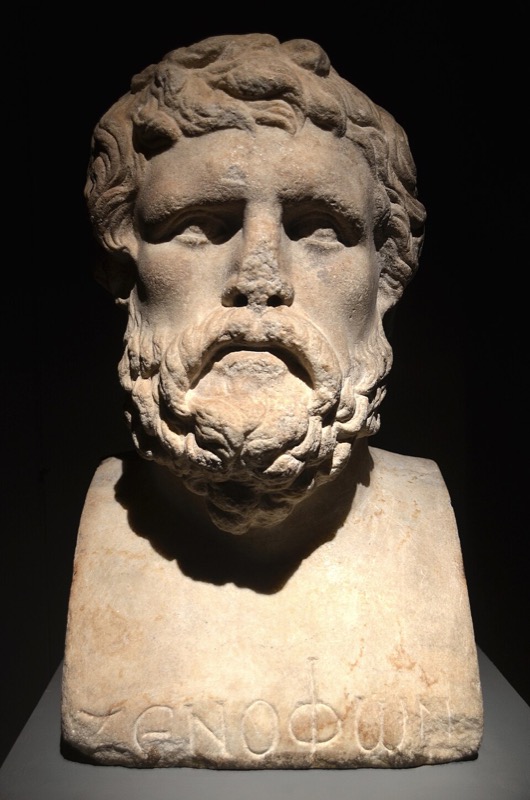

Summary
The Persian Expedition, known in Greek as the Anabasis or 'march up-country', is Xenophon's account of the campaign of 401–399 BCE in which about ten thousand Greek mercenaries followed Cyrus the Younger into Mesopotamia and then fought their way home. Cyrus, younger son of Darius II, gathers an army in Sardis on the pretext of a war against Pisidian raiders, while his real aim is to unseat his brother, King Artaxerxes II. The Greeks, led chiefly by the Spartan exile Clearchus, march through Cilicia and Syria to the Euphrates, growing suspicious and nearly mutinying before they learn the truth. At Cunaxa near Babylon the Greek line routs the Persian left, but Cyrus, charging his brother with the cry 'I see the man', wounds the king and is killed. The victorious Greeks are suddenly an army without a cause in the heart of the empire. The satrap Tissaphernes offers to escort them home, then lures Clearchus and four other generals to a parley and has them seized and later beheaded. Book II ends with Xenophon's portraits of the dead generals: the harsh disciplinarian Clearchus, the decent but soft Proxenus, and the treacherous, greedy Menon. In Book III Xenophon, who had come along as Proxenus's guest rather than as a soldier, wakes from a dream of lightning striking his father's house and rouses the officers to elect new commanders, himself among them. The army burns its wagons and moves north up the Tigris, harried by slingers and cavalry, then forces its way through the mountains of the Carduchians and across the snows of Armenia, where men die of cold, hunger-faintness, snow-blindness and frostbite. In Book IV, from Mount Theches, the vanguard sights the Black Sea and the cry 'The sea! the sea!' runs back through the column. Near Trapezus the soldiers eat wild honey and fall down vomiting and delirious, recovering after a day or two. The second half of the book is less heroic and more political. Along the Black Sea coast the army, now a wandering mercenary community, plunders, quarrels, splits into factions, and is courted and cheated by Greek colonies and Spartan officials. Xenophon dreams of founding a city, is accused of hubris for striking soldiers during the winter march, and defends himself in an army assembly. In Book VII the survivors serve the Thracian prince Seuthes, who fails to pay them, before they are finally hired by Sparta for war against the Persian satraps in Asia Minor, where Xenophon hands them over. Written decades later and partly in self-defence, the work is both a vivid campaign narrative and a study of leadership in a body of free citizens.
Plot or Argument
- Book I: The march to Cunaxa
Cyrus musters Greek and native troops at Sardis and leads them east, concealing his target. After unrest at Tarsus and the Euphrates, the battle of Cunaxa ends with Cyrus dead in his charge on Artaxerxes; the book closes with an obituary praising his generosity and justice.
- Book II: Truce and treachery
The Greeks refuse to surrender their arms, negotiate with Tissaphernes and march under his escort. At a conference Clearchus and the other generals are seized; Xenophon sketches the characters of Clearchus, Proxenus and Menon.
- Book III: Xenophon takes command
After a sleepless night and a dream, Xenophon speaks to the officers, is elected general, and reorganises the army into a hollow square with slingers and cavalry. The retreat up the Tigris begins under constant harassment; surgeons are appointed for the wounded.
- Book IV: Mountains, snow and the sea
The army fights through the Carduchian highlands, crosses the Centrites, and endures an Armenian winter of deep snow, frostbite and starvation. From Mount Theches they see the Black Sea and build a cairn; the honey of Colchis poisons hundreds before they reach Trapezus.
- Book V: Along the Black Sea
Games, raids and negotiations with Greek cities; plans to sail home stall. Xenophon's idea of founding a colony provokes suspicion, and he answers charges of striking men during the winter march, including the soldier who tried to bury a living comrade.
- Books VI–VII: Factions, Thrace and the Spartans
The army elects a single commander, then splits along regional lines and suffers disaster before reuniting. In Thrace it serves Seuthes, who withholds pay; finally Spartan officers hire the survivors for war against Tissaphernes and Pharnabazus.
Characters
- Xenophon, author, general
Young Athenian who joins as a guest and becomes a leader of the rearguard; written about in the third person.
- Cyrus the Younger, pretender to the Persian throne
Charismatic prince and satrap whose death at Cunaxa strands the Greeks; Xenophon eulogises him as the most kingly Persian since Cyrus the Great.
- Artaxerxes II, Great King of Persia
Cyrus's elder brother, wounded at Cunaxa, whose wound was treated by the Greek physician Ctesias.
- Clearchus, Spartan general
Harsh, war-loving commander respected for discipline and feared for severity; executed after Tissaphernes' treachery.
- Proxenus of Boeotia, general, Xenophon's friend
Pupil of Gorgias who invited Xenophon on the expedition; ambitious for honour but unable to inspire fear.
- Menon the Thessalian, general
Greedy, faithless commander whom Xenophon paints as the anti-type of a leader; the same Menon appears in Plato's dialogue.
- Tissaphernes, Persian satrap
Royal official who escorts the Greeks with promises, betrays their generals and harasses the retreat.
- Cheirisophus, Spartan general
Leader of the vanguard who works closely, and sometimes tensely, with Xenophon in the rear.
- Ariaeus, Cyrus's Persian lieutenant
Commander of Cyrus's native troops who abandons the Greeks and goes over to the king.
- Seuthes, Thracian prince
Hires the army for raids in Thrace and fails to pay it in full.
- Ctesias of Cnidus, court physician
Greek doctor at the Persian court, cited as the source for the king's wound and its healing.
Lessons
Authority must be rebuilt by persuasion
When the generals are seized, the army has no legal chain of command. Xenophon's response in Book III is to call the officers together, speak, and be elected. The Anabasis shows command in a citizen army as something earned through speech, example and shared hardship rather than inherited rank.
- What in Xenophon's speech after his dream wins over the officers?
- How does the army's habit of voting help and hinder it during the retreat?
Three portraits of command
The obituaries of Clearchus, Proxenus and Menon in Book II, Chapter VI form a short treatise on leadership: severity that works only in danger, kindness that cannot impose discipline, and cunning that serves only greed. Xenophon invites readers to measure his own conduct against them.
- Which of the three generals does Xenophon most resemble, and is that intentional?
- Why might Xenophon portray Menon so much more harshly than Plato does?
The body sets the limits of strategy
The winter in Armenia turns the campaign into a contest with cold, hunger and exhaustion. Xenophon distributes food to men collapsed from hunger-faintness, forces stragglers to keep moving, and learns practical remedies for snow-blindness and frostbite. Survival depends on attention to bodies as much as to enemies.
- How does Xenophon justify beating men who sat down in the snow, and is his reasoning persuasive?
- What does the honey episode reveal about the army's vulnerability in unfamiliar country?
Arriving is harder than marching
Once the sea is reached, the epic of return dissolves into squabbles over pay, plunder and leadership. The book's second half suggests that a shared external danger held the army together, and that peace, not war, exposes its fractures.
- Why does the army fall apart after the cry of 'The sea! the sea!'?
- How does Xenophon present his own wish to found a colony, and why does it arouse suspicion?
Context
The expedition followed the Peloponnesian War, which had left thousands of Greek men trained in arms and without livelihoods. Persia, which had funded Sparta's victory, was riven by dynastic rivalry between Artaxerxes II and his younger brother Cyrus, satrap in western Anatolia. The Greeks' survival in the heart of the empire, and their passage through it, was later read as proof of Persian weakness, an argument used by Isocrates and realised by Alexander the Great.
Composition
Xenophon wrote the Anabasis probably in the 370s or 360s BCE, during his exile at Scillus, decades after the events. He refers in the Hellenica to an account of the march by 'Themistogenes of Syracuse', which ancient readers took to be a pseudonym for the Anabasis itself. Another participant, Sophaenetus, may have written a rival version. The work is divided into seven books, with summaries at the start of several books that are probably later additions. H. G. Dakyns's translation was published in the 1890s as part of his complete Xenophon.
Reception
The Anabasis was read throughout antiquity; Arrian modelled the title and style of his history of Alexander on it. It became a staple of Greek teaching in modern schools because of its clear Attic prose. 'Thalatta! thalatta!' became proverbial for longed-for homecoming, echoed in Joyce's Ulysses. The story has inspired works from Heine's poem 'Thalatta' to Sol Yurick's novel The Warriors and its 1979 film adaptation, and modern historians use it as evidence for Persian provincial geography and mercenary life.
Comparisons
- the-odyssey
Both are stories of Greeks trying to get home through a hostile world, but Homer's single hero becomes, in Xenophon, ten thousand men electing their leaders, and the gods' interventions are replaced by sacrifices, omens and logistics.
- the-history-of-the-peloponnesian-war
Thucydides narrates the war that produced Xenophon's unemployed hoplites; Xenophon later continued Thucydides in the Hellenica, but in the Anabasis he writes as a participant rather than an analyst detached from events.
- the-histories
Herodotus describes the Persian empire at its height invading Greece; Xenophon's march shows a small Greek force crossing the same empire from inside, with ethnographic notes on Carduchians and Mossynoeci that recall Herodotus's interest in strange customs.
- the-conquest-of-gaul
Caesar and Xenophon both write about their own campaigns in the third person and use plain style to persuade; Caesar writes as an unquestioned commander building a career, Xenophon as an elected officer answerable to an assembly.
- the-age-of-alexander
Plutarch's Alexander crosses the same lands two generations later; the Anabasis was read as having revealed how vulnerable Persia was to a disciplined Greek army.
- seven-pillars-of-wisdom
T. E. Lawrence, who knew his classics, also narrates an irregular march through the Near East in which supply, endurance and the politics of a volunteer force matter more than set-piece battles.
Quotes
“I see the man”
“This, according to the statement of Ctesias the surgeon, who further states that he himself healed the wound.”
“what he sought after insatiably was wealth. Rule he sought after only as a stepping-stone to larger spoils”
“As soon as he was fully awake, the first clear thought which came into his head was, Why am I lying here”
“appointed eight surgeons to attend to the many wounded”
“many of the men were afflicted with "boulimia" (or hunger-faintness”
“disabled soldiers, struck down with snow-blindness or with toes mortified by frostbite”
“Presently they could hear the soldiers shouting and passing on the joyful word, "The sea! the sea”
“A small dose produced a condition not unlike violent drunkenness, a large one an attack very like a fit of madness, and some dropped down, apparently at death's door”
“on the third or fourth day got on their legs again like convalescents after a severe course of medical treatment”
“by the same token we shall all one day be dead, but that is no reason why meantime we should all be buried alive”
“sitting down and keeping quiet helped the blood to freeze and the toes to mortify”
For Students
A reading companion for classical Christian high school students. See the student guide.
Reading Guide
Watch for
- Cyrus's concealment of his real target in Book I, and the near-mutiny at Tarsus, where Clearchus first tries to force the men and then wins them over by speaking to them in assembly.
- The paired portraits at the end of Book II of the three executed generals, Clearchus, Proxenus, and Menon. Each is a lesson in a different way to fail or succeed at command.
- Xenophon's sleepless night and dream at the start of Book III, and the speech in which an Athenian who came as a guest rouses the stunned officers to choose new generals.
- The winter march across Armenia in Book IV: snow, hunger-faintness, frostbite, and men who sit down and will not rise. Watch how Xenophon treats the stragglers.
- The army assemblies of Books V-VII, especially Xenophon's defence in Book V, Chapter VIII, against the charge of striking soldiers. Notice how an army of free Greeks governs itself once it has no paymaster.
Key terms and names
- Anabasis
- The Greek title of the work, meaning the march up-country from the coast into Asia. Only Book I is truly an ascent; the rest of the book is the long retreat back to the sea.
- Cunaxa
- The battlefield near Babylon in Book I where the Greek line routs the Persian wing opposite it, but Cyrus is killed charging his brother the king. The Greeks win their part of the battle and lose the reason they came.
- The Ten Thousand
- The name later given to the Greek mercenary force that followed Cyrus. After Cunaxa it becomes a self-governing community on the move, electing generals and voting in assembly.
- Tissaphernes
- The Persian satrap who offers to escort the Greeks home, then seizes Clearchus and the other generals at a parley in Book II. His treachery is what makes Xenophon's leadership necessary.
- Hollow square
- The defensive formation Xenophon and the other new generals adopt in Book III, with baggage and camp followers inside and hoplites on all sides. It lets the army keep moving while harried by Persian cavalry and slingers.
- Carduchians
- The mountain people north of the Tigris whose country the army forces its way through in Book IV, fighting for every pass. Their arrows and rolling boulders cost the Greeks more than the Persian cavalry did.
- Mount Theches
- The mountain in Book IV, Chapter VII, from which the vanguard first sees the Black Sea. The cry runs back down the column, and the soldiers pile up a great cairn of stones.
- Boulimia
- The hunger-faintness that strikes men in the Armenian snows in Book IV, Chapter V. Xenophon finds that a little food restores them, and treats it as a practical problem of command.
Seminar Questions
- Comprehension How does Cyrus gather his army in Book I without telling the Greeks whom they are marching against, and when do they learn the truth?
- Comprehension What happens to Clearchus and the other generals at the parley with Tissaphernes in Book II?
- Comprehension What does Xenophon dream at the beginning of Book III, and what does he do as soon as he wakes?
- Interpretation Xenophon describes Clearchus as feared, Proxenus as liked but not obeyed, and Menon as greedy and faithless. Using these three portraits, what does Xenophon think a good commander must combine?
- Interpretation In Book V, Chapter VIII, Xenophon admits striking a soldier who was trying to bury a living comrade in the snow. How does he defend himself, and is his defence convincing?
- Interpretation Xenophon writes about himself in the third person and wrote the book decades after the march. How should a reader weigh his account of his own wisdom and courage?
- Interpretation Why does the army hold together through the snows of Armenia but quarrel and split apart once it reaches the Greek cities of the Black Sea coast?
- Big Question Can a body of free men in mortal danger be led by persuasion and vote, or does survival finally require one man's command?
Faith Connections
- Mark 10:42-45 (Scripture)
Jesus contrasts rulers of the Gentiles who lord it over others with the one who leads by serving. Xenophon, who commands the rearguard, helps carry the exhausted and rouses the stragglers in the snow, and answers to the soldiers' assembly, offers a pagan example of authority exercised among and for the led.
- Proverbs 11:14 (Scripture)
Where no counsel is, the people fall, but in the multitude of counsellors there is safety. The army's survival after the loss of its generals in Book II depends on Xenophon calling the officers together and on repeated assemblies where plans are argued before they are adopted.
- Hebrews 11:13-16 (Scripture)
The patriarchs confessed that they were strangers and pilgrims seeking a better country. The Ten Thousand's cry at the sight of the sea in Book IV expresses the longing of men far from home, which the epistle turns toward a homeland no march can reach.
- Augustine, City of God IV.4 (Church Fathers)
Augustine asks what kingdoms are without justice but great bands of robbers. In Books V-VII the leaderless army plunders villages, extorts Greek cities, and serves Seuthes for pay, and Xenophon's speeches to them struggle with exactly the question of what separates an army from a band of robbers.
Logic and Rhetoric
Central argument: An army stranded in enemy country survives not by numbers but by order, morale, and good leadership. The Greeks lost their generals through trusting Tissaphernes, yet the army itself remained intact as long as the men would elect new commanders, obey them, and keep discipline on the march. Leadership in such a body must win consent through speech and example, as Xenophon does in Book III, while still enforcing hard measures when lives depend on them. Therefore a free and disciplined citizen army, well led, can do what the empire around it thought impossible.
Rhetorical device: illeism (narrating oneself in the third person). Xenophon never says I in the narrative. In Book III, Chapter I, he describes himself waking from his dream with the thought, Why am I lying here, as though reporting on another man. The distance lends his own role the look of an impartial historian's judgment.
Debate: Resolved: Xenophon was justified in striking soldiers to keep the army moving during the winter march.
Memory Work
Presently they could hear the soldiers shouting and passing on the joyful word, "The sea! the sea
by the same token we shall all one day be dead, but that is no reason why meantime we should all be buried alive
Writing Prompts
Essay: Xenophon ends Book II with portraits of Clearchus, Proxenus, and Menon, and then shows himself leading the army from Book III onward. Argue which qualities of the three dead generals Xenophon claims for himself and which he avoids, using his conduct in the Carduchian mountains, the Armenian snows, and the army assemblies.
Comparison with The Odyssey: The Odyssey and The Persian Expedition both tell of Greeks trying to get home through a hostile world, but Homer's single hero loses every companion while Xenophon brings thousands of men to the sea by election, assembly, and logistics. Compare Odysseus's leadership of his crew with Xenophon's leadership of the army, and argue which work offers the truer picture of what it takes to bring men home.
Medical Lens
The Anabasis is a rare ancient eyewitness record of the medical side of a long campaign. It names the Cnidian physician Ctesias treating the Persian king's wound, mentions eight surgeons appointed for the wounded, and describes cold injury in practical detail: snow-blindness eased by dark cloth before the eyes, frostbitten feet made worse by sandals frozen to them, and 'boulimia' (hunger-faintness) reversed by food. The honey episode at Trapezus is the classic early description of 'mad honey' poisoning, now attributed to grayanotoxins in rhododendron nectar; the vomiting, diarrhoea, ataxia, delirium and recovery within about a day match modern case reports. Xenophon's sleepless night and prophetic dreams show how decision-making under extreme stress was framed through divination. His trial for striking soldiers raises questions of triage and abandonment that still trouble military medicine.
- Book I, Chapter VIII
At Cunaxa Cyrus wounds Artaxerxes through his corselet; Ctesias the physician states he healed the wound. Cyrus is struck under the eye by a javelin and killed.
- Book III, Chapter I
Xenophon's distress, insomnia and dream of lightning striking his father's house, which he interprets as both promise and warning before taking command.
- Book III, Chapter IV
Eight surgeons are appointed; the army halts three days for its many wounded, and so many men are carrying the wounded that marching and fighting become impossible together.
- Book IV, Chapter V
The Armenian snows: deep drifts, a north wind, men dying overnight without fire or food, hunger-faintness, snow-blindness and frostbitten toes, with practical remedies.
- Book IV, Chapter VIII
Mass poisoning by wild honey: dose-dependent intoxication, vomiting, diarrhoea, inability to stand, delirium and collapse, with recovery after a day and convalescence over three to four days.
- Book V, Chapter VIII
Xenophon's defence at the army's audit: he struck men who left the disabled behind or tried to bury a living comrade, and forced stragglers to keep moving to prevent freezing.
Creative Prompts
- Fiction
Tell the honey episode at Trapezus from the point of view of a hoplite who ate a large dose: the sweetness, the vertigo, the night lying among hundreds of stricken men, and the strange recovery at the same hour the next day.
- Dialogue
Write the conversation at the Persian court between Ctesias of Cnidus and Artaxerxes as the physician dresses the wound Cyrus gave him, with both knowing Greek mercenaries are still camped nearby.
- Essay
Compare Xenophon's methods for cold injury and hunger-faintness in Book IV with modern guidance on frostbite and hypoglycaemia. What did experience teach correctly, and what did it miss?
- Classroom
Hold the Book V audit as a class trial: students prosecute and defend Xenophon for striking soldiers, using his own account of the winter march as evidence.
Further Reading
- The Long March: Xenophon and the Ten Thousand, Robin Lane Fox (ed.)
- Xenophon's Anabasis, or The Expedition of Cyrus, Michael A. Flower
- The Sea! The Sea!: The Shout of the Ten Thousand in the Modern Imagination, Tim Rood
Reception history of the march and its famous cry.
- Memorabilia, Xenophon
Xenophon's recollections of Socrates, who advised him to consult Delphi before joining Cyrus.
- The Warriors, Sol Yurick
1965 novel transposing the Anabasis to New York street gangs.
Verification notes
Narrative structure, characters and the main episodes are well established. All quotes were checked against the stored Dakyns translation (Project Gutenberg #1170); the footnote marker after 'Ctesias the surgeon' has been removed from the quote. Chapter divisions follow the standard book/chapter numbering; Dakyns's text marks book divisions clearly but chapter numbers should be checked against a reference edition. The grayanotoxin explanation of the honey episode is modern scholarship, not Xenophon's.
- Chapter numbers within books (e.g. honey episode IV.8, sea sighted IV.7, trial V.8) against a standard edition.
- Date of composition (370s versus 360s BCE) is debated.