Work record
The Odyssey
c. 8th century BCE · Ancient · Epic · Ancient Greek
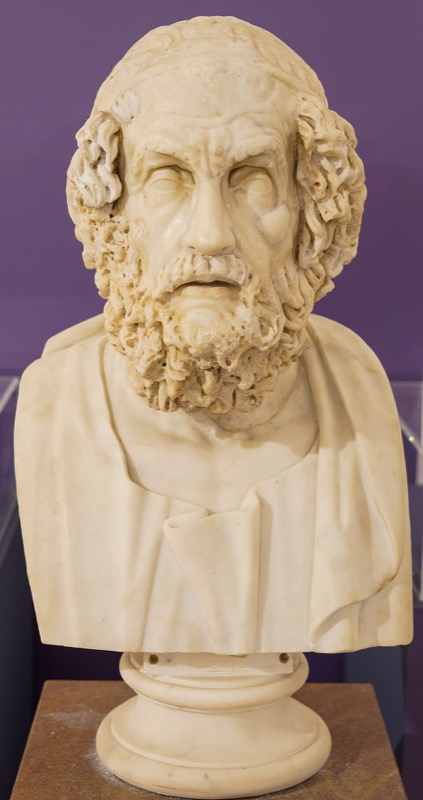
.jpg)
Summary
The Odyssey tells the story of Odysseus's long return from Troy to Ithaca and of the household that must survive his absence. The poem opens not with Odysseus but with disorder: his son Telemachus is growing up under the pressure of suitors who consume the estate and demand that Penelope choose a new husband. Athena prompts Telemachus to seek news of his father from Nestor and Menelaus, turning the son's search into a coming-of-age journey. Odysseus meanwhile is detained by the nymph Calypso. When the gods order his release, he sails away, is wrecked by Poseidon, and reaches the Phaeacians, where he narrates his wanderings. His account moves through the Cicones, Lotus-Eaters, the Cyclops Polyphemus, Aeolus's winds, the Laestrygonians, Circe's island, the underworld, the Sirens, Scylla and Charybdis, the cattle of Helios and shipwreck. These adventures test appetite, curiosity, leadership and the boundary between human and monstrous worlds. The second half returns Odysseus to Ithaca in disguise. With Athena's help he tests servants, reunites secretly with Telemachus, endures insults from the suitors and reveals himself only when the moment is ripe. The bow contest exposes his identity; he and his allies slaughter the suitors, punish disloyal servants and reunite with Penelope through the private sign of their rooted marriage bed. The poem closes by containing civil conflict, as the suitors' families seek revenge and Athena enforces peace. The Odyssey is a poem about intelligence under pressure: not only clever tricks, but timing, endurance, self-control, storytelling and recognition. It is also a poem about damaged veterans, aging parents, servants who remember, strangers who need care and a marriage tested by time. Its medical lens includes wounds, sleep, grief, trauma after war, drugs and antidotes, caregiving, aging, death ritual and the ancient idea that song, hospitality and memory can treat a wounded social body.
Plot or Argument
- Books 1-4: Telemachus searches
Athena visits Ithaca and moves Telemachus to resist the suitors and seek news from Nestor and Menelaus. The journey begins his transition from helpless son to active heir.
- Books 5-8: Odysseus reaches the Phaeacians
Calypso releases Odysseus, Poseidon wrecks him, and Nausicaa helps him reach the Phaeacian court. Songs of Troy provoke his tears and prepare his self-revelation.
- Books 9-12: The wanderings
Odysseus narrates encounters with the Cicones, Lotus-Eaters, Cyclops, Aeolus, Laestrygonians, Circe, the dead, Sirens, Scylla and Charybdis, and the cattle of Helios.
- Books 13-16: Return in disguise
The Phaeacians bring Odysseus to Ithaca. Athena disguises him as a beggar, and he meets Eumaeus before revealing himself to Telemachus.
- Books 17-20: Testing the house
Odysseus enters his palace in disguise, observes the suitors, is recognized by Argos and Eurycleia, and prepares vengeance while Penelope tests possibilities.
- Books 21-22: The bow and slaughter
Penelope sets the bow contest. Odysseus strings the bow, reveals himself and kills the suitors with Telemachus and loyal servants.
- Books 23-24: Recognition and settlement
Penelope verifies Odysseus through the secret of the bed. The suitors' kin seek revenge, but Athena imposes peace.
Characters
- Odysseus, hero and wanderer
King of Ithaca, famed for cunning, endurance and storytelling, struggling to return from war to household order.
- Penelope, queen of Ithaca
Odysseus's wife, who delays remarriage through intelligence, weaving and testing.
- Telemachus, son of Odysseus
A young man growing from passive heir into participant in his father's return and revenge.
- Athena, divine patron
Goddess who protects Odysseus and Telemachus through disguise, counsel and force.
- Poseidon, divine antagonist
God of the sea, hostile to Odysseus because of the blinding of Polyphemus.
- Calypso, nymph
Immortal who keeps Odysseus on Ogygia and offers him deathless ease without homecoming.
- Circe, enchantress
Goddess who transforms Odysseus's men and later instructs him about the underworld and dangers ahead.
- Polyphemus, Cyclops
One-eyed son of Poseidon, blinded by Odysseus after murdering and eating several of his men.
- Eumaeus, swineherd
Loyal servant who shelters the disguised Odysseus and helps restore the household.
- Antinous, leading suitor
Arrogant and violent suitor who embodies the predatory disorder in Odysseus's house.
Lessons
Homecoming requires more than arrival
Odysseus reaches Ithaca long before he can reclaim his name, wife and authority. The poem teaches that return after violence demands recognition, testing and the repair of social bonds.
- Why must Odysseus return in disguise?
- What does Penelope need to know before accepting him?
- Does the slaughter restore home or damage it further?
Intelligence includes restraint
Odysseus survives because he can invent names, stories and tactics, but his boast to Polyphemus shows cunning undone by pride. The poem admires cleverness most when it is joined to timing and self-command.
- Where does Odysseus's intelligence fail him?
- How do Penelope and Odysseus mirror one another?
Hospitality is a moral diagnostic
The poem repeatedly judges societies by their treatment of strangers. Good hosts restore identity and safety; bad hosts devour guests, drug them, trap them or consume their goods.
- Which hosts best reveal the poem's ethics?
- How do the suitors violate hospitality from inside the home?
Storytelling heals and endangers
Odysseus's narratives win aid and preserve memory, yet stories can also conceal, manipulate and defer accountability. The poem asks readers to value narrative skill while watching its moral risks.
- When is Odysseus most truthful?
- Do the Phaeacians help him because of who he is or because of how he tells his story?
Context
The Odyssey emerged from archaic Greek oral epic traditions shaped by performance, formulaic diction and mythic memory of the Bronze Age. Its world combines heroic aristocracy, seafaring trade, household economy, sacrifice, gift exchange and divine intervention.
Composition
The poem was probably composed in something like its surviving form in the late eighth or early seventh century BCE, using inherited oral materials. It is written in dactylic hexameter and closely linked to, but tonally distinct from, the Iliad.
Reception
The Odyssey became foundational for Greek education and later European literature. Its scenes of wandering, temptation, descent, disguise and recognition have shaped epic, novel, drama, psychoanalysis, modernism and postcolonial rewriting.
Comparisons
- the-iliad
The Iliad centers wrath and battlefield mortality; the Odyssey asks how a warrior returns from that world to household, marriage and civil order.
- the-nibelungenlied
Both are heroic epics, but Odysseus survives by flexibility and disguise while the Burgundian heroes die through rigid honor.
- don-quixote
Both works define later narrative through wandering episodes, embedded stories and the tension between heroic imagination and social reality.
- The Aeneid (Virgil)
Virgil's epic, outside this manifest, adapts Odyssean wandering into a Roman poem of destiny, exile and empire.
- treasure-island
Stevenson's adventure inherits the sea voyage, testing of youth and moralized danger, though without Homer's divine machinery.
Quotes
Frequently cited
“Tell me, O Muse, of that ingenious hero who travelled far and wide after he had sacked the famous town of Troy”
Frequently cited
“my name is Noman”
“Hold your peace, my good fellow, and do not be so foolish as to provoke this savage creature further.”
For Students
A reading companion for classical Christian high school students. See the student guide.
Reading Guide
Watch for
- The poem opens in Books 1-4 with Telemachus, not Odysseus. Notice what the suitors' feasting does to the house and how the son changes between the assembly in Ithaca and his visits to Nestor and Menelaus.
- Hospitality scenes: Nestor at Pylos, Menelaus at Sparta, Alcinous and Nausicaa among the Phaeacians, Eumaeus in his hut, and the suitors in the palace. Ask in each case how the stranger is received, and compare the Cyclops in Book 9.
- Books 9-12 are told by Odysseus himself at the Phaeacian court. Watch how he shapes the story of his own wanderings, and where his cleverness saves his men and where his pride costs them.
- The series of recognitions in Ithaca: Telemachus in Book 16, the old dog Argos in Book 17, Eurycleia and the scar in Book 19, the bow in Book 21, and Penelope's test of the bed in Book 23. Each one requires a different kind of proof.
- Calypso's offer of deathless life on Ogygia in Book 5, and Odysseus's choice to leave for an aging wife and a rocky island. Set it beside the Lotus-Eaters and the Sirens, which also tempt him to stop going home.
Key terms and names
- Xenia (guest-friendship)
- The sacred Greek custom of receiving strangers with food, bath, gifts, and safe conduct before asking their names. The suitors and Polyphemus violate it; Eumaeus and the Phaeacians keep it, and the poem's justice turns on the difference.
- Ithaca
- Odysseus's small, rocky island kingdom, which he prefers to Calypso's paradise. Its disorder under the suitors in Books 1-4 is the problem the whole poem must solve.
- Noman
- The false name Odysseus gives Polyphemus in Book 9. When the blinded Cyclops cries that Noman is killing him, his neighbors go home, but Odysseus later shouts his real name and so brings Poseidon's anger on himself.
- Phaeacians
- The seafaring people of Scheria ruled by Alcinous and Arete, whose princess Nausicaa finds the shipwrecked Odysseus in Book 6. At their court he weeps at the bard Demodocus's song of Troy and then tells his own story.
- The bow of Odysseus
- The great bow Penelope sets as the test in Book 21: whoever strings it and shoots through twelve axes may marry her. None of the suitors can string it, and the beggar does it with ease.
- The marriage bed
- The bed Odysseus built around the trunk of a living olive tree, so that it cannot be moved. In Book 23 Penelope tests him by ordering it moved, and his angry answer proves who he is.
- Eumaeus
- The loyal swineherd who shelters the disguised Odysseus in Books 14-16 without knowing him. His humble hut is the first true household Odysseus finds on Ithaca.
Seminar Questions
- Comprehension What are the suitors doing in Odysseus's house in Book 1, and what does Athena, disguised as Mentes, urge Telemachus to do about it?
- Comprehension How does Odysseus escape the cave of Polyphemus in Book 9, and what mistake does he make as he sails away?
- Comprehension What test does Penelope set in Book 23 before she will accept Odysseus as her husband, and why does it work?
- Interpretation Why does Homer spend the first four books on Telemachus rather than beginning with Odysseus himself?
- Interpretation Penelope weaves and unweaves Laertes' shroud, tests the stranger, and sets the bow contest. Is she as cunning as Odysseus, and what in the text supports your answer?
- Interpretation Odysseus refuses Calypso's offer of immortality in Book 5. What does his choice reveal about what makes a human life worth living in this poem?
- Interpretation Odysseus tells the tale of his own wanderings in Books 9-12. Can we trust him as a narrator, given how often he lies elsewhere in the poem?
- Big Question The slaughter of the suitors and the hanging of the disloyal maids in Book 22 restore order to Ithaca, and Athena must stop the cycle of revenge in Book 24. Is the justice of the poem's ending complete, or does it need Athena's intervention to be just at all?
Faith Connections
- Hebrews 13:2 (Scripture)
The writer urges hospitality to strangers, since some have entertained angels unawares. In the Odyssey gods walk among men in disguise, as Athena does in Book 1, and the suitors abuse a beggar who is in fact their king.
- Matthew 25:31-46 (Scripture)
Christ judges the nations by how they treated the hungry stranger, saying that what was done to the least was done to him. Eumaeus feeding the ragged guest in Book 14 and Antinous throwing a stool at him in Book 17 are judged by the same measure when the master is revealed.
- Clement of Alexandria, Exhortation to the Greeks (Protrepticus), ch. 12 (Church Fathers)
Clement tells his readers to sail past the Sirens' song of pagan custom as Odysseus did, bound to the wood, which for Christians is the cross. The early Church read Book 12 as a picture of the soul passing temptation by being fastened to something stronger than its own will.
- Basil the Great, Address to Young Men on Greek Literature (Great Conversation)
Basil holds up the shipwrecked Odysseus before the Phaeacians as an example of virtue honored even when a man stands naked and destitute. His essay defends reading Homer for what it teaches about character, which is how the Odyssey entered Christian education.
Logic and Rhetoric
Central argument: A household and a kingdom depend on the return of their rightful head, and the man fit to return is one who masters appetite, endures suffering, and knows when to hide and when to act. Odysseus's men perish because they cannot restrain their hunger, as with the cattle of Helios; the suitors perish because they violate hospitality in another man's house. Odysseus survives because he chooses home over ease and waits for the right moment. Therefore intelligence joined to endurance and loyalty restores order, though the gods must still set a limit to vengeance.
Rhetorical device: paronomasia (pun on a name). In Book 9 Odysseus tells Polyphemus, my name is Noman. When the blinded Cyclops shouts that Noman is hurting him, the other Cyclopes hear that no one is hurting him and leave. The pun saves the men, and Odysseus's later boast of his true name undoes the protection it gave.
Debate: Resolved: Odysseus is responsible for the deaths of his crew.
Memory Work
Tell me, O Muse, of that ingenious hero who travelled far and wide after he had sacked the famous town of Troy
my name is Noman
Writing Prompts
Essay: Compare three hosts in the Odyssey, chosen from Nestor, Menelaus, Alcinous, Eumaeus, Polyphemus, and the suitors. Argue what the poem teaches about the duties of host and guest, and show how those duties explain the violence of Book 22.
Comparison with The Aeneid: Both Odysseus at the Phaeacian court and Aeneas at Dido's court in Carthage tell the story of their own wanderings to a foreign ruler, and both must leave a woman who wants them to stay. Compare Odysseus's departure from Calypso with Aeneas's departure from Dido, and argue what each departure shows about the duty that draws the hero onward.
Medical Lens
The Odyssey is rich for ancient medicine broadly construed: wounds are washed and dressed, sleep is a divine and physiological force, drugs can erase grief or transform perception, and return from war entails psychic and social reintegration. Helen's grief-dissolving drug, the lotus, Circe's potion and Hermes' moly belong to a preclinical pharmacological imagination in which substances alter memory, desire and agency. Odysseus's repeated tears, startle-like caution and concealment can be discussed as trauma readings only with care, since Homeric grief and heroic endurance use cultural categories different from modern PTSD.
- Book 4
Helen mixes a drug into wine that suppresses grief and anger, a striking ancient fantasy of pharmacological emotional control.
- Book 5
Odysseus is shipwrecked, battered and washed ashore exhausted, showing exposure, pain and recovery at the edge of death.
- Book 9
The Lotus-Eaters offer a plant that dissolves the will to return, making appetite and drugged forgetting enemies of homecoming.
- Book 10
Circe's potion transforms men into swine; Hermes provides moly as protective antidote before Odysseus confronts her.
- Book 11
The underworld journey stages grief, memory, sacrificial blood and conversation with the dead.
- Books 19 and 23
Odysseus's scar is recognized by Eurycleia, and the marriage bed confirms identity, joining wound memory to bodily recognition.
Creative Prompts
- Fiction
Write Eurycleia's recognition of Odysseus's scar as a scene about the body remembering what speech conceals.
- Essay
Compare Helen's grief-dissolving drug with modern hopes and fears around medication that changes emotional memory.
- Dialogue
Stage Penelope and Athena debating whether disguise is wisdom, cruelty or necessary medicine for a damaged house.
Further Reading
- The Iliad, Homer
- The World of Odysseus, M. I. Finley
- The Singer of Tales, Albert B. Lord
- The Return of Ulysses, Edith Hall
- The Greeks and the Irrational, E. R. Dodds
Verification notes
Plot, themes and medical passages are standard. Butler quotations are included only where wording is familiar, but should still be checked against the 1900 text for punctuation and capitalization.
- Exact Butler wording and punctuation of the Book 1 invocation and Book 9 Noman exchange.
- Whether the reference edition's book divisions or line references should be added to locators.
- Best public-domain translation label if the site standardizes Odyssey quotations away from Butler.