Work record
The Complete Poems
1855–1892 · 19th Century · Poetry · English
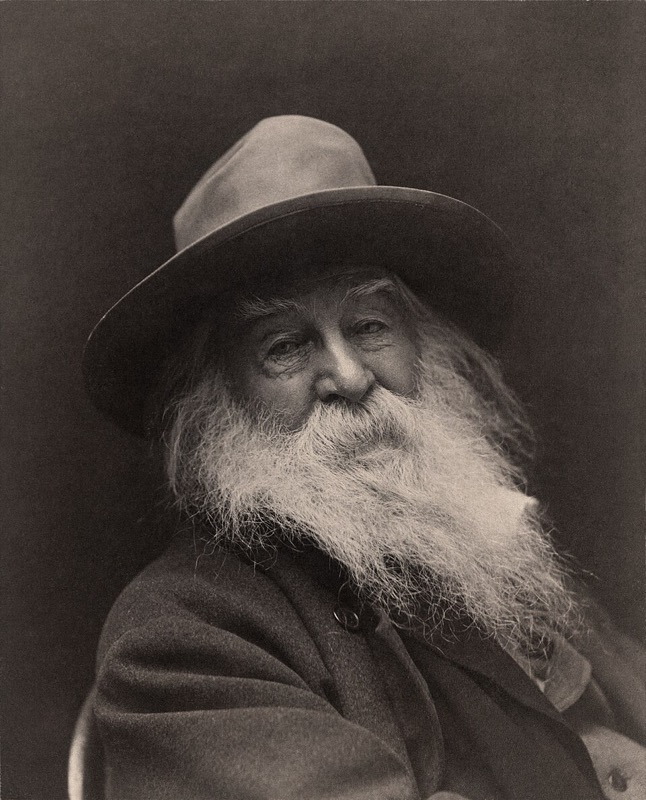

Summary
The Complete Poems of Walt Whitman gathers the evolving work of a poet who made the self expansive enough to contain a democracy. The center is Leaves of Grass, first published in 1855 and revised across multiple editions until Whitman's death. In poems such as Song of Myself, I Sing the Body Electric, Crossing Brooklyn Ferry, Out of the Cradle Endlessly Rocking, the Calamus cluster, Drum-Taps and When Lilacs Last in the Dooryard Bloom'd, Whitman invents a poetic voice that is intimate, public, bodily, mystical and catalogic. He writes the self not as private enclosure but as porous contact: with workers, lovers, strangers, enslaved people, soldiers, the dead, cities, animals, plants and cosmic processes. The poems celebrate the body with unprecedented frankness, including sexuality, touch, sweat, breath, labor and comradeship. They also confront death, especially through the Civil War poems shaped by Whitman's hospital visits in Washington, D.C., where he nursed and comforted wounded soldiers. Whitman's poetry can be exuberant, egotistical, tender, prophetic and uneven. Its democratic ambition sometimes strains against its historical limits, especially around race, empire and gender. Yet its achievement is immense: it remade poetic line, address and subject matter. The lifelong revisions also show a poet repeatedly reimagining his public body and national voice. His catalogues attempt to include the nation by naming its occupations, regions, bodies and desires. The poems move from swaggering self-announcement to elegy, comradeship, old age and cosmic absorption. They also insist that poetry can touch public life without abandoning intimacy. For a medical lens, Whitman is central. He writes bodies as sacred, wounded, erotic, aging and dying; he records nursing care, amputation-era war medicine, grief, infection, convalescence, touch as comfort, and the relation between physical and spiritual health. His poetry is one of the great literary archives of nineteenth-century democratic embodiment.
Plot or Argument
- 1855 breakthrough
The first Leaves of Grass introduces Whitman's long line, self-mythologizing speaker and radical celebration of body and democracy.
- Song of Myself and bodily democracy
Whitman's major early poem expands the self through catalogues of people, labor, sexuality, nature and cosmic identification.
- Calamus and comradeship
The Calamus poems explore male affection, adhesiveness, public democracy and private longing.
- Sea, memory and mourning
Poems such as Out of the Cradle Endlessly Rocking turn loss, sound and nature into poetic vocation.
- Drum-Taps and Civil War care
The war poems move from martial excitement to hospital witness, nursing, deathbeds and national grief.
- Late poems
The later work reflects aging, fame, illness, memory, spirituality and the ongoing revision of Leaves of Grass.
Lessons
The body can be democratic scripture
Whitman makes ordinary bodies worthy of poetic reverence. His work teaches that democracy is not only a political idea but a way of seeing bodies without contempt.
- How does Whitman connect body and soul?
- Where does his democratic vision feel most expansive?
- Where are its limits?
Care is a form of attention
The Civil War poems and hospital writings show nursing as presence, touch, witnessing and small acts of comfort. Whitman makes care poetic without sanitizing wounds.
- How does the war change Whitman's voice?
- What kinds of care can poetry record?
The self can be plural
Whitman's speaker absorbs contradiction, multiplicity and relation. The poems challenge narrow ideas of identity by making selfhood a meeting place.
- Is Whitman's 'I' personal, national, cosmic or theatrical?
- When does expansiveness become appropriation?
Mourning can become public song
Whitman's elegies transform private and national grief into ritual language. He teaches that poetry can hold loss without closing it.
- How does Whitman mourn Lincoln without writing only biography?
- What images make grief communal?
Context
Whitman's career spans antebellum reform, slavery crisis, the Civil War, Reconstruction and the rise of modern American mass democracy. His poetry responds to journalism, oratory, opera, urban growth, westward expansion and new ideas of sexuality and the body.
Composition
Leaves of Grass first appeared in 1855 and was revised repeatedly in 1856, 1860, 1867, 1871-72, 1881-82 and the 1891-92 deathbed edition. The Complete Poems gathers this lifelong process of expansion and revision.
Reception
Whitman was controversial for sexual frankness and unconventional form, admired by Emerson and attacked by many reviewers. He later became a central figure in American and world poetry, claimed by democratic, queer, modernist and nationalist traditions.
Comparisons
- twenty-love-poems-and-a-song-of-despair
Neruda inherits a Whitmanian expansiveness of body and world, though his early love poems are more erotically focused and melancholic.
- testament-of-youth
Brittain and Whitman both write war through bodies, nursing and grief, from different wars and genders of witness.
- the-bhagavad-gita
Both imagine the self in cosmic relation, though Whitman's mystical democracy differs from the Gita's theology of disciplined action.
- the-waves
Woolf and Whitman both stretch individual voice toward plurality, rhythm and the impersonal life of nature.
Quotes
Frequently cited
“I celebrate myself, and sing myself, And what I assume you shall assume, For every atom belonging to me as good belongs to you”
Frequently cited
“Do I contradict myself? Very well then I contradict myself, (I am large, I contain multitudes”
Frequently cited
“I sound my barbaric yawp over the roofs of the world”
For Students
A reading companion for classical Christian high school students. See the student guide.
Reading Guide
Watch for
- Song of Myself, section 6, where a child brings the speaker a handful of grass and asks what it is, and the speaker answers with guesses, the flag of his disposition, the handkerchief of the Lord, the uncut hair of graves.
- The long catalogues of Song of Myself, such as section 15, where line after line presents a new American at work, and the speaker claims all of them as part of himself.
- Crossing Brooklyn Ferry, where the speaker on the ferry addresses people who will make the same crossing generations later and insists that years and distance make no difference between him and them.
- The hospital poems of Drum-Taps, especially The Wound-Dresser and A Sight in Camp in the Daybreak Gray and Dim, where the third dead soldier's face reminds the speaker of the face of Christ.
- When Lilacs Last in the Dooryard Bloom'd, Whitman's elegy for Lincoln, built on three symbols, the lilac, the western star, and the singing hermit thrush, and on the train carrying the coffin across the country.
Key terms and names
- Leaves of Grass
- The single book Whitman published in 1855 and kept enlarging and revising until 1892. The Complete Poems is essentially its final form, with poems moved, retitled, and regrouped across his life.
- Catalogue
- Whitman's signature technique of long lists of people, places, trades, and things, each given a line. The catalogues try to make the poem as large and various as the nation it describes.
- Free verse
- Poetry without regular meter or rhyme. Whitman builds his long lines instead from repetition, parallel structure, and the rhythms of oratory and the King James Bible.
- Drum-Taps
- The cluster of Civil War poems Whitman published in 1865. It moves from the excitement of recruiting to the hospitals of Washington, where Whitman spent years visiting and nursing wounded soldiers.
- Calamus
- A cluster of poems named for a marsh plant, about friendship and affection between men, which Whitman called adhesiveness. He presents such comradeship as the bond that could hold a democracy together.
- The hermit thrush
- The shy bird singing in the swamp in When Lilacs Last in the Dooryard Bloom'd. Its song becomes the poem's carol of death, the voice through which the speaker can finally accept loss.
- The barbaric yawp
- Whitman's phrase near the close of Song of Myself for his own untamed poetic cry. It names his deliberate break with polished European verse in favor of a rough, American voice.
Seminar Questions
- Comprehension In section 6 of Song of Myself, what answers does the speaker give to the child's question about the grass?
- Comprehension In The Wound-Dresser, what does the old speaker remember doing as he moves through the hospital wards?
- Comprehension What are the three central symbols of When Lilacs Last in the Dooryard Bloom'd, and how is each one connected to Lincoln?
- Interpretation In section 1 Whitman claims that every atom belonging to him belongs to the reader as well. Is this generosity, presumption, or a theory of what a poem does?
- Interpretation In A Sight in Camp in the Daybreak Gray and Dim, why does the third soldier's face recall Christ, and how does that comparison change the way the reader sees the other two?
- Interpretation In section 51 the speaker cheerfully admits that he contradicts himself. Is this an evasion of criticism, or a serious claim about the self?
- Interpretation How does the voice of the hospital poems in Drum-Taps differ from the confident voice of Song of Myself, and what seems to have caused the change?
- Big Question Whitman treats the body as holy and death as part of a continuing life. How does his vision agree with, and differ from, the Christian teaching that the body is a temple and will be raised?
Faith Connections
- 1 Corinthians 15:35-44 (Scripture)
Paul answers the question of how the dead are raised with the image of a seed sown in the ground. Whitman's grass growing from graves in section 6 of Song of Myself uses a similar image of life from burial, but without Paul's distinction between the natural and the spiritual body.
- Matthew 25:35-40 (Scripture)
Christ says that whatever is done for the sick and the stranger is done for him. The Wound-Dresser and A Sight in Camp, where a dead soldier's face looks like Christ's, come close to Christ's own identification with the suffering.
- 1 Corinthians 6:19-20 (Scripture)
Paul calls the body a temple of the Holy Spirit, bought with a price. Whitman's I Sing the Body Electric also treats the body as sacred, though for Whitman its holiness belongs to it by nature rather than by indwelling and redemption.
- Francis of Assisi, The Canticle of the Creatures (Great Conversation)
Francis praises God for Brother Sun, Sister Moon, and at the end for Sister Bodily Death. The carol of death sung by the hermit thrush in When Lilacs Last in the Dooryard Bloom'd also welcomes death as a sister to all creatures, which makes the comparison an exact test of how Whitman's mysticism differs from Francis's faith.
Logic and Rhetoric
Central argument: Every person, in body as well as soul, is worthy of celebration. What the poet is, every reader is, since the same atoms and the same life run through all. Therefore the poet may speak for workers, soldiers, the sick, and the dead, and democracy is the political form of this shared worth. The Civil War poems test the claim against wounds and deathbeds, and Whitman's answer is care: a self large enough to contain multitudes must also dress their wounds and mourn their dead.
Rhetorical device: anaphora. The catalogues of Song of Myself, as in section 15, begin line after line with the same grammatical pattern, a new figure followed by a present-tense action. The repeated openings give the sense of a crowd passing in procession and make the list itself an argument that every life deserves a line.
Debate: Resolved: Whitman's claim to speak for all Americans enlarges his readers more than it overrides them.
Memory Work
I celebrate myself, and sing myself, And what I assume you shall assume, For every atom belonging to me as good belongs to you
Do I contradict myself? Very well then I contradict myself, (I am large, I contain multitudes
Writing Prompts
Essay: Compare the speaker of Song of Myself with the speaker of The Wound-Dresser. Argue whether the hospital wards deepened the vision of body and self announced in 1855 or turned Whitman toward a different vision altogether.
Comparison with Sermons and Devotions upon Emergent Occasions: Donne in his Devotions upon Emergent Occasions and Whitman in his hospital poems both write from beside a sickbed and both insist that no one suffers or dies alone. Compare how each grounds that conviction, Donne in the Church and the body of Christ, Whitman in a democratic and cosmic self, and argue which account better explains the obligation to care for the dying.
Medical Lens
Whitman is essential for literature and medicine. His Civil War hospital work produced poems and prose attentive to wounds, amputations, infection, dying soldiers, touch and bedside presence. His broader poetics sacralize the body, sexuality and mind-body continuity. Late poems add aging and illness. The medical lens should combine Whitman's actual caregiving with his poetic theory of embodiment.
- Song of Myself
The speaker's celebration of bodies, breath, touch, labor and sexuality makes embodiment central to democratic vision.
- I Sing the Body Electric
The poem treats the human body as spiritually charged and socially meaningful.
- Drum-Taps
The Civil War poems move through camps, hospitals, wounds, deathbeds and nursing care.
- When Lilacs Last in the Dooryard Bloom'd
Whitman's Lincoln elegy turns national mourning into ritualized grief and meditation on death.
- Late poems
Whitman's later work reflects aging, bodily limitation and spiritual persistence.
Creative Prompts
- Essay
Analyze Whitman's hospital poems as a poetics of nursing presence.
- Poetry
Write a Whitmanian catalogue of a modern hospital shift without making suffering decorative.
- Classroom
Ask students to compare Whitman's celebratory body poems with his wounded-body war poems.
Further Reading
- Specimen Days, Walt Whitman
- Walt Whitman's America, David S. Reynolds
- Walt Whitman: The Song of Himself, Jerome Loving
- Memoranda During the War, Walt Whitman
Verification notes
Major works, revision history and medical relevance are secure. Quotes omitted pending exact edition choice because Whitman revised poems across editions.
- Which Leaves of Grass edition the Complete Poems edition uses for lineation and titles.
- Exact locators for hospital poems if adding quotations.