Work record
The Iliad
c. 8th century BCE · Ancient · Epic · Ancient Greek
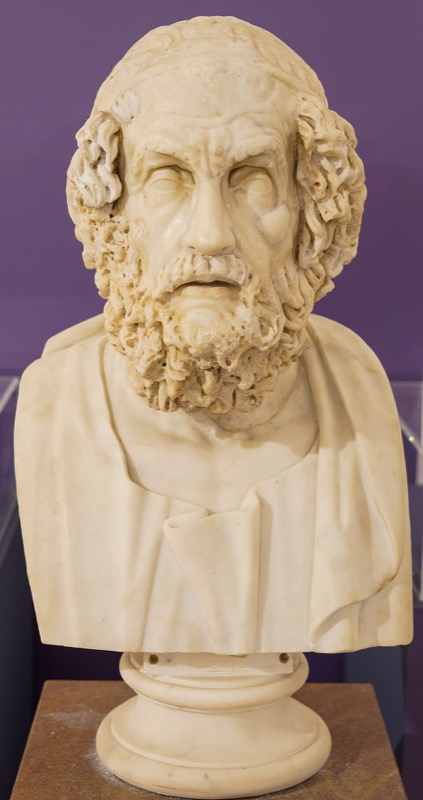
.jpg)
Summary
The Iliad tells of a few weeks in the tenth year of the Greek siege of Troy, and its subject, announced in the first line, is the wrath of Achilles. A plague sent by Apollo ravages the Greek camp because Agamemnon, commander of the Achaeans, has refused to return the captive daughter of Apollo's priest Chryses. Forced to give her up, Agamemnon takes Achilles' prize, the captive woman Briseis, in compensation. Achilles, the greatest Greek warrior, withdraws from battle and asks his mother, the sea-goddess Thetis, to persuade Zeus to give the Trojans victory until the Greeks recognize his worth. Zeus agrees. The battles that follow fill most of the poem. Paris and Menelaus fight a duel for Helen that is broken off by divine intervention; the truce is broken; Diomedes rampages, even wounding Aphrodite and Ares. Hector, Troy's greatest defender, returns to the city and takes leave of his wife Andromache and infant son Astyanax in one of the most moving scenes in literature. As the Trojans drive the Greeks back to their ships, Agamemnon sends an embassy offering Achilles rich gifts, but Achilles refuses. Odysseus and Diomedes make a night raid. Agamemnon, Diomedes, Odysseus and the healer Machaon are wounded, and Patroclus, Achilles' beloved companion, tends the wounded Eurypylus. Hera seduces Zeus to distract him, and the Trojans breach the Greek wall and fire a ship. Patroclus persuades Achilles to let him fight in Achilles' armour; he drives the Trojans back but, after killing Zeus' son Sarpedon, he is struck by Apollo and killed by Hector, who strips the armour. Achilles' grief is overwhelming. Thetis obtains new armour forged by Hephaestus, whose shield depicts the whole world of peace and war. Achilles reconciles with Agamemnon, refuses food, and returns to battle in a frenzy, slaughtering Trojans and fighting the river Scamander itself. He kills Hector before the walls of Troy, while Hector's parents watch, and drags his body behind his chariot. He holds magnificent funeral games for Patroclus. Finally, guided by Hermes, old King Priam comes by night to Achilles' tent to ransom his son's body. The two enemies weep together, Achilles for his father and Patroclus, Priam for Hector. Achilles returns the body, and the poem ends with the Trojan laments and Hector's funeral.
Plot or Argument
- Books 1–2: the quarrel
Apollo's plague, the quarrel over Briseis, Achilles' withdrawal, Zeus' promise, and the catalogue of ships.
- Books 3–7: battle and Hector in Troy
Paris and Menelaus' duel, the broken truce, Diomedes' exploits, and Hector's farewell to Andromache.
- Books 8–10: the embassy
The Trojans gain the upper hand; Achilles refuses Agamemnon's offer; the night raid.
- Books 11–15: the Greeks in retreat
The Greek leaders are wounded, the wall is breached, Hera deceives Zeus, and the ships are threatened.
- Books 16–17: Patroclus
Patroclus fights in Achilles' armour, kills Sarpedon, and is killed by Hector.
- Books 18–22: Achilles' return
Achilles' grief, the shield, reconciliation, his rampage and the death of Hector.
- Books 23–24: funeral and ransom
The funeral games for Patroclus; Priam's visit to Achilles; Hector's funeral.
Characters
- Achilles, protagonist
Greatest Greek warrior, whose wrath and grief drive the poem.
- Hector, Trojan champion
Prince and defender of Troy, devoted husband and father, killed by Achilles.
- Agamemnon, Greek commander
King of Mycenae whose seizure of Briseis provokes the quarrel.
- Patroclus, Achilles' companion
Gentle warrior and healer of others, killed in Achilles' armour.
- Priam, king of Troy
Aged father who ransoms Hector's body from Achilles.
- Andromache, Hector's wife
Grieving wife who foresees widowhood and slavery.
- Hecuba, queen of Troy
Hector's mother, who laments his death.
- Helen, cause of the war
Wife of Menelaus taken to Troy by Paris, full of self-reproach.
- Odysseus, Greek leader
Shrewd counsellor and warrior.
- Diomedes, Greek warrior
Young hero who wounds gods in battle.
- Machaon, healer
Son of Asclepius and physician to the Greek army, wounded in Book 11.
- Thetis, Achilles' mother
Sea-goddess who pleads for her doomed son.
Lessons
The cost of honour
Achilles' pursuit of honour costs the lives of countless Greeks and of Patroclus. The poem questions the warrior code it celebrates.
- Is Achilles right to withdraw from battle?
- What does he say about honour in his reply to the embassy in Book 9?
Grief and rage
Achilles' grief for Patroclus turns into inhuman rage, refusal of food and desecration of Hector's body. The poem traces the psychology of bereavement in war with extraordinary insight.
- How does Achilles' grief manifest in his body and behaviour?
- What finally ends his rage?
- How does Book 24 change our view of the whole poem?
Shared mortality
In Priam's meeting with Achilles, enemies recognize a common human condition of loss. The poem's deepest wisdom is compassion grounded in mortality.
- Why do Priam and Achilles weep together?
- What is the image of the two jars of Zeus meant to teach?
War seen from the city
Hector's farewell and the women's laments show what war means to those who wait. Homer gives voice to the defeated as well as the victors.
- What does Andromache ask of Hector, and why does he refuse?
- Whose suffering does the poem dwell on most?
Context
The poem is set in a heroic Bronze Age past, perhaps reflecting memories of Mycenaean Greece and conflict in northwest Anatolia around 1200 BCE, but its social world mixes elements from many periods down to the eighth century. Archaeological excavation at Hisarlik since Schliemann has identified the site of Troy.
Composition
Composed in dactylic hexameter within an oral tradition, possibly written down in the eighth or seventh century BCE. The standard division into twenty-four books was made by Alexandrian scholars.
Reception
The foundational text of Greek education and Western literature, imitated by Virgil and translated by Chapman, Pope and countless others. In the twentieth century it was read anew after the world wars, notably in Simone Weil's essay on the Iliad as the poem of force, and in Jonathan Shay's study of combat trauma.
Comparisons
- the-odyssey
Homer's other epic follows the war's aftermath and a veteran's long return home.
- testament-of-youth
Brittain's women's-eye account of the First World War continues the laments of Andromache and Hecuba for men killed in war.
- the-nibelungenlied
A medieval Germanic epic of honour, revenge and the mass slaughter of heroes.
- the-bhagavad-gita
Another epic dialogue on the battlefield, where a hero's hesitation to kill kin is overcome by divine counsel.
- troilus-and-criseyde
Chaucer's love story set during the siege of Troy draws on the medieval Troy tradition descended from Homer's war.
- lysistrata-and-other-plays
Aristophanes' women stop a war by refusing their husbands, a comic reversal of the Iliad's world where women are prizes of war.
Quotes
Frequently cited
“Sing, O goddess, the anger of Achilles son of Peleus, that brought countless ills upon the Achaeans”
Frequently cited
“Men come and go as leaves year by year upon the trees”
For Students
A reading companion for classical Christian high school students. See the student guide.
Reading Guide
Watch for
- The anger of Achilles announced in the first line, and how its target shifts: against Agamemnon from Book 1 to Book 16, then against Hector and the Trojans after Patroclus dies, until it finally gives way in Book 24.
- Hector's farewell to Andromache and Astyanax at the Scaean gate in Book 6, where the baby shrinks from his father's plumed helmet and Hector takes it off to hold him.
- Achilles' reply to the embassy of Odysseus, Phoenix, and Ajax in Book 9, where he weighs the two fates his mother foretold: glory and an early death at Troy, or a long life at home without fame.
- The shield Hephaestus forges in Book 18, with a city at peace and a city at war, a wedding, a lawsuit, ploughing, harvest, and a dance, the whole world the war has put aside.
- Priam in Achilles' hut in Book 24, kissing the hands that killed his son, and Achilles' answering speech about the two jars of Zeus.
Key terms and names
- Achaeans
- Homer's most common name for the Greek army besieging Troy, used alongside Danaans and Argives. The poem never calls them Greeks as a single nation.
- Briseis
- The captive woman awarded to Achilles as his prize of honor. Agamemnon's seizure of her in Book 1 is the insult that sets off Achilles' wrath.
- Time (honor)
- The Greek word for honor as public recognition, measured in prizes, place, and gifts. Achilles withdraws because his time has been taken, and in Book 9 he begins to ask whether any prize is worth a life.
- Kleos (glory)
- The undying fame a warrior wins by deeds remembered in song. It is the reward Achilles chooses over long life, and in a sense the Iliad itself is his kleos.
- Myrmidons
- Achilles' own troops from Phthia, idle beside their ships during his withdrawal. Patroclus leads them into battle in Book 16 wearing Achilles' armor.
- Scamander
- The river of Troy, also a god, who rises against Achilles in Book 21 when he chokes its stream with Trojan dead. Hephaestus has to drive it back with fire.
- Supplication
- The ritual of clasping an enemy's knees to beg for life or mercy. Achilles refuses it to Lycaon in Book 21 and to the dying Hector in Book 22, then grants it to Priam in Book 24.
- The two jars of Zeus
- Achilles' image in Book 24 of two urns on Zeus's floor, one of evils and one of blessings. Zeus gives some men a mixture and some only evils, but no mortal receives only good.
Seminar Questions
- Comprehension Why does Apollo send the plague in Book 1, and how does ending it lead Agamemnon to take Briseis from Achilles?
- Comprehension What does Patroclus ask of Achilles in Book 16, what warning does Achilles give him, and how does Patroclus die?
- Comprehension How does Priam reach Achilles' hut in Book 24, and what does he ask Achilles to remember when he begs for Hector's body?
- Interpretation In Book 9 Agamemnon offers Achilles Briseis back and a great treasure besides. Why does Achilles refuse, and what does his refusal reveal about the limits of honor measured in prizes?
- Interpretation Homer gives the most tender family scene in the poem, Hector with Andromache and Astyanax in Book 6, to the enemy of the Greeks. Why does the poet make us love the man Achilles will kill?
- Interpretation Achilles kills Lycaon, who clasps his knees in Book 21, yet grants Priam's supplication in Book 24. What has happened between those books to make mercy possible?
- Interpretation The Iliad ends not with the fall of Troy but with Hector's funeral. What does that choice of ending say about what the poem is finally about?
- Big Question Achilles chooses a short life with undying glory over a long life without it. Is glory worth dying for, and is there any glory the Iliad treats as greater than the warrior's?
Faith Connections
- Isaiah 40:6-8 (Scripture)
Isaiah says that all flesh is grass and its beauty fades like the flower of the field, while the word of God stands forever. Glaucus's image of men as leaves in Book 6 shares the same sense of human transience, but Isaiah sets it against something that does not fade, which Homer's world lacks.
- 2 Samuel 1:17-27 (Scripture)
David's lament over Saul and Jonathan mourns fallen warriors and a beloved companion in the same breath. Set it beside Achilles' grief for Patroclus in Book 18 and the laments of Andromache, Hecuba, and Helen in Book 24 to see two ancient traditions of mourning the mighty.
- Matthew 5:43-48 (Scripture)
Christ commands love of enemies as a likeness to the Father who sends rain on the just and the unjust. Priam and Achilles weeping together in Book 24 reach a kind of enemy-love through shared grief rather than command, which invites students to ask how the two are alike and how they differ.
- Simone Weil, The Iliad, or the Poem of Force (1940) (Great Conversation)
Weil, writing as France fell and drawing on her Christian convictions, read the Iliad as the purest picture of force turning both victim and victor into things. She saw Book 24's moment of pity between Priam and Achilles as the poem's rare light, close to the spirit of the Gospels.
Logic and Rhetoric
Central argument: The poem's dramatic argument runs in three steps. Achilles' wrath, pursued for honor, causes the Greek losses that bring Patroclus into battle and to his death, so the wrath destroys what Achilles loves most. Grief then turns the wrath into something worse, the slaughter of Book 21 and the defiling of Hector's body. Only when Priam's supplication makes Achilles see his own father Peleus in an enemy does the wrath end. Conclusion: the warrior's glory is real, but it cannot make a life whole; what restores Achilles' humanity is recognizing the mortality he shares with those he fights.
Rhetorical device: epic simile. In Book 6.146 Glaucus answers Diomedes' question about his lineage with an extended comparison drawn from nature: Men come and go as leaves year by year upon the trees. Homer's similes, like this one, step outside the battlefield to the seasons, farms, and forests, reminding the listener of the ordinary world the war has interrupted.
Debate: Resolved: Achilles is justified in withdrawing from battle after Agamemnon takes Briseis.
Memory Work
Sing, O goddess, the anger of Achilles son of Peleus, that brought countless ills upon the Achaeans
Men come and go as leaves year by year upon the trees
Writing Prompts
Essay: Hector fights to defend his city and family; Achilles fights for honor and then for revenge. Using Book 6, Book 9, and Book 22, argue which of the two the Iliad presents as the better model of a hero, and whether the poem's ending in Book 24 changes your answer.
Comparison with The Aeneid: The Iliad ends with Achilles granting Priam's supplication and returning Hector's body; the Aeneid ends with Aeneas refusing Turnus's plea and killing him. Compare the two endings and argue what each poet suggests about anger, mercy, and the duties a hero owes to the gods, his people, and his enemy.
Medical Lens
The Iliad is the oldest substantial source for Greek battlefield medicine. Homer describes some hundred and forty wounds with anatomical precision, specifying entry and exit points and their usually fatal effects, and some medical historians have argued that he shows real anatomical knowledge. Machaon and Podalirius, sons of Asclepius, are the army's physicians; a speaker declares that a healer who can cut out arrows and apply soothing herbs is worth many other men. Patroclus cuts an arrow from Eurypylus' thigh, washes the wound and applies a bitter root that stops pain and bleeding. The poem opens with a plague sent by Apollo's arrows, among the earliest literary epidemics. Achilles' grief, refusal of food, sleeplessness and berserk rage were influentially compared with the combat trauma of Vietnam veterans by the psychiatrist Jonathan Shay; such readings are illuminating but anachronistic and should be framed as interpretation. Hector's corpse is miraculously preserved from decay, and the laments in Book 24 are a key text for the history of mourning.
- Book 1.43–52
Apollo shoots his arrows into the Greek camp, killing first mules and dogs and then men, for nine days.
- Book 4.190–219
Machaon is summoned to treat Menelaus' arrow wound: he draws the arrow, sucks out the blood and applies healing herbs.
- Book 5
Diomedes' rampage: detailed anatomical wounds, and the healing of the wounded gods by the divine physician Paieon.
- Book 11.504–520
Machaon is wounded and carried from the field; the healer is said to be worth many men.
- Book 11.828–848
Patroclus cuts the arrow from Eurypylus' thigh, washes the wound, and applies a bitter, pain-killing root.
- Book 18.22–35
Achilles learns of Patroclus' death: he pours ashes on his head, tears his hair and groans so terribly that Antilochus fears he will cut his own throat.
- Book 19
Achilles refuses food before battle; Athena sustains him with nectar and ambrosia.
- Book 24.1–18
Achilles, sleepless, weeps and drags Hector's body around Patroclus' tomb each dawn.
Creative Prompts
- Essay
Catalogue the wounds of one book of the Iliad and assess what they reveal about Homeric anatomical knowledge.
- Fiction
Write a day in the life of Machaon, the Greek army's physician, before he is wounded.
- Dialogue
Write the conversation Andromache and Hecuba might have had the night after Hector's funeral.
Further Reading
- Achilles in Vietnam: Combat Trauma and the Undoing of Character, Jonathan Shay
- The Iliad, or the Poem of Force, Simone Weil
- The Healing Hand: Man and Wound in the Ancient World, Guido Majno
- The Song of Achilles, Madeline Miller
- Memorial, Alice Oswald
Poem built from the Iliad's catalogue of the dead.
Verification notes
Content and structure are certain. The two quotations are from Butler's prose translation; the opening is very widely reproduced, and the Glaucus line is the first sentence of a longer passage. Line numbers refer to the Greek text and are approximate to within a few lines.
- Line ranges for Machaon treating Menelaus (4.190–219) and Patroclus treating Eurypylus (11.828–848).