Work record
Essays
1580-1595 · Renaissance Early Modern · Essays · French
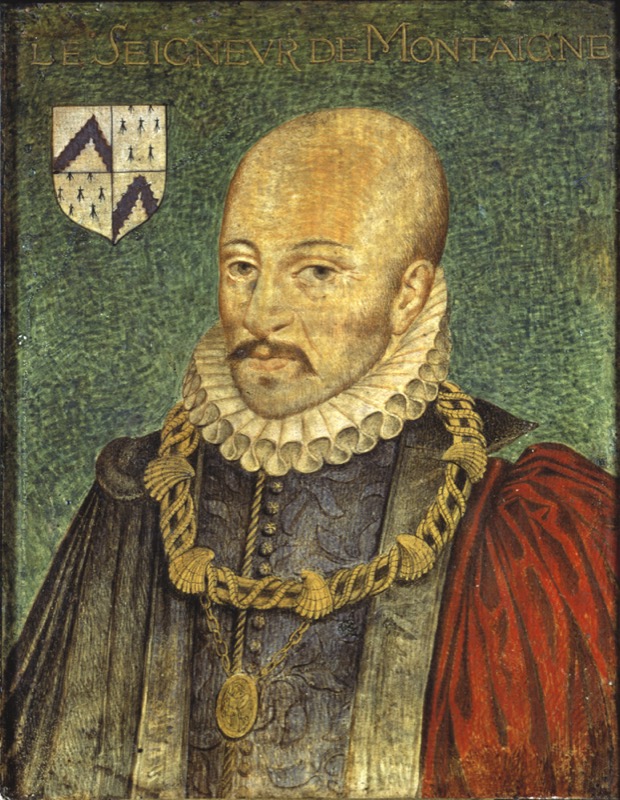

Summary
Montaigne called his pieces essais, 'trials' or 'attempts', and the word names both a method and a new literary genre. The book gathers 107 chapters in three books, ranging from one-page notes on thumbs, smells and names to the sprawling 'Apology for Raymond Sebond', which fills a sixth of the whole. The earliest chapters, written in the 1570s, resemble Renaissance commonplace books: strings of classical anecdotes from Plutarch, Seneca and Livy about sieges, constancy, fear and the deaths of famous men. Gradually the anecdotes give way to the author. 'To the Reader' announces that he himself is the matter of the book, and later chapters examine his memory, digestion, sexual life, laziness, handwriting, tastes in wine and reluctance to correct his drafts. The 1588 edition added Book III, the most personal and freely digressive, and Montaigne went on annotating a copy until his death; his adopted 'daughter' Marie de Gournay published the expanded text in 1595. Several fixed concerns run through the shifting surface. Death is the first: Book I's 'That to study philosophy is to learn to die' recommends Stoic rehearsal of mortality, but by the final essay, 'Of Experience', Montaigne advises leaving death to nature and attending to life. The second is scepticism. In the 'Apology', a nominal defence of a Catalan theologian, Montaigne dismantles human pretensions to knowledge, compares people unfavourably with animals, and adopts the Pyrrhonist question 'What do I know?' along with the emblem of a balance. The third is custom: 'Of Cannibals' uses reports of the Tupinambá of Brazil to argue that Europeans, who torture the living in the name of religion, have no standing to call others barbarous. Friendship receives a single great essay, a memorial to La Boétie that describes a union of souls without seam. Medicine is everywhere. Montaigne inherited his father's kidney stones and his distrust of physicians; he records passing stones on horseback, compares spa waters across Europe, and in 'Of the Resemblance of Children to Fathers' mocks the contradictory prescriptions of doctors while treating his own pain as a tutor in dying. 'Of the Force of Imagination' collects cases of suggestion, sympathetic illness and sexual impotence cured by a trick, a sixteenth-century catalogue of what is now called the placebo and nocebo effect. The book ends not with a doctrine but with a man accepting his body: kings and philosophers sit on their own behinds, and the finest lives are those that conform to the ordinary human pattern without miracle or extravagance.
Plot or Argument
- Book I: commonplaces turning into self-portrait
The 57 chapters begin with military and moral examples (how to treat the defeated, whether a besieged governor should parley) and move toward Montaigne's own temperament. Key pieces are 'Of Idleness' (why he began writing), 'That to study philosophy is to learn to die', 'Of the Force of Imagination', 'Of Pedantry', 'Of the Education of Children', 'Of Friendship', 'Of Cannibals' and 'Of Solitude'.
- The La Boétie chapter and its empty centre
'Of Friendship' was designed to frame La Boétie's Discourse on Voluntary Servitude at the middle of Book I. Once Protestant pamphleteers printed that treatise as propaganda, Montaigne substituted twenty-nine of his friend's sonnets, and later editions omit even those, leaving a memorial essay around a missing text.
- Book II: inconstancy, cruelty and the limits of reason
Book II opens with 'Of the Inconstancy of Our Actions', which denies that people have stable characters, and includes 'Of Drunkenness', 'A Custom of the Isle of Cea' (on suicide), 'Of Conscience', 'Of Cruelty' and 'Of Presumption', Montaigne's frankest account of his own faculties.
- The 'Apology for Raymond Sebond'
Ostensibly a defence of Sebond's Natural Theology, which Montaigne had translated for his father, the chapter attacks reason itself. It argues that animals may communicate and reason, that the senses deceive, that philosophers contradict one another, and that faith alone, not argument, can ground religion. It is the main conduit by which ancient Pyrrhonism entered early modern thought.
- Body, inheritance and the doctors (II.37)
Written after Montaigne's first attacks of the stone, the last chapter of Book II asks how a father's illness passes to a son through a drop of seed, then turns into a sustained polemic against physicians: their contradictory rules, their fees, and the fear they add to illness.
- Book III: the essay at full length
The thirteen long chapters of 1588 roam freely: 'Of Repentance' (he does not regret his nature), 'Upon Some Verses of Virgil' (sex and ageing), 'Of Coaches' (the Spanish conquest of Mexico and Peru), 'Of Vanity' (travel and Rome), 'Of Physiognomy' (plague and war at his estate in 1585–1586).
- 'Of Experience' as conclusion
The final essay sets personal experience against law and learning, describes Montaigne's regimen, sleep, diet and colic in close detail, and closes with praise of an ordinary, measured life that accepts the body rather than straining to transcend it.
Characters
- Montaigne (the essayist), author and subject
A self-described idle, forgetful, healthy-then-ailing country gentleman who makes his own changing judgements the subject of the book.
- Étienne de La Boétie, dead friend
Magistrate and humanist (1530–1563) whose friendship with Montaigne inspires 'Of Friendship' and whose death haunts the project.
- Pierre Eyquem, Montaigne's father
Mayor of Bordeaux who had his son taught Latin from infancy, commissioned the Sebond translation, and passed on the kidney stones.
- Raymond Sebond, theologian under discussion
Fifteenth-century Catalan author of a Natural Theology whose 'defence' becomes Montaigne's longest sceptical chapter.
- Socrates, exemplar
The figure Montaigne most admires, a model of natural, unforced virtue and of an ordinary death well met.
- The Tupinambá, subjects of 'Of Cannibals'
Brazilian people known to Montaigne through travellers and a servant, used to test European claims of civility.
Lessons
An ordinary life contains the whole human condition
Montaigne defends writing about one undistinguished man on the ground that each person bears the full form of humanity. The book shows that close attention to a single temperament can yield general wisdom without heroic subject matter.
- Why does Montaigne think a private life is as instructive as a public one?
- What details of his body or habits seem trivial at first but turn out to carry argument?
- Is self-portraiture a form of philosophy or a substitute for it?
Doubt as a discipline against cruelty
The 'Apology' and 'Of Cannibals' connect scepticism with tolerance: if no one can be certain, no one has warrant to burn, torture or conquer in the name of truth. Montaigne's uncertainty is moral as well as intellectual, written during massacres over doctrine.
- How does 'Of Cannibals' reverse the meaning of the word barbarous?
- Can scepticism ground any positive moral commitment, or only restraint?
Rehearsing death versus trusting nature
Early Montaigne echoes Seneca in urging constant meditation on death; late Montaigne, having seen peasants die calmly during plague, suggests nature teaches dying well enough. Tracing that change shows a mind revising itself in print.
- What experiences might explain Montaigne's change of mind about preparing for death?
- Which approach is more useful to someone facing a serious diagnosis?
The patient as expert on his own case
Living with kidney stones, Montaigne records symptoms, regimens and the effects of fear with the attention of a clinician, while refusing the authority of physicians who contradict one another. He models a patient who knows his body intimately and still treats his own judgement with doubt.
- Where is Montaigne's distrust of doctors justified for his era, and where does it look like bravado?
- What does his account of the stone add to modern discussions of chronic pain?
Context
The Essays were written during the French Wars of Religion (1562–1598), including the St Bartholomew's Day Massacre of 1572, when Catholic and Huguenot armies crossed Montaigne's region of Périgord. A Catholic loyal to the crown with Protestant relatives and friends, Montaigne acted as a go-between for Henri III and Henri of Navarre. The book also absorbs the humanist recovery of Sextus Empiricus (printed in Latin in 1562), Lucretius and Plutarch, and the first European accounting for the Americas.
Composition
Begun after Montaigne's retirement in 1571. Books I and II appeared at Bordeaux in 1580; a slightly revised edition in 1582 followed his travels to Germany, Switzerland and Italy (recorded in a separate Travel Journal, partly in search of spa cures for the stone). Book III and some 600 additions to Books I–II appeared in the Paris edition of 1588. Montaigne's further handwritten additions survive in the 'Bordeaux Copy'; Marie de Gournay's posthumous edition of 1595 drew on a parallel copy. Florio's English translation came in 1603, Cotton's in 1685–1686.
Reception
Shakespeare used Florio's version of 'Of Cannibals' for Gonzalo's commonwealth speech in The Tempest. Bacon borrowed the title for his own Essays, Pascal argued with Montaigne throughout the Pensées, and Descartes's method of doubt answers his scepticism. The Essays were placed on the Catholic Index in 1676. Later admirers include Emerson, Nietzsche, Virginia Woolf and Sarah Bakewell, and the book is regularly named as the origin of the personal essay.
Comparisons
- on-friendship
Cicero's Laelius treats friendship as a civic bond between good men; Montaigne cites it but claims his union with La Boétie surpassed any classical model because it had no cause beyond the two persons themselves.
- pensees
Pascal read Montaigne closely and turned his scepticism into a weapon for faith: where Montaigne rests content in uncertainty, Pascal makes the same uncertainty an unbearable condition from which only grace delivers.
- the-anatomy-of-melancholy
Burton's encyclopedic digressions and quotation-laden prose descend from the same commonplace habit, but Burton organizes his learning to diagnose a disease while Montaigne uses his to examine one man's changing humours.
- letters-from-a-stoic
Seneca is Montaigne's most quoted moralist; the early essays on death and constancy borrow Senecan rehearsal of mortality that the late essays quietly abandon for a more relaxed acceptance.
- essays-bacon
Bacon adopted Montaigne's French title in 1597 but wrote compressed counsels for the ambitious, a mode of public prudence quite unlike Montaigne's leisurely private self-trial.
- meditations-on-first-philosophy
Descartes inherits the sceptical arguments of the 'Apology' (dreams, deceiving senses) but raises them in order to defeat them with certainty, the reverse of Montaigne's willingness to live inside doubt.
Quotes
“Thus, reader, myself am the matter of my book: there’s no reason thou shouldst employ thy leisure about so frivolous and vain a subject”
“The premeditation of death is the premeditation of liberty; he who has learned to die has unlearned to serve”
“the very sight of another’s pain materially pains me, and I often usurp the sensations of another person”
“he found the same operation and effect that those do who have taken one indeed”
“If a man should importune me to give a reason why I loved him, I find it could no otherwise be expressed, than by making answer: because it was he, because it was I”
“every one gives the title of barbarism to everything that is not in use in his own country”
“When I play with my cat who knows whether I do not make her more sport than she makes me”
“This fancy will be more certainly understood by interrogation: “What do I know?” as I bear it with the emblem of a balance”
“I am in conflict with the worst, the most sudden, the most painful, the most mortal, and the most irremediable of all diseases”
“every man carries the entire form of human condition”
“I study myself more than any other subject; ‘tis my metaphysic, my physic”
“When I dance, I dance; when I sleep, I sleep”
“when seated upon the most elevated throne in the world, we are but seated upon our breech”
For Students
A reading companion for classical Christian high school students. See the student guide.
Reading Guide
Watch for
- The short note To the Reader (dated 1580), where Montaigne announces that he himself is the matter of his book and tells the reader there is no reason to spend leisure on it. Ask why an author would open by discouraging his audience.
- The change in Montaigne's views on death between That to study philosophy is to learn to die in Book I and Of Physiognomy and Of Experience in Book III, after he has watched peasants die calmly during plague and war.
- Of Friendship, built to frame La Boétie's treatise at the centre of Book I, which now surrounds a missing text. Notice how grief for one man shapes the whole essay.
- Of Cannibals, where reports of the Tupinambá of Brazil lead Montaigne to ask who is more barbarous: those who eat the dead, or Europeans who torture the living in the name of piety.
- The Apology for Raymond Sebond (II.12), the longest chapter, which begins as a defence of a theologian and becomes an attack on the pride of human reason, ending in the motto What do I know? and the emblem of a balance.
Key terms and names
- Essai
- French for a trial, attempt or test. Montaigne uses it for his chapters because each one tests his judgement on a subject rather than delivering a finished doctrine.
- Étienne de La Boétie
- Montaigne's closest friend, a magistrate and humanist who died in 1563. Of Friendship is his memorial, and his loss is often read as one reason Montaigne began to write.
- Pyrrhonism
- The ancient sceptical school, known to Montaigne through Sextus Empiricus, that suspends judgement on all claims. The Apology adopts its arguments to humble reason and leave room for faith.
- Raymond Sebond
- A fifteenth-century Catalan theologian whose Natural Theology Montaigne translated at his father's request. The Apology nominally defends Sebond's attempt to prove the faith by reason.
- Custom
- Montaigne's word for the habits and laws that each people takes for nature. In Of Cannibals and elsewhere he shows how custom governs judgement more than reason does.
- The stone
- Montaigne's kidney stones, inherited in his view from his father, which tormented him from about 1578. They supply the essays with first-hand reflections on pain, physicians and the approach of death.
- Fideism
- The position that religious truth rests on faith rather than on rational proof. The Apology is often read this way: reason is too weak to reach God, so belief must come by grace.
Seminar Questions
- Comprehension In To the Reader, what does Montaigne say the subject of his book is, and why does he say a reader need not bother with it?
- Comprehension What explanation does Montaigne give in Of Friendship for why he loved La Boétie, and how does he contrast their friendship with ordinary friendships?
- Comprehension In Of Cannibals, what customs of the Brazilian people does Montaigne describe, and what European practices does he set beside them?
- Interpretation In the Apology, Montaigne asks whether his cat is playing with him more than he with her. How does this small example serve his larger argument against human pride?
- Interpretation Early Montaigne says the premeditation of death is the premeditation of liberty; late Montaigne advises leaving dying to nature. What changed his mind, and which view does the book finally favour?
- Interpretation Montaigne calls the study of himself his metaphysic and his physic. How can writing about one ordinary man be both philosophy and medicine?
- Big Question The Apology argues that reason cannot reach God and that faith comes only as a gift. Does Montaigne's scepticism protect Christian faith from proud reason, or does it leave faith without any defence?
Faith Connections
- 1 Corinthians 1:18-25 (Scripture)
Paul says God has made foolish the wisdom of the world and that the foolishness of God is wiser than men. The Apology for Raymond Sebond turns this into a sustained argument: the more reason is examined, the less it can claim on its own.
- Ecclesiastes 1-3 (Scripture)
Montaigne had sentences painted on the beams of his library, several of them from Ecclesiastes. The Preacher's sense of vanity, change and the limits of knowledge runs through the Essays, as does his counsel to receive ordinary life as a gift.
- Augustine, Confessions IV and X (Church Fathers)
Augustine says that after his friend's death he became a great question to himself, and in Book X examines his memory and appetites in detail before God. Montaigne inherits this self-examination and the link between grief for a friend and self-scrutiny, though he addresses the reader rather than God.
- Pascal, Pensées (Great Conversation)
Pascal read Montaigne constantly and argued with him throughout the Pensées. He admired Montaigne's exposure of human weakness but objected to his ease in uncertainty, insisting that the same uncertainty should drive a person to seek God.
Logic and Rhetoric
Central argument: Human reason is unstable, the senses deceive, and custom shapes judgement more than evidence. Each person nonetheless carries the entire form of the human condition. Therefore the most honest path to wisdom is not to build systems but to test one's own judgement on every subject, record its changes, accept the body and its limits, and leave certainty about God to faith rather than argument.
Rhetorical device: bathos. Near the end of Of Experience (III.13), Montaigne reminds the reader that even on the most elevated throne in the world we are seated upon our breech, dropping from the height of royal dignity to the plainest bodily fact to deflate human pretension.
Debate: Resolved: Montaigne's scepticism serves Christian faith better than it threatens it.
Memory Work
When I dance, I dance; when I sleep, I sleep
If a man should importune me to give a reason why I loved him, I find it could no otherwise be expressed, than by making answer: because it was he, because it was I
Writing Prompts
Essay: Montaigne's Essays begin with Stoic rehearsal of death in Book I and end with acceptance of the body and ordinary life in Of Experience. Trace how his views change across the book and argue whether the late Montaigne is wiser or merely more tired.
Comparison with Pensees: Pascal built much of the Pensées in argument with Montaigne. Compare Montaigne's Apology for Raymond Sebond with Pascal's fragments on the misery and greatness of man, and argue which writer draws the better conclusion from the weakness of human reason.
Medical Lens
Montaigne is a primary witness to Renaissance medicine from the patient's side. His kidney stones (renal colic with haematuria and gravel, from roughly 1578) generate first-person records of pain, regimen, spa cures and the passage of stones, together with a sceptical polemic against physicians that echoes Pliny and anticipates later therapeutic nihilism. 'Of the Force of Imagination' gathers suggestion, sympathetic symptoms, sexual impotence relieved by a ritual trick, and the mimed clyster, cases that read today as placebo and nocebo phenomena, though Montaigne frames them through imagination and the humours rather than through any modern model. II.37 asks how a father's disease can be transmitted through seed, an early lay meditation on heredity. 'A Custom of the Isle of Cea' surveys ancient arguments for and against suicide without settling them. The plague of 1585–1586, which drove Montaigne from his home, appears in 'Of Physiognomy'. Any modern labelling of his temperament (for instance as depressive in the period after La Boétie's death) is speculative and should be presented as interpretation.
- Book I, Ch. XIX (Cotton), 'That to study philosophy is to learn to die'
Stoic and Epicurean arguments for habitual meditation on death as a cure for fear of it.
- Book I, Ch. XX, 'Of the Force of Imagination'
Sympathetic coughs and fevers, impotence induced and cured by belief, the merchant who responds to a mimed clyster, and other cases of suggestion acting on the body.
- Book I, Ch. XXVII, 'Of Friendship'
Memorial to La Boétie, whose death leaves Montaigne describing himself as only half a person.
- Book II, Ch. III, 'A Custom of the Isle of Cea'
Survey of classical and biblical cases of voluntary death and the arguments for and against it, including unbearable pain as a justification.
- Book II, Ch. XII, 'Apology for Raymond Sebond'
Sceptical attack on the reliability of the senses and of reason, with frequent appeal to illness, fever and madness as states that alter perception.
- Book II, Ch. XXXVII, 'Of the Resemblance of Children to Their Fathers'
First-person account of kidney stone attacks, speculation on hereditary transmission from his father, and a long critique of physicians' contradictions and fees.
- Book III, Ch. V, 'Upon Some Verses of Virgil'
Candid reflection on ageing, waning sexual vigour and the body's decline.
- Book III, Ch. XII, 'Of Physiognomy'
Montaigne and his household flee plague and civil war; he admires how ordinary people meet death without philosophy.
- Book III, Ch. XIII, 'Of Experience'
Detailed personal regimen (sleep, diet, habits) and colic attacks, with the argument that long experience of one's own body outranks medical rules.
Creative Prompts
- Essay
Write a Montaigne-style essai on one chronic symptom you know well: record it honestly, test what the authorities say about it, and let the essay change its mind halfway through.
- Dialogue
Imagine Montaigne consulting a present-day urologist about his stones: he questions every recommendation, cites Pliny, and asks why the doctor's advice contradicts what last year's guidelines said.
- Classroom
Have students compare 'That to study philosophy is to learn to die' (Book I) with the closing pages of 'Of Experience' (Book III) and chart exactly which views on death Montaigne revised and why.
- Fiction
Tell the story of the Tupinambá men whom Montaigne met at Rouen in 1562, from their point of view, ending with the three observations about France they gave him.
Further Reading
- How to Live: A Life of Montaigne in One Question and Twenty Attempts at an Answer, Sarah Bakewell
- Montaigne in Motion, Jean Starobinski
- Montaigne's Travel Journal, Michel de Montaigne
Records his search for spa cures for the stone in 1580–1581.
- The Complete Essays, Michel de Montaigne, trans. M. A. Screech
Modern translation with Villey-based numbering.
- The History of Scepticism: From Savonarola to Bayle, Richard H. Popkin
Places the 'Apology' within the revival of Pyrrhonism.
Verification notes
Biographical facts, edition history and essay contents are well established. All quotes were checked verbatim against the stored Cotton/Hazlitt text (Project Gutenberg #3600), including its curly apostrophes. Chapter numbers in quote locations follow that text; Cotton's numbering of Book I differs by one from the Villey/Screech numbering in places (e.g. Cotton I.19 'learn to die' = Villey I.20; Cotton I.27 'Of Friendship' = Villey I.28; Cotton I.30 'Of Cannibals' = Villey I.31).
- Date of onset of Montaigne's kidney stones (commonly given as 1577–1578).
- Count of chapters (107) and the claim that the 'Apology' fills about a sixth of the book.
- Year the Essays were placed on the Index (1676).
- Correspondence between Cotton chapter numbers and the Villey numbering for Books II–III (Cotton III.2 'Of Repentance', III.13 'Of Experience' match Villey).