Work record
Personal Memoirs
1885-1886 · 19th Century · Memoir · English
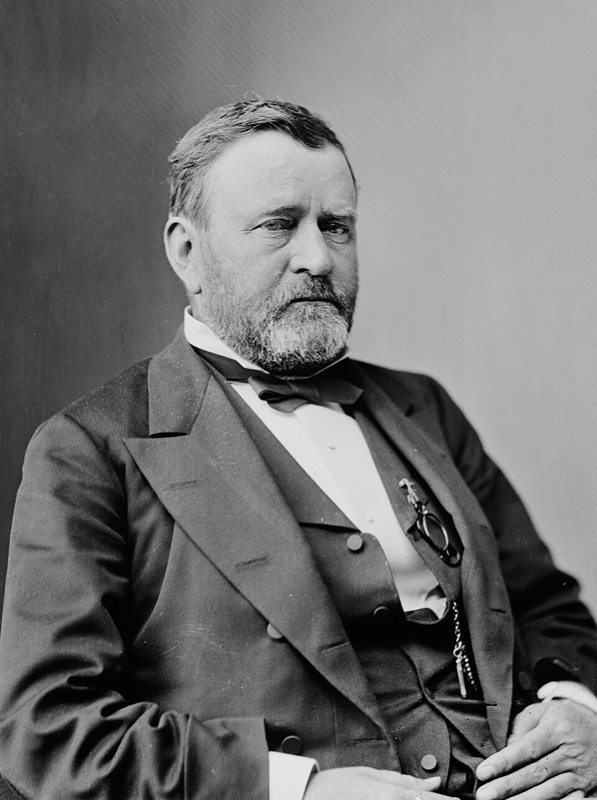

Summary
The Personal Memoirs of U. S. Grant were written in a race against death. In the spring of 1884 the brokerage firm of Grant & Ward collapsed through his partner's fraud, leaving the former president living on borrowed money. That autumn he was diagnosed with cancer of the throat. He began by writing articles on his battles for the Century Magazine, then contracted with his friend Mark Twain's publishing house, Charles L. Webster & Company, for a two-volume memoir. He dictated and then wrote in pencil through the winter and spring of 1885 as the tumour advanced, and finished at Mount McGregor in the Adirondacks a few days before he died on 23 July. The preface, dated that month, notes that he had been 'reduced almost to the point of death'. The book covers his life only to the end of the Civil War, with a short conclusion. Volume I moves briskly through his Ohio boyhood, his reluctant entry into West Point, and an early cough that frightened a family with consumption in it. The Mexican War is narrated by a junior officer who served under both Zachary Taylor and Winfield Scott, and who calls it 'one of the most unjust ever waged by a stronger against a weaker nation' and sees the Civil War as the nation's punishment for it. The Panama crossing of 1852 kills about a third of his party with cholera. There follow lonely Pacific service, resignation, and a bout of fever and ague. The Civil War chapters show his education in command: the discovery near Florida, Missouri that his opponent 'had been as much afraid of me as I had been of him'; Belmont; the demand for 'unconditional and immediate surrender' at Fort Donelson; the surprise and near-disaster at Shiloh, where he spends a rainy night unable to bear the amputations in a field hospital; and the long Vicksburg campaign, which cut loose from its supply line and ended with the city's surrender on 4 July 1863. Volume II covers the relief of Chattanooga, his appointment as lieutenant-general, and the Overland Campaign of 1864. He gives an unsparing admission that he always regretted the last assault at Cold Harbor. The siege of Petersburg follows, then the final pursuit of Lee, during which Grant suffers a sick headache treated with mustard plasters until Lee's note offering surrender cures him instantly. At Appomattox he feels 'sad and depressed' at the downfall of a brave foe fighting for 'one of the worst' causes 'for which a people ever fought'. The prose is famously plain, exact and unrhetorical. Grant assesses colleagues and opponents with dry candour, admits his mistakes sparingly but plainly, and keeps logistics, terrain and timing always in view. Twain called it the best military memoir since Caesar's Commentaries. It sold some three hundred thousand sets and restored his family's fortune.
Plot or Argument
- Vol. I, Ch. I–II: Ohio boyhood and West Point
Ancestry, tanning and horses in Georgetown, Ohio; a congressman's slip that renamed him 'U. S. Grant'; unenthusiastic cadetship; a wasting cough before graduation and fear of the family's consumption.
- Vol. I, Ch. III–XIII: the Mexican War
Service under Taylor at Palo Alto, Resaca de la Palma and Monterey, then under Scott from Vera Cruz to Mexico City. Grant judges the war unjust and the annexation of Texas a slaveholders' project, and admires Scott's campaign while preferring Taylor's simplicity.
- Vol. I, Ch. XIV–XVI: Panama, the Pacific and private life
Cholera on the Isthmus kills about a third of the party Grant shepherds; garrison life in Oregon and California; resignation in 1854; farming near St. Louis, fever and ague, and clerking in his father's Galena leather store.
- Vol. I, Ch. XVII–XXIV: from colonel to Donelson and Shiloh
Mustering volunteers in Illinois, the lesson of mutual fear in Missouri, Belmont, Forts Henry and Donelson with the 'unconditional surrender' letter, and the two days at Shiloh, including a night spent with a bruised leg beside a field hospital.
- Vol. I, Ch. XXV–XXXIX: the Vicksburg campaign
Failed canal and bayou schemes, the running of the batteries, the crossing below Vicksburg, the march inland living off the country, Champion Hill, the siege and the surrender on 4 July 1863; disease among troops and sanitary arrangements for hospitals.
- Vol. II: Chattanooga and command of all the armies
Opening the 'cracker line' to the besieged Army of the Cumberland, Lookout Mountain and Missionary Ridge, promotion to lieutenant-general and the strategy of simultaneous advances by all Union armies in 1864.
- Vol. II: the Overland Campaign and Petersburg
The Wilderness, Spotsylvania, North Anna and Cold Harbor, whose final assault Grant regrets; the crossing of the James, the Crater and the long siege; Sherman, Sheridan and Thomas in other theatres.
- Vol. II: Appomattox and conclusion
The pursuit to Appomattox, the sick headache cured by Lee's letter, the surrender meeting and generous terms. The conclusion reflects on causes of the war, Lincoln's death, Reconstruction and his hope, sustained by kindness during his illness, of reconciliation.
Characters
- Ulysses S. Grant, author and narrator
Self-effacing, precise narrator who presents himself as an ordinary man shaped by circumstance.
- Robert E. Lee, principal opponent
Commander of the Army of Northern Virginia, portrayed with respect at Appomattox though Grant condemns his cause.
- William Tecumseh Sherman, subordinate and friend
Grant's closest lieutenant from Shiloh to the March to the Sea.
- Abraham Lincoln, president
Supportive civilian chief whose assassination Grant regards as a calamity for the South as well as the nation.
- Zachary Taylor and Winfield Scott, Mexican War commanders
Contrasting models of generalship whom the young Grant observed closely.
- Henry W. Halleck, superior
Department commander whose caution and suspicion nearly ended Grant's career in 1862.
- Julia Dent Grant, wife
Mentioned sparingly; her financial security was the reason the book was written.
Lessons
The enemy is as afraid as you are
Grant's account of approaching Colonel Harris's camp with his heart in his throat, only to find it abandoned, gives the book's central psychological insight. Courage in command began, for him, with imagining the other side's fear, and he says he never again felt trepidation facing an enemy.
- How does this anecdote change the way Grant fights for the rest of the war?
- Is perspective-taking a teachable skill in high-stakes professions such as surgery or emergency medicine?
Plain style as a moral choice
Grant writes without heroics, gore or self-justification, letting dates, distances and numbers carry the story. The restraint makes his few judgments more forceful: the Mexican War was unjust, Cold Harbor was a mistake, the Confederate cause was among the worst ever fought for.
- What does Grant leave out, and does the silence (for example on his drinking) undermine trust?
- Compare Grant's account of Cold Harbor with his account of Vicksburg. How does he handle failure?
Writing against the clock of a terminal illness
The memoir is also an act of dying well: Grant finishes a major work to secure his family while the cancer destroys his ability to speak and swallow. The preface's brief reference to being 'reduced almost to the point of death' is the only overt trace of the circumstances in the text.
- How does knowing the conditions of composition change your reading of the Appomattox chapters?
- What makes a project like this a source of meaning at the end of life?
Disease was the larger enemy
From cholera on the Isthmus to measles and smallpox at Vicksburg and fever and ague in Missouri, Grant records illness as a constant force. His own sick headache before Appomattox shows how stress and relief act on the body.
- Why does Grant include the detail that Lee's letter instantly cured his headache?
- What does the Panama crossing reveal about the limits of a commander's responsibility?
Context
Grant wrote as Reconstruction was being abandoned and the 'Lost Cause' interpretation of the war was gaining ground. Confederate generals' memoirs and the Century Magazine's 'Battles and Leaders' series were turning the war into a contest of reputations. Grant's book defends the Union cause and his own record without the polemics of many contemporaries. It insists that slavery caused the war and that the Mexican War was the original sin from which it grew.
Composition
After the Grant & Ward failure in May 1884, Grant wrote four Century articles, then in early 1885 signed with Charles L. Webster & Co., Mark Twain's firm, which offered a 70 percent royalty. Diagnosed with cancer of the throat in October 1884, he worked through severe pain, treated by physicians including John H. Douglas with cocaine solution applied to the throat and morphine. His son Frederick and the aide Adam Badeau helped with research. In June 1885 he moved to Mount McGregor, New York, finished the manuscript in mid-July and died on 23 July. The two volumes appeared in December 1885 and early 1886, sold by subscription agents.
Reception
The memoirs were a commercial and critical triumph, earning Julia Grant roughly $450,000. Twain compared them to Caesar's Commentaries; later admirers include Matthew Arnold (with reservations), Gertrude Stein, Edmund Wilson in Patriotic Gore, and many military historians. Since the late twentieth century, historians such as William McFeely, Brooks Simpson and Ron Chernow have used the memoirs to rehabilitate Grant from the caricature of a drunken butcher and corrupt president.
Comparisons
- shermans-memoirs
Sherman's memoirs, published a decade earlier, are combative, opinionated and full of documents, whereas Grant's are restrained. The two accounts of Shiloh and of Sherman's doubts before Vicksburg can be checked against each other.
- the-conquest-of-gaul
Twain's comparison is apt: like Caesar, Grant writes a clear, apparently impersonal campaign narrative that is also a carefully managed self-portrait, with modesty serving as a rhetorical strategy.
- on-war
Grant never mentions Clausewitz, but his insistence that all Union armies advance together in 1864, and his tying of military strategy to the political aim of destroying the Confederacy, follow the logic of On War.
- twelve-years-a-slave
Northup's narrative shows from the inside the system that Grant, from outside, calls the cause of the war. Read together they span the moral and political arc from bondage to Union victory.
- the-death-of-ivan-ilyich
Tolstoy's novella appeared in 1886, the same year as Grant's second volume. Ivan Ilyich's fictional dying and Grant's real one show two responses to terminal illness, one ending in late revelation and one in disciplined work.
- the-persian-expedition
Xenophon's Anabasis is another general's plain retrospective of a campaign against long odds, with the same attention to supply, terrain and morale, and the same quiet management of its author's reputation.
Quotes
“Later I was reduced almost to the point of death, and it became impossible for me to attend to anything for weeks”
“There was consumption in my father's family, two of his brothers having died of that disease, which made my symptoms more alarming”
“For myself, I was bitterly opposed to the measure, and to this day regard the war, which resulted, as one of the most unjust ever waged by a stronger against a weaker nation”
“Nations, like individuals, are punished for their transgressions”
“About one-third of the people with me died, either at Cruces or on the way to Panama”
“I managed to keep along very well until 1858, when I was attacked by fever and ague”
“It occurred to me at once that Harris had been as much afraid of me as I had been of him”
“The sight was more unendurable than encountering the enemy's fire, and I returned to my tree in the rain”
“I have always regretted that the last assault at Cold Harbor was ever made”
“I spent the night in bathing my feet in hot water and mustard, and putting mustard plasters on my wrists and the back part of my neck, hoping to be cured by morning”
“When the officer reached me I was still suffering with the sick headache, but the instant I saw the contents of the note I was cured”
“I felt like anything rather than rejoicing at the downfall of a foe who had fought so long and valiantly, and had suffered so much for a cause, though that cause was, I believe, one of the worst for which a people ever fought”
“The universally kind feeling expressed for me at a time when it was supposed that each day would prove my last, seemed to me the beginning of the answer to "Let us have peace”
For Students
A reading companion for classical Christian high school students. See the student guide.
Reading Guide
Watch for
- The preface and its single sentence about being reduced almost to the point of death. Grant wrote the whole book while dying of throat cancer, yet he almost never mentions it; notice what that silence does to the tone of the rest.
- Grant's judgment on the Mexican War in Vol. I, Ch. III, where a young officer who fought bravely in it calls it unjust and links it to the Civil War as a national punishment.
- The march toward Colonel Harris's camp in Vol. I, Ch. XVIII, where Grant's heart is in his throat until he finds the camp abandoned. He says the lesson changed how he faced every later enemy.
- The Vicksburg campaign in Vol. I, especially the decision to cross the Mississippi below the city and march inland, cut off from his supply line, against the advice of his own officers.
- The Appomattox chapter in Vol. II: the sick headache cured by Lee's note, Grant's plain clothes beside Lee's full uniform, his feelings at the surrender, and the terms he writes, including letting the men take their horses home.
Key terms and names
- Unconditional surrender
- Grant's demand to the Confederate commander at Fort Donelson in February 1862, which made his name in the North. The phrase was soon read into his initials.
- Vicksburg campaign
- Grant's long effort in 1862 and 1863 to take the Confederate river fortress at Vicksburg, Mississippi. After failed canal and bayou schemes he crossed below the city, marched inland, and besieged it until its surrender on 4 July 1863.
- Shiloh
- The two-day battle of April 1862 in Tennessee where Grant's army was surprised and nearly driven into the river. Grant spent the rainy night between the two days unable to bear the amputations in a log-house hospital.
- Overland Campaign
- Grant's 1864 advance against Lee through the Wilderness, Spotsylvania, North Anna and Cold Harbor toward Richmond, accepting heavy losses to keep constant pressure on Lee's army.
- Cold Harbor
- The Virginia battlefield where Grant ordered a frontal assault on 3 June 1864 that failed with great loss. In Vol. II he writes that he always regretted it, one of his few plain admissions of error.
- Appomattox
- The Virginia courthouse village where Lee surrendered the Army of Northern Virginia to Grant in April 1865. Grant's terms allowed officers to keep their sidearms and soldiers to take their horses home for spring planting.
- Mount McGregor
- The cottage in the Adirondacks where Grant finished the manuscript in July 1885, communicating by pencilled notes after he lost his voice, and where he died days later.
Seminar Questions
- Comprehension Why did Grant write these memoirs, under what conditions did he finish them, and how much of that story does the book itself tell?
- Comprehension What did Grant learn on the approach to Colonel Harris's camp in Vol. I, Ch. XVIII, and how does he say it affected him afterward?
- Comprehension Describe the surrender at Appomattox as Grant tells it: what he wore, how he felt, and what terms he offered Lee's army.
- Interpretation Grant says nations, like individuals, are punished for their transgressions, and he connects the Mexican War to the Civil War. What does this claim reveal about how he understood history and his own part in it?
- Interpretation Grant admits regret for the last assault at Cold Harbor but says little about other losses. How does his plain, restrained style shape the reader's judgment of him as a commander?
- Interpretation At Appomattox Grant feels anything but rejoicing at the defeat of a brave foe, while calling the cause one of the worst ever fought for. How can he hold both judgments at once?
- Interpretation Why might a dying man include a story about curing a sick headache with mustard plasters, only to be cured instantly by Lee's note? What does the story say about the war's weight on him?
- Big Question Grant finished his book in pain to provide for his family and died days later. What makes work done at the end of life meaningful, and is there a kind of courage in finishing a task that differs from courage in battle?
Faith Connections
- Proverbs 14:34 (Scripture)
Righteousness exalts a nation, but sin is a reproach to any people. Grant's conviction that the nation was punished in the Civil War for the injustice of the Mexican War applies this proverb to American history in the language of a soldier rather than a preacher.
- Romans 12:20-21 (Scripture)
Paul teaches that if one's enemy hungers, one should feed him, and that evil is overcome with good. At Appomattox Grant sends rations to Lee's hungry men and lets them take their horses home, a victor's mercy that the memoir records without comment.
- Augustine, City of God XIX.12 (Church Fathers)
Augustine argues that even those who wage war desire peace, and that war is waged for the sake of peace. Grant's closing hope that the kindness shown him from North and South in his illness was the beginning of the answer to his old slogan, Let us have peace, shows a general who understood his war as a road to reconciliation.
- Abraham Lincoln, Second Inaugural Address (1865) (Great Conversation)
Lincoln suggested that the war might be the judgment of God on the offense of American slavery and urged the nation to bind up its wounds with malice toward none. Grant's memoir shares both convictions, the war as national reckoning and the peace as generous, though he states them with far less rhetoric.
Logic and Rhetoric
Central argument: The Civil War was caused by slavery and grew out of the unjust Mexican War, so it was in part a national punishment. The Union won not through brilliance alone but through clear aims, steady pressure, attention to supply and terrain, and the willingness of commanders to act despite fear, knowing the enemy was afraid too. Grant's own record, honestly told with its mistakes admitted, shows a commander who served that cause. Therefore the war's victory should be remembered as both just and costly, and its end as the beginning of a reconciliation the nation should continue.
Rhetorical device: litotes and understatement. At Appomattox, Vol. II, Ch. LXVII, Grant says he felt like anything rather than rejoicing at the downfall of a brave foe. Instead of naming his sorrow directly, he denies its opposite, and the restraint makes the feeling stronger. The same understatement governs his one-sentence regret for the last assault at Cold Harbor.
Debate: Resolved: Grant's generous terms at Appomattox were the wisest decision of his military career.
Memory Work
It occurred to me at once that Harris had been as much afraid of me as I had been of him
Nations, like individuals, are punished for their transgressions
Writing Prompts
Essay: Mark Twain compared Grant's memoirs to Caesar's Commentaries for their plain style. Using the Harris episode, the Cold Harbor admission and the Appomattox chapter, argue whether Grant's restraint makes the memoir more trustworthy as history or whether it is itself a careful way of shaping his reputation.
Comparison with On War: Grant never mentions Clausewitz, yet his 1864 plan to advance all Union armies at once and his tying of every battle to the political aim of ending the Confederacy echo On War. Compare Grant's account of the Vicksburg or Overland Campaign with Clausewitz's ideas of friction, moral forces and war as a continuation of policy, and argue how far the practitioner confirms the theorist.
Medical Lens
The memoir is a document of terminal illness as well as war. Grant was diagnosed in 1884 with a carcinoma of the throat, generally attributed to heavy cigar smoking. His physicians treated the pain with topical cocaine solution and morphine, and he wrote on through dysphagia, haemorrhage and loss of voice, communicating by pencilled notes in the last weeks. The text barely mentions any of this (only the preface), which is itself revealing. Within the narrative, disease recurs everywhere: fear of hereditary consumption at West Point, yellow fever and cholera, the 1852 Panama crossing that killed a third of his party, malarial fever and ague, measles and smallpox among recruits, and orders establishing general hospitals during the Vicksburg campaign. The Shiloh field-hospital night and the Appomattox 'sick headache', probably migraine though any such label is retrospective, cured by Lee's letter, are classic passages for teaching about war surgery and stress-related somatic symptoms. Persistent stories of Grant's drinking are absent from the book.
- Preface
Grant notes he was 'reduced almost to the point of death' while writing and that his son F. D. Grant helped with the work.
- Vol. I, Ch. II
A wasting cough before graduation and the family history of consumption, which later killed his younger brother and sister.
- Vol. I, Ch. XIV
Cholera at Cruces and Panama in 1852; hospital hulk and tents; roughly a third of Grant's party dead and a seventh of the regiment lost overall.
- Vol. I, Ch. XVI
A year-long attack of fever and ague in 1858 that undermines his farming.
- Vol. I, Ch. XXIV
Shiloh: bruised and sleepless after his horse falls, Grant takes refuge in a log-house used as a hospital, where amputations go on all night, and returns to the rain.
- Vol. I, Ch. XXXII
The flooded winter before Vicksburg: malarial fevers, measles and smallpox among troops, hospital arrangements Grant credits with limiting deaths, and orders establishing general hospitals between Duckport and Milliken's Bend.
- Vol. II, Ch. LXVII
Sick headache treated with hot mustard footbaths and plasters, cured on reading Lee's note; Grant's 'sad and depressed' feelings at the surrender.
Creative Prompts
- Fiction
Write a scene at Mount McGregor in July 1885 in which Grant, no longer able to speak, passes pencilled notes to his physician while correcting proofs of the Appomattox chapter.
- Essay
Analyse the Appomattox 'sick headache' as a case history: what does Grant's account tell us about stress, relief and somatic symptoms, and what must remain uncertain?
- Classroom
Pair the Cold Harbor passage with a modern morbidity-and-mortality conference: how does Grant admit error, and what does he leave unsaid?
- Dialogue
Imagine Grant and Mark Twain negotiating the publishing contract in February 1885, each aware of the diagnosis and neither willing to name it.
Further Reading
- Grant, Ron Chernow
- Grant: A Biography, William S. McFeely
- Patriotic Gore, Edmund Wilson
Includes an influential chapter on Grant's memoirs.
- Grant's Final Victory: Ulysses S. Grant's Heroic Last Year, Charles Bracelen Flood
Narrative of the illness, treatment and composition at Mount McGregor.
- Memoirs of General W. T. Sherman, William Tecumseh Sherman
Verification notes
Biography, publication history and campaign narrative are well established. All quotations were checked by hand against the Project Gutenberg text stored at content/texts/personal-memoirs.txt. Chapter numbers were confirmed against the chapter headings of that text. Medical details of Grant's final illness (cocaine and morphine, Dr. John H. Douglas) come from biographies and his physicians' accounts, not from the memoir. 'Migraine' for the Appomattox headache is a retrospective reading.
- The royalty figure (commonly given as 70 percent of net profits) and total paid to Julia Grant (about $450,000).
- Exact histology and site of Grant's cancer as reported by his physicians (often described as squamous cell carcinoma of the oropharynx).