Work record
Meditations
c. 170–180 CE · Ancient · Philosophy · Ancient Greek
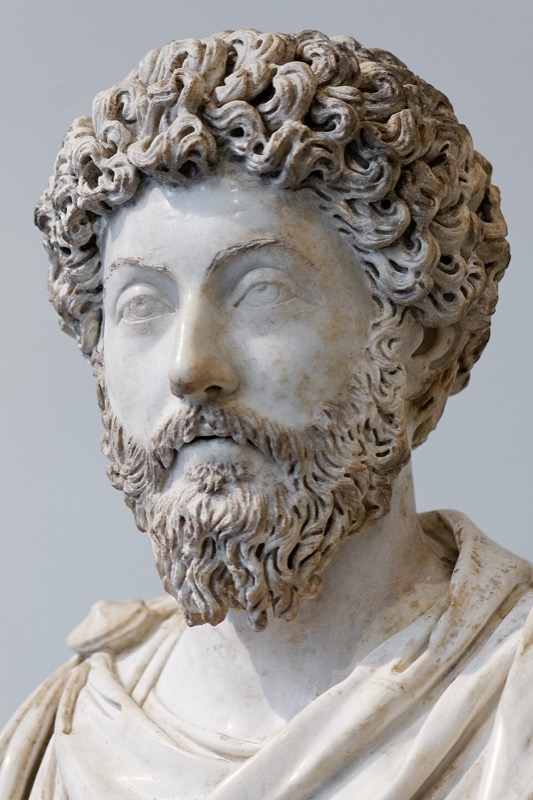

Summary
The Meditations, which Marcus Aurelius may have titled simply 'To Himself', is a private notebook of philosophical reflections written in Greek, probably during his military campaigns on the Danube in the 170s CE. It was not intended for publication and consists of twelve books of entries ranging from single sentences to short essays, often repeated and varied as exercises to fix principles in the mind. Book One stands apart: a list of what Marcus learned from family, teachers and friends, including his adoptive father Antoninus Pius, his tutors and the gods, an extended act of gratitude. The remaining books return again and again to core Stoic themes. The universe is a rational whole governed by providence or, at worst, by atoms, and either way a person's task is to live in accordance with nature and reason. Only virtue is good and only vice evil; everything else, including pain, illness, reputation, wealth and death, is 'indifferent'. What disturbs us is not things themselves but our judgments about them, which are in our power; if we remove the judgment 'I have been harmed', the harm is removed. Each person has a ruling faculty that can withdraw into itself, a 'citadel', and need not seek retreats in the country or by the sea. Human beings are made for cooperation like hands and feet, so one should not be angry at wrongdoers but correct or bear with them, remembering that they act from ignorance. Marcus constantly reminds himself of the brevity of life and the vastness of time, the flux of all things, the deaths of famous men, emperors, philosophers and physicians, and the smallness of fame. Death is a natural process like birth, a dissolution of elements, and should be awaited calmly. Pain is either bearable or ends life. The work also includes self-exhortations to get out of bed in the morning, to do one's duty as emperor without becoming 'Caesarified', to act justly, to be grateful and to prefer simplicity, and it records moments of fatigue, loneliness and self-reproach. Its tone is earnest, sometimes weary, sometimes lyrical, and it has been read for centuries as a manual of practical philosophy.
Plot or Argument
- Book I: Debts and gratitude
What Marcus learned from relatives, teachers, friends and the gods: modesty, self-control, the example of Antoninus Pius.
- Books II–III: Beginnings of practice
Morning preparation for difficult people, the shortness of life, living by the ruling faculty, and the deaths of great men including Hippocrates.
- Book IV: Opinion and retreat
Retreat into oneself, 'the universe is transformation, life is opinion', and the removal of harm by removing judgment.
- Books V–VI: Duty and acceptance
Rising to the work of a human being, accepting what nature brings, and working for the common good.
- Books VII–IX: Pain, anger and providence
How to bear pain, the folly of anger, the choice between providence and atoms, and death as natural.
- Books X–XII: Final reflections
Living as on a mountain, the inner citadel, the brevity of fame, and preparation to depart from life serenely.
Characters
- Marcus Aurelius, author
Roman emperor writing private philosophical exercises to himself.
- Antoninus Pius, adoptive father
Emperor whose patience, diligence and modesty Marcus takes as a model.
- Junius Rusticus, teacher
Stoic mentor who introduced Marcus to the discourses of Epictetus.
- Epictetus, philosophical influence
Former slave and Stoic teacher whose ideas Marcus quotes and adapts.
Lessons
Judgments, not events, disturb us
Marcus repeatedly separates what happens from our opinions about it, which are within our control. This insight underlies modern cognitive approaches to emotional distress.
- Is it always possible to remove the judgment 'I have been harmed'?
- Where does this idea help, and where might it mislead?
- How does it compare with cognitive behavioural therapy?
Power without corruption
The most powerful man in the world reminds himself not to become 'Caesarified'. The Meditations model leadership as service and self-discipline.
- What temptations of power does Marcus guard against?
- Did his philosophy make him a better ruler?
Mortality as a guide
Remembering death and the brevity of fame helps Marcus focus on what matters now. The book treats contemplation of mortality as liberating rather than morbid.
- Why does Marcus list the deaths of famous men?
- Is his view of death consoling to you?
Context
Marcus wrote during the Marcomannic Wars along the Danube and the Antonine Plague (from 165 CE), probably smallpox, which killed a large share of the empire's population. Stoicism, founded by Zeno around 300 BCE, was the dominant philosophy of the Roman elite, and Marcus drew especially on Epictetus.
Composition
The notebooks were written in Greek in the 170s CE; the headings of Books II and III place them 'among the Quadi' and 'at Carnuntum'. They survived through Byzantine copies and were first printed in 1559 with a Latin translation by Xylander.
Reception
Admired by figures from Frederick the Great to modern statesmen, the Meditations had a large readership in the Victorian era and a major revival in the 21st century as a manual of practical Stoicism. Founders of cognitive therapy, notably Albert Ellis and Aaron Beck, acknowledged Stoic influence.
Comparisons
- the-bhagavad-gita
Both teach action without attachment to results and equanimity in pleasure and pain, framed around a warrior's duty.
- confessions
Both are inward-turned writings by men of public responsibility; Marcus addresses himself in Stoic discipline, Augustine addresses God.
- fragments
Marcus cites Heraclitus repeatedly; his meditations on flux and logos draw on Heraclitean ideas.
- plutarch-essays
Plutarch's moral essays, such as 'On Tranquillity of Mind', offer a Platonist parallel to Marcus's Stoic therapy of the passions.
- the-last-days-of-socrates
Socrates' calm acceptance of death was a model for the Stoics, and Marcus invokes Socrates as an exemplar.
Quotes
Frequently cited
“Begin the morning by saying to thyself, I shall meet with the busy-body, the ungrateful, arrogant, deceitful, envious, unsocial.”
Frequently cited
“The universe is transformation: life is opinion.”
Frequently cited
“If thou art pained by any external thing, it is not this thing that disturbs thee, but thy own judgement about it.”
“Of human life the time is a point, and the substance is in a flux, and the perception dull”
“Hippocrates after curing many diseases himself fell sick and died.”
“Take away thy opinion, and then there is taken away the complaint, 'I have been harmed.' Take away the complaint, 'I have been harmed,' and the harm is taken away.”
“Think continually how many physicians are dead after often contracting their eyebrows over the sick”
“In the morning when thou risest unwillingly, let this thought be present—I am rising to the work of a human being.”
For Students
A reading companion for classical Christian high school students. See the student guide.
Reading Guide
Watch for
- Book I, a list of what Marcus learned from his grandfather, his mother, his teachers such as Rusticus, who gave him the discourses of Epictetus, and above all his adoptive father Antoninus Pius in I.16. Notice that the emperor's private notebook begins with gratitude, not with doctrine.
- The place-names at the head of Books II and III, among the Quadi and at Carnuntum, which show that these entries were written in army camps on the Danube frontier during war.
- The morning exercises at II.1 and V.1, where Marcus prepares himself to meet ungrateful and meddling people and argues himself out of bed by reminding himself he was made for the work of a human being.
- Marcus's habit, as in VI.13, of describing prized things in plain physical terms, roast meat as a dead fish or bird, the imperial purple as sheep's wool dyed in shellfish blood, to strip them of false value.
- The repeated lists of the famous dead, Hippocrates, Alexander, Augustus's court, the whole age of Vespasian in IV.32, which keep returning Marcus to the shortness of life and fame.
Key terms and names
- Ruling faculty (hegemonikon)
- The reasoning part of the soul, which Marcus holds is fully in his own power. Book IV teaches that it can withdraw into itself at any time, a better retreat than any country house or seashore.
- Indifferents
- The Stoic name for everything that is neither virtue nor vice, including health, pain, wealth, reputation, and death. Marcus repeatedly reminds himself that such things cannot make him good or bad.
- Judgment
- For Marcus, the opinion the mind forms about events, which is the true source of disturbance. At IV.7 and VIII.47 he argues that removing the judgment that one has been harmed removes the harm.
- Providence or atoms
- The alternative Marcus poses several times: either the universe is ordered by a rational providence or it is a chance scattering of atoms. He argues that in either case the right response is to act well and accept what comes.
- Logos
- The divine reason that, for the Stoics, pervades and orders the whole universe and is shared by every rational being. It grounds Marcus's belief that all people are kin and made to work together like hands and feet.
- Caesarified
- Marcus's coined word at VI.30 for being swallowed up by the role of emperor. He warns himself against it and holds up Antoninus Pius as a ruler who stayed simple and just.
- Antonine Plague
- The epidemic, probably smallpox, that spread through the empire from 165 CE. It forms part of the background to Marcus's many reflections on death and his remark that the corruption of the mind is a worse plague than any in the air.
Seminar Questions
- Comprehension What qualities does Marcus say he learned from Antoninus Pius in Book I, and why might he have placed this list at the start of his notebook?
- Comprehension At II.1, what kinds of people does Marcus expect to meet each day, and what reasons does he give himself for not being angry with them?
- Comprehension Where in Book IV does Marcus say a person can go to find quiet, and what does he say is there?
- Interpretation Marcus writes that if the opinion of harm is removed, the harm is removed. Is this true of all suffering, or only of some kinds, and how would he answer the objection of someone in physical pain?
- Interpretation The Meditations were written to the author himself, not to readers. How does the private purpose of the notebook explain its repetitions and its tone of self-correction?
- Interpretation Marcus was the most powerful man in the world, yet he constantly reminds himself that fame is brief and that he too will be forgotten. Why would an emperor need these reminders most?
- Interpretation Marcus leaves open whether the universe is governed by providence or by atoms. Does his ethics depend on the answer?
- Big Question Marcus seeks peace by making himself independent of everything outside his own judgment. Is that the same as the peace Christians speak of, or a different thing that resembles it?
Faith Connections
- Philippians 4:11-13 (Scripture)
Paul says he has learned to be content in every state, whether full or hungry, and that he can do all things through Christ who strengthens him. Marcus seeks a similar contentment through his own ruling reason, so the passages invite a precise comparison of where each man finds his strength.
- Ecclesiastes 1:2-11 (Scripture)
The Preacher sees generations passing, rivers running to the sea, and nothing new under the sun. Marcus's meditations on the forgotten court of Vespasian and the endless flux of things echo this book closely, though Ecclesiastes ends by commanding fear of God and Marcus by accepting nature.
- Justin Martyr, First Apology 1 (Church Fathers)
Justin addressed his defense of the Christians to Antoninus Pius and his son Verissimus the philosopher, that is, the young Marcus, appealing to them as lovers of reason. Marcus's only possible mention of Christians, at XI.3, dismisses their readiness to die as obstinacy, and some scholars think the words a later gloss.
- Augustine, City of God XIX.4 (Church Fathers)
Augustine respects the Stoic call to endure but argues that their sages cannot be called happy in this life, since they admit that some evils are severe enough to justify leaving it. His critique is a fair challenge to Marcus's claim that the ruling faculty can always find peace within.
Logic and Rhetoric
Central argument: Only virtue is good and only vice is evil; everything else, including pain, loss, and death, is indifferent. Events themselves are outside our power, but our judgments about them are within it, and it is judgment, not events, that disturbs us. Since the universe is a rational whole and human beings are made for one another, the reasonable person accepts what nature brings, does his own work justly, and bears with others' faults as ignorance. Therefore peace is available to anyone, even an emperor at war, by governing one's own judgments.
Rhetorical device: self-address (apostrophe to oneself). Marcus speaks to himself in the second person throughout, as at V.1: In the morning when thou risest unwillingly, let this thought be present. The notebook argues with its own author, which gives the precepts the urgency of an exercise rather than the distance of a treatise.
Debate: Resolved: Marcus Aurelius's Stoicism asks a person to control more than is truly in human power.
Writing Prompts
Essay: Marcus repeatedly claims that we are disturbed not by things but by our judgments about them (IV.7, VIII.47). Using his morning exercises in Books II and V, his reflections on the famous dead, and his remarks on pain, evaluate whether this principle is a source of strength or a refusal to grieve what deserves grief.
Comparison with Confessions: Marcus writes to himself and Augustine writes to God; both turn inward to examine their lives. Compare what each finds when he looks within, and argue which book offers the more honest account of the human will and its power to change itself.
Medical Lens
The Meditations are the classic text of philosophy as therapy and are regularly cited as an ancestor of cognitive behavioural therapy: the principle that distress arises from judgments rather than events was explicitly acknowledged by Albert Ellis and Aaron Beck. Marcus repeatedly addresses pain (bearable or fatal, and not dishonourable), illness, ageing and death, and lists physicians who died despite their art, including Hippocrates. Historical context is rich: his court physician was Galen, who prepared theriac for him, a compound remedy containing opium, and the historian Thomas Africa (1961) argued that Marcus may have been habituated to opium; this hypothesis is contested and should be presented as speculative. The Antonine Plague devastated the empire during his reign. His self-exhortations to leave his bed in the morning and his recurrent weariness have been read by some as signs of low mood, again a matter of interpretation.
- Book 1.17
Marcus thanks the gods for remedies given in dreams, including for spitting of blood and giddiness.
- Book 3.3; 4.48
Catalogues of the dead, including Hippocrates and physicians who frowned over the sick.
- Book 5.1
Argument with himself about getting out of bed in the morning.
- Book 7.33, 7.64
On pain: if intolerable it ends life, if lasting it is bearable; in every pain remember there is no dishonour.
- Book 9.2
Corruption of the mind is a worse pestilence than any plague of the air.
- Book 9.3; 12.36
Death as a natural process like birth and growing old; departing serenely.
Creative Prompts
- Essay
Does Stoic acceptance of pain help or hinder good pain management? Use Book 7 and modern pain science.
- Fiction
Write a scene in which Galen, preparing the emperor's theriac, reads over his shoulder.
- Classroom
Keep a one-week 'To Myself' notebook in Marcus's manner and compare entries.
Further Reading
- Discourses, Epictetus
- Letters from a Stoic, Seneca
- The Inner Citadel: The Meditations of Marcus Aurelius, Pierre Hadot
- Marcus Aurelius: A Life, Frank McLynn
Verification notes
Content, context and Book.section numbering are well established. Quotes follow George Long's translation from memory; most are widely reproduced in this wording, but punctuation should be checked. The opium hypothesis (Africa 1961) is a scholarly speculation, presented as such.
- Long's exact wording for all quotes, especially 2.17 and 4.48.
- Section numbers for the pain passages (7.33, 7.64) and the 'pestilence' passage (9.2).
- Book 1.17 reference to remedies in dreams for spitting blood and giddiness.
- Citation of Thomas W. Africa's 1961 article on Marcus Aurelius and opium.