Work record
St. Thomas Becket and the Canterbury Miracles
1170-1173; miracle collections late 12th century · Medieval · Hagiography · Latin
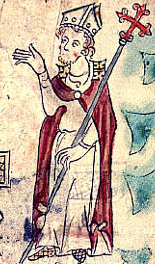
.jpg)
Summary
St. Thomas Becket and the Canterbury Miracles traces a murder into a medical archive. Becket's political story is familiar: the brilliant royal chancellor becomes archbishop of Canterbury, clashes with Henry II over ecclesiastical liberty and royal jurisdiction, goes into exile, returns under tense compromise, and is killed in the cathedral on 29 December 1170 by knights acting in the atmosphere of the king's fury. Edward Grim's eyewitness Vita gives the murder its unforgettable immediacy: the archbishop at prayer, the knights' blows, Grim's wounded arm, and the shattered skull on the pavement. The Golden Legend later compresses the scene into martyr spectacle. Yet for this library the afterlife is just as important as the death. Canterbury rapidly became a healing shrine. Monks collected blood, diluted it in water, distributed ampullae of the water of St. Thomas, and recorded miracle claims. Benedict of Peterborough and William of Canterbury gathered stories of fever, blindness, paralysis, wounds, childbirth danger, epilepsy-like seizures, madness, leprosy, drowning, and accidents. These are not clinical case histories in the modern sense, but they are unusually rich evidence: names, towns, body parts, symptoms, vows, journeys, offerings, relapse, and recovery often appear with concrete detail. The shrine thus became both devotional center and data-gathering institution. A medical reader should neither accept the cures uncritically nor discard them as useless. They show what kinds of suffering drove people to pilgrimage, how families described disease, which impairments were socially catastrophic, and how relic water functioned as portable therapy. The Becket cult also links healing to politics. A murdered archbishop becomes a posthumous physician whose miracles pressure kings, enrich Canterbury, and gather the sick into a public story of justice. Read beside Chaucer's later Canterbury frame, the miracle collections show what pilgrimage meant before it became mainly literary scenery: bodies in pain moving toward a shrine where law, sanctity, and hope converged.
Plot or Argument
- Conflict with Henry II
Becket moves from royal service to episcopal opposition, and the dispute over church liberties and royal power prepares the political charge of the martyrdom.
- The cathedral murder
Edward Grim's eyewitness account centers on the knights' attack, Becket's refusal to flee, Grim's failed protection, and the violent wounds that become relic matter.
- Blood becomes water
Canterbury monks preserve blood and tissue, mix blood with water, and distribute the water of St. Thomas in ampullae as a contact relic for pilgrims.
- Miracles become records
Benedict and William collect claims of healing and rescue, often preserving places, symptoms, witnesses, vows, and forms of treatment around the shrine.
- Pilgrimage reshapes memory
The cult transforms Becket from political martyr into healer, doctor-saint, and destination for bodies that law and medicine could not restore.
Characters
- Thomas Becket, archbishop and martyr
Former royal chancellor and archbishop of Canterbury, murdered in 1170 and rapidly venerated as a healing saint.
- Edward Grim, eyewitness biographer
Clerk who witnessed the murder, was wounded protecting Becket, and supplied a key firsthand narrative.
- Henry II, king and antagonist
Angevin king whose conflict with Becket and later penance shaped the political meaning of the cult.
- Benedict of Peterborough, miracle collector
Canterbury monk associated with the earliest systematic recording of Becket miracles.
- William of Canterbury, miracle collector
Monk whose collection expanded the record of illnesses, cures, and pilgrim testimony at the shrine.
Lessons
A shrine can become an archive
Canterbury did more than receive pilgrims. By recording miracle claims, the monks preserved a body of evidence about medieval illness, disability, travel, family desperation, and healing expectation.
- What makes a miracle collection useful to medical historians?
- How does shrine record-keeping differ from clinical record-keeping?
Relic water is portable medicine
The water of St. Thomas let pilgrims carry contact with the martyr away from Canterbury. It functioned as devotional object, therapeutic medium, and proof that the shrine's power could travel.
- How does relic water compare with a prescribed remedy?
- Why would portability matter for a healing cult?
Martyrdom can alter political medicine
Becket's healing cult did not float above politics. The murdered archbishop's posthumous cures supported Canterbury's authority and kept Henry II's conflict with the church in public memory.
- How can a healing miracle carry a political message?
- Why would a king's penance matter to sick pilgrims?
Claims are evidence even when cures are debated
A modern reader need not accept every miracle as fact to learn from the record. The claims reveal what sufferers feared, how witnesses described symptoms, and what counted as recovery.
- What can be learned from a miracle claim if the cure is uncertain?
- Which illnesses in the collections would be hardest to translate into modern terms?
Context
Becket's murder in 1170 shocked Latin Christendom and quickly produced canonization, royal penance, pilgrimage, relic traffic, and miracle collecting. Canterbury became one of the great medieval pilgrimage centers.
Composition
Edward Grim wrote as an eyewitness to the murder. Benedict of Peterborough and William of Canterbury collected miracle narratives in the years after the death, while later compilations and the Golden Legend reshaped the story for preaching and lay devotion.
Reception
The Becket cult spread through liturgy, stained glass, badges, ampullae, hospitals, wells, and pilgrimage roads. Chaucer later made Canterbury pilgrimage a literary frame, but the earlier shrine was a place where sick bodies sought cure.
Comparisons
- golden-legend-popular-saints
The earlier saints entry includes Becket as a popular martyr; this standalone entry follows the medical afterlife of the shrine and its miracle records.
- the-trial-of-joan-of-arc
Joan and Becket both turn legal-political conflict into sanctity, but Becket's cult is especially useful for studying posthumous healing claims.
- life-of-st-martin
Martin heals through personal presence while alive; Becket heals posthumously through relics, water, shrine contact, and recorded testimony.
- the-varieties-of-religious-experience
James helps readers ask what religious healing does psychologically, but the Canterbury collections also demand social and institutional analysis.
- The Canterbury Tales (Geoffrey Chaucer)
Chaucer's pilgrims travel to Becket's shrine in a comic literary frame; Benedict and William show the older healing cult that made such journeys matter.
Quotes
“And anon the knights smote him, and one of them smote off the crown of his head, and another brake the point of his sword upon the pavement”
For Students
A reading companion for classical Christian high school students. See the student guide.
Reading Guide
Watch for
- Becket's change of course after Henry II made him archbishop in 1162: the king's chancellor and friend becomes the defender of the Church's liberties, and the quarrel over the Constitutions of Clarendon drives him into six years of exile in France.
- Edward Grim's account of the evening of 29 December 1170: the knights arriving in the cathedral, Becket refusing to bar the doors or flee, and Grim himself wounded in the arm as he tries to shield the archbishop.
- The Golden Legend's compressed version of the death, in which one knight strikes off the crown of Becket's head and another breaks his sword on the pavement. Compare its brevity with the eyewitness detail of Grim.
- What happens in the hours and days after the murder: the monks gather the blood from the floor, the water of St. Thomas is mixed and carried away by pilgrims, and the first cures are reported.
- The miracle collections of Benedict of Peterborough and William of Canterbury, with their names, towns, illnesses, vows, relapses, and recoveries. Notice how much ordinary detail about the sick and their families the monks chose to record.
Key terms and names
- Henry II
- King of England from 1154 and Becket's former friend, who raised him to chancellor and then archbishop. His anger at Becket preceded the murder, and in 1174 he did public penance at Becket's tomb.
- Constitutions of Clarendon
- The articles of 1164 by which Henry II sought to define royal authority over the clergy, including the trial of clerics accused of crimes. Becket's refusal to accept them began his open break with the king.
- Edward Grim
- A clerk visiting Canterbury who witnessed the murder, was badly wounded in the arm while trying to protect Becket, and later wrote a Life of the archbishop that is among the most vivid eyewitness accounts of the twelfth century.
- Water of St. Thomas
- Water mixed with a trace of the martyr's blood, given to pilgrims in small flasks called ampullae. The miracle stories credit it with cures of fever, blindness, paralysis, wounds, and madness.
- Miracle collection
- A written gathering of reported cures and rescues at a shrine. Benedict of Peterborough began recording the Canterbury miracles soon after the murder, and William of Canterbury continued the work, together preserving hundreds of cases.
- Martyr
- From the Greek for witness, one who dies for the faith. Becket was venerated as a martyr for the liberty of the Church and was canonized by Pope Alexander III in 1173, little more than two years after his death.
- Pilgrimage
- A journey to a holy place for prayer, penance, or healing. Canterbury became one of the chief pilgrimage destinations of medieval Europe, and pilgrims carried home badges and ampullae as tokens.
Seminar Questions
- Comprehension What was the quarrel between Henry II and Becket about, and how did Becket's role change between his years as chancellor and his years as archbishop?
- Comprehension According to Edward Grim's account, how did Becket respond when the knights came into the cathedral, and what happened to Grim himself?
- Comprehension What was the water of St. Thomas, how was it made, and what kinds of cures do the miracle collections credit to it?
- Interpretation Becket could have fled or barred the doors of the cathedral. Why does the eyewitness tradition stress that he refused, and what does that refusal make his death mean?
- Interpretation Benedict and William record not only cures but also names, towns, relapses, and the vows of families. Why might monks who believed in the miracles still take such care to record evidence and witnesses?
- Interpretation Henry II came to Canterbury in 1174 as a penitent. How did the miracles at the tomb change the balance of power between the murdered archbishop and the living king?
- Big Question When the authority of the Church and the authority of the state conflict, what should a faithful Christian in public office do?
- Big Question How should a Christian judge reports of miraculous healing: with trust, with doubt, or with some careful combination of both?
Faith Connections
- Acts 7:54-60 (Scripture)
Stephen, the first martyr, dies praying for his killers and commending his spirit to the Lord. Becket's feast falls on 29 December, in the days after Stephen's, and the accounts of his death present him, like Stephen, commending himself and his cause to God as he falls.
- Matthew 22:15-22 (Scripture)
Jesus tells the Pharisees to render to Caesar the things that are Caesar's and to God the things that are God's. The quarrel between Henry and Becket was, at bottom, a dispute over where that line falls for clergy, courts, and church property.
- Acts 19:11-12 (Scripture)
Handkerchiefs and aprons carried from Paul's body to the sick are said to heal them. Medieval Christians saw the water of St. Thomas and other contact relics in the light of this passage, as signs that God works through the bodies and belongings of his saints.
- Augustine, City of God, Book XXII, Chapter 8 (Church Fathers)
Augustine lists healings at the shrine of St. Stephen in Hippo and other African churches and urges that accounts be written down and read publicly so they are not forgotten. The Canterbury collections continue this practice of recording a shrine's miracles with names and witnesses.
Logic and Rhetoric
Central argument: The Becket dossier argues: Thomas died defending the liberty of the Church against royal power; he died willingly in his own cathedral, at prayer and without resistance, which marks him as a true martyr rather than a political casualty; God confirmed his cause by the healings that followed at his tomb and through his blood; therefore the murdered archbishop is a saint, Canterbury is a holy place, and even the king must come to it as a penitent.
Rhetorical device: contrast of witness accounts (amplification and compression). Edward Grim amplifies the murder with eyewitness detail, including his own wound, while the Golden Legend compresses it into a single sentence of blows (quote 0: one knight smites off the crown of his head and another breaks his sword on the pavement), turning a historical event into a martyr's emblem fit for preaching.
Debate: Resolved: Becket was right to resist the Constitutions of Clarendon even at the cost of his life.
Writing Prompts
Essay: Becket's death was a political murder, yet within a few years it had become the foundation of one of Europe's great healing shrines. Using Edward Grim's eyewitness account, the water of St. Thomas, and the miracle collections of Benedict and William, argue how the meaning of Becket's death was shaped by what happened after it.
Comparison with The Trial of Joan of Arc: Becket and Joan of Arc were both killed in conflicts where Church and crown were bound up together, and both were later honored as saints. Compare how each defends obedience to God against earthly authority, using Grim's account of Becket and Joan's answers to her judges, and argue whose witness depends more on the manner of their death.
Medical Lens
The Becket miracle collections are crucial for medical history because they preserve lay reports of symptoms and cures across a wide range of conditions. They should not be mined as diagnoses without caution. Their value lies in descriptions of suffering, pilgrimage logistics, relic-water use, family testimony, disability, and the institutional recording of healing claims.
- Edward Grim murder account
The violent wounds of martyrdom generate relic matter and connect political violence to later healing devotion.
- Water of St. Thomas
Blood mixed with water becomes a portable contact relic used externally and internally in healing stories.
- Benedict and William miracle collections
The collections record claims involving fever, blindness, paralysis, seizures, madness, leprosy, wounds, and accidents with unusually concrete social detail.
Creative Prompts
- Essay
Compare Becket's miracle records with modern adverse-event or outcome registries, focusing on witness, causality, and institutional trust.
- Classroom
Ask students to classify Becket miracle stories by symptom, social status, distance traveled, and remedy used.
Further Reading
- Materials for the History of Thomas Becket, James Craigie Robertson, editor
Rolls Series edition of Becket lives, letters, and miracle materials.
- The Lives of Thomas Becket, Michael Staunton
Modern guide to Becket's biographers and their contexts.
- Wonderful to Relate, Rachel Koopmans
Modern study of miracle stories and miracle collecting in high medieval England.
- The Canterbury Tales, Geoffrey Chaucer
Later literary afterlife of pilgrimage to Becket's shrine.
Verification notes
The murder, Grim's eyewitness role, and the existence of Benedict and William's miracle collections are secure. This pass does not attach a complete public-domain miracle-collection translation, so the medical-lens claims are contextual rather than quote-heavy.
- Attach public-domain extracts from Benedict of Peterborough and William of Canterbury in a future pass, especially cases involving fever, leprosy, blindness, seizures, and the water of St. Thomas.