Work record
The Trial of Joan of Arc
1431; rehabilitation 1450-1456; Murray translation 1902 · Medieval · Hagiography · French and Latin

Summary
The trial records of Joan of Arc are not a saint's life in the ordinary devotional sense. They are hostile legal documents that accidentally preserve one of the most vivid medieval voices. In 1431, after capture by Burgundian forces and transfer to English custody, Joan was examined at Rouen by an ecclesiastical court led by Pierre Cauchon. The judges pressed her on clothing, obedience, signs, visions, sacraments, and political claims. She answered as a teenager under lethal pressure: evasive when necessary, bold when trapped, pious without being submissive to every clerical demand. Her voices of St. Michael, St. Catherine, and St. Margaret stood at the center of the prosecution because they authorized her mission beyond ordinary female and lay obedience. The condemnation process turned those voices into evidence of presumption, superstition, disobedience, and heresy. The rehabilitation inquiry of the 1450s reversed the story. Witnesses recalled Joan's piety, simplicity, courage, and unfair treatment; the earlier trial was annulled, and her reputation moved from condemned heretic toward national heroine and eventually canonized saint. Popular culture usually receives Joan as armor, banner, bobbed hair, flame, and defiant girlhood. The primary records are more unsettling. They show a court trying to classify a charismatic religious experience within law, gender discipline, war politics, and institutional fear. They also show how a teenage laywoman used silence, conditional answers, and appeals to God to resist trained clerics. For a medical reader, Joan's voices invite modern diagnostic speculation about epilepsy, migraine, psychosis, trauma, or dissociation, but the responsible historical move is restraint. The sources tell us what she said, what her judges needed those statements to mean, and how later witnesses reframed them. They do not license confident retrospective diagnosis, but they do show how institutions decide when unusual experience counts as sanctity, illness, fraud, or political rebellion.
Plot or Argument
- Capture and jurisdiction
Joan is captured near Compiegne, sold into English hands, and placed before a church court whose politics are inseparable from the Hundred Years' War and the legitimacy of Charles VII.
- Interrogation of the voices
The judges repeatedly ask about the origin, appearance, timing, and authority of Joan's voices. Her answers combine religious confidence with tactical refusal.
- Clothing, obedience, and gender
Male clothing becomes a legal and symbolic battlefield. The court treats dress as evidence of disobedience while Joan connects it to safety, mission, and command.
- Abjuration and execution
Under pressure Joan signs or is made to submit to an abjuration, then resumes the clothing and claims that lead to condemnation as a relapsed heretic and execution by burning.
- Rehabilitation
The later inquiry gathers testimony from family, neighbors, clergy, and officials, attacking the Rouen process and restoring Joan's reputation.
- Afterlives
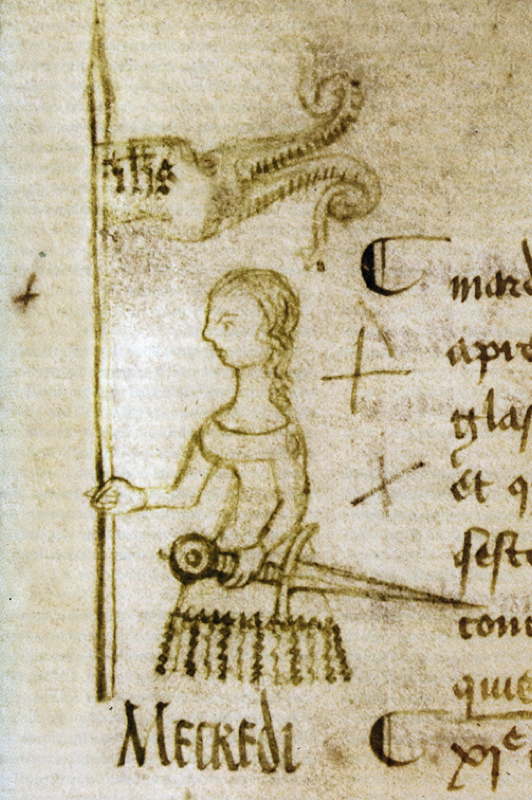
Joan becomes a French national symbol, a Catholic saint, a feminist and theatrical icon, and a recurring film figure. Each afterlife selects a different Joan from the record.
Characters
- Joan of Arc, defendant, visionary, military figure
Young woman whose claimed divine voices, military mission, and refusal to fit expected gender roles made her both powerful and vulnerable.
- Pierre Cauchon, presiding bishop
Bishop of Beauvais who led the condemnation process at Rouen under English political pressure.
- Jean Le Maitre, vice-inquisitor
Inquisitorial representative drawn into the proceedings that condemned Joan.
- Charles VII, French king
The dauphin whom Joan helped bring to coronation at Reims and whose legitimacy shaped the trial's politics.
- St. Catherine and St. Margaret, voices named by Joan
Female saints whom Joan identified among her heavenly counselors and whose authority unsettled her judges.
- Guillaume Bouille, rehabilitation investigator
Cleric associated with the posthumous inquiry that reopened and reversed the condemnation.
Lessons
A hostile archive can preserve a living voice
The trial aimed to control and condemn Joan, yet its questions and answers preserve her pressure-tested intelligence. Readers must use the record gratefully and suspiciously at once.
- Where does Joan seem most in control of the exchange?
- How does a legal transcript shape the person it appears to quote?
Vision becomes dangerous when it authorizes action
Joan's voices were not private consolations; they justified travel, clothing, military intervention, and political obedience. That public effect made them intolerable to enemies and difficult for church authorities to manage.
- Would Joan's voices have been treated differently if they had not affected war politics?
- How does the court try to separate true revelation from dangerous presumption?
Retrospective diagnosis can become another trial
Modern theories about epilepsy, psychosis, migraine, or trauma can illuminate possibilities, but they can also repeat the court's urge to master Joan by classification. Historical tact means admitting uncertainty.
- What evidence would a clinician need that the trial record cannot provide?
- How can medical curiosity avoid becoming reduction?
Canonization and nationalism edit the same person differently
The saint, the patriot, the feminist icon, and the tragic child are all later Joans. Each afterlife is revealing, but none should replace the difficult trial record.
- Which modern Joan is closest to the trial documents?
- What does each later image need to ignore?
Context
Joan's trial belongs to the late Hundred Years' War, when English and Burgundian interests challenged the legitimacy of Charles VII. A visionary who had helped bring him to coronation could be attacked politically by being condemned theologically.
Composition
The condemnation record was produced by the Rouen court in 1431 through interrogations, articles, deliberations, and sentence. The rehabilitation inquiry, opened after the war's balance shifted, collected testimony in the 1450s and annulled the earlier verdict in 1456.
Reception
Joan's reputation moved from heresy conviction to rehabilitation, national myth, Romantic and theatrical fascination, Catholic canonization in 1920, and modern film and political symbolism. The trial remains the core source because it is closest to her spoken self.
Comparisons
- The Trial (Franz Kafka)
Kafka's modern legal nightmare offers opaque accusation without theological certainty; Joan's trial is equally procedural but anchored in war, gender, and claims of revelation.
- the-bible
Joan's judges and defenders both work inside biblical models of prophecy, obedience, and testing spirits; scripture supplies the courtroom's shared grammar.
- early-christian-lives
Ancient martyr acts often stylize defiant answers before judges; Joan's transcript gives a later medieval version with more documentary texture and political pressure.
- the-varieties-of-religious-experience
James helps modern readers think about voices and vocation, but Joan's record shows religious experience under interrogation rather than in reflective case history.
- the-anatomy-of-melancholy
Burton's learned categories for enthusiasm and melancholy reveal how early modern writers might classify visions, while Joan's court used heresy and obedience as its main categories.
- medical-inquiries-and-observations-upon-diseases-of-the-mind
Rush's medicalized explanations of mental disease contrast with the trial's theological-legal framework for judging voices, certainty, and behavior.
Quotes
“Pass that by. I was thirteen when I had a Voice from God for my help and guidance. The first time that I heard this Voice, I was very much frightened; it was mid-day, in the summer, in my father's garden”
“If I were in a wood, I could easily hear the Voice which came to me. It seemed to me to come from lips I should reverence. I believe it was sent me from God”
“I have answered it, and will not, without the leave of Our Lord, reveal what has been revealed to me”
“I would He might send me yet more, so that it might be discerned that I am come from God and that it is He Who hath sent me”
For Students
A reading companion for classical Christian high school students. See the student guide.
Reading Guide
Watch for
- Joan's account of first hearing her Voice at thirteen, at midday in summer in her father's garden at Domremy. Notice how she opens with a refusal to answer before she gives the testimony.
- The question whether Joan knew herself to be in the grace of God, a trap in which yes would sound presumptuous and no would be a confession. Look at how she escapes it by placing the matter in God's hands.
- The repeated questioning about her male clothing, and how Joan ties it to her mission and her safety in prison. Ask why the court treats dress as a matter of faith and obedience.
- Joan's refusals to reveal certain things without the leave of Our Lord, and her distinction between submitting to the Church and submitting to the particular judges in front of her.
- The abjuration in the cemetery of Saint-Ouen in May 1431, her return to male clothing days later, and the rehabilitation witnesses of the 1450s who remember her as simple, devout, and young.
Key terms and names
- The Voices
- The heavenly counsel Joan said she received from Saint Michael, Saint Catherine, and Saint Margaret, beginning when she was thirteen. The judges treated the Voices as the center of the case because they authorized everything else she did.
- Pierre Cauchon
- The bishop of Beauvais, allied with the English and Burgundian party, who presided over the condemnation trial at Rouen. Joan was captured within his diocese, which gave him a claim to judge her.
- Rouen
- The Norman city, held by the English, where Joan was imprisoned, tried, and burned in the Old Market on 30 May 1431.
- Charles VII
- The dauphin whom Joan led to coronation at Reims in July 1429 after the relief of Orleans. Condemning Joan as a heretic also cast doubt on the legitimacy of the king she had crowned.
- Abjuration
- A formal renunciation of errors. Joan signed one on 24 May 1431 under threat of burning, and her return to male clothing soon after was judged a relapse into heresy.
- Relapsed heretic
- A person who returns to errors after formally renouncing them. Under the law of the time, a relapsed heretic was handed to the secular power for execution, which is how Joan's case ended.
- Rehabilitation trial
- The inquiry authorized by Pope Callixtus III that heard witnesses from Domremy, Orleans, and Rouen and annulled the condemnation in July 1456.
Seminar Questions
- Comprehension What does Joan say about when, where, and how she first heard her Voice, and which saints does she name as her counselors?
- Comprehension Why was Joan's case tried before a church court at Rouen, and what were the political stakes for the English and for Charles VII?
- Interpretation Joan often refuses to answer or says she will reveal nothing without God's leave. Are her refusals evasions, acts of obedience to her Voices, or a shrewd defense, and how do the judges read them?
- Interpretation Joan says she would like God to send her yet more, so that it might be seen she comes from Him. What does this answer show about how she understood the purpose of her trial?
- Interpretation The court presses Joan to submit to the Church Militant, and Joan answers that she submits to God first. How does she distinguish the Church from the judges, and was that distinction fair to them or to her?
- Interpretation The rehabilitation witnesses describe a simple, devout girl who loved the sacraments, while the trial record shows a quick and sometimes sharp debater. Can both portraits be true?
- Big Question How should the Church, or anyone, test whether a person who claims a message from God is truly sent, and did the judges at Rouen apply such a test honestly?
Faith Connections
- Matthew 10:16-20 (Scripture)
Jesus sends his disciples out as sheep among wolves, tells them to be wise as serpents and innocent as doves, and promises that when they are brought before governors they will be given what to say. Joan's answers at Rouen, simple and cunning at once, read like a long commentary on this passage.
- 1 John 4:1 (Scripture)
John warns believers not to believe every spirit but to test the spirits whether they are of God. The whole Rouen process claimed to be such a test, and the later annulment judged that it had been carried out in bad faith.
- Judges 4-5 (Scripture)
Deborah, a prophetess, summons Barak to war at God's command and goes with the army into battle. Joan's defenders could point to Deborah as a scriptural precedent for a woman sent by God to deliver her people.
- Jean Gerson, On Distinguishing True from False Revelations (Great Conversation)
Gerson, chancellor of the University of Paris, compared discerning visions to testing a coin and named humility, discretion, patience, truth, and charity as the marks of a genuine revelation. Shortly before his death in 1429 he wrote in support of Joan's mission, so his criteria are a fair measure for the judges who condemned her.
Logic and Rhetoric
Central argument: The court reasoned that private revelations must submit to the judgment of the Church, that Joan refused to submit her Voices and her conduct to the Church as represented by her judges, and that she therefore erred in faith and, after abjuring, relapsed. Joan's answers imply a counterargument: her Voices came from God, she submitted to God and to the Pope but not to judges who were her enemies, and so obedience to God could not be heresy. The rehabilitation trial accepted the force of her side by annulling the verdict.
Rhetorical device: the dilemma and its escape. When asked whether she knew herself to be in the grace of God, Joan faced a trap in which either answer could condemn her. Her reply placed the matter entirely in God's hands, slipping between the horns of the dilemma and turning a theological snare into a prayer.
Debate: Resolved: Joan's refusal to submit her Voices to the judgment of the Rouen court was obedience to God, not disobedience to the Church.
Memory Work
Pass that by. I was thirteen when I had a Voice from God for my help and guidance. The first time that I heard this Voice, I was very much frightened; it was mid-day, in the summer, in my father's garden
I would He might send me yet more, so that it might be discerned that I am come from God and that it is He Who hath sent me
Writing Prompts
Essay: The condemnation record was written by Joan's enemies, yet it preserves her voice more fully than any friendly source. Using her answers about the Voices and her refusals to reveal what God had not permitted, argue what kind of person the hostile record reveals.
Comparison with The Last Days of Socrates: Socrates in the Apology and Joan at Rouen are both tried for their claims to divine guidance, Socrates for his inner sign and Joan for her Voices, and both refuse to buy their lives by denying that guidance. Compare their defenses and argue which one better shows how to stand before an unjust court.
Medical Lens
Joan's voices are a classic case for the ethics of retrospective diagnosis. Epilepsy, migraine, schizophrenia, trauma, and dissociation have all been proposed in modern discussions, but the trial record is not a clinical interview and is shaped by coercion, translation, theology, and politics. Present diagnostic language as hypothesis about reception, not fact about Joan.
- Condemnation trial, first voice testimony
Joan describes onset, fear, time of day, location, light, and auditory experience, giving material often cited in medical speculation.
- Condemnation trial, repeated interrogations
The court repeatedly pressures Joan to define the voices, creating a hostile setting unlike any modern diagnostic encounter.
- Capture, imprisonment, and execution
The wider record involves captivity, threat, public humiliation, and execution, all relevant to trauma-informed reading.
Creative Prompts
- Dialogue
Write a restrained conversation between Joan, William James, and a modern psychiatrist about what can and cannot be known from a trial transcript.
- Essay
Compare Joan's hostile archive with Kafka's Trial, focusing on how institutions produce guilt through procedure.
- Classroom
Have students mark each trial question as theological, political, gendered, or psychological, then discuss where the categories overlap.
Further Reading
- The Trial of Jeanne d'Arc, W. P. Barrett, translator
- Joan of Arc: Her Story, Regine Pernoud and Marie-Veronique Clin
- Joan of Arc: The Image of Female Heroism, Marina Warner
- Personal Recollections of Joan of Arc, Mark Twain
Verification notes
The Murray translation is public domain and useful for a source packet, but exact wording should be checked against a preferred scholarly edition for publication. Medical interpretations are deliberately framed as later hypotheses, not conclusions.
- A future comparison entry could add Mark Twain's Joan novel as an adaptation, but it should not replace the trial record as primary evidence.