Work record
The Bacchae and Other Plays
405 BCE (The Bacchae) · Ancient · Drama · Greek
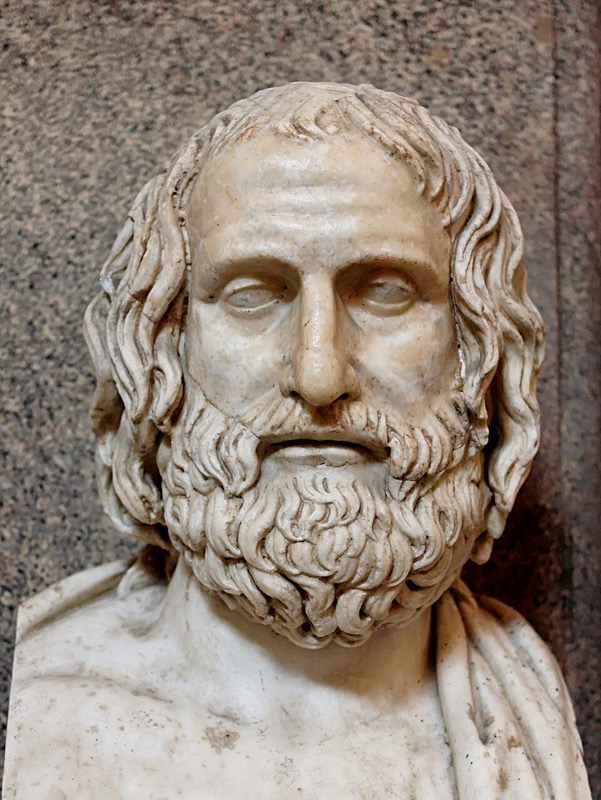

Summary
The Bacchae and Other Plays presents Euripides at his most dangerous: gods are real, but that does not make them gentle. The Bacchae begins when Dionysus arrives at Thebes in disguise to punish the royal house for denying his divinity and slandering his mother Semele. The women of Thebes, including Agave, have gone to Mount Cithaeron in ecstatic worship. Pentheus, young king of Thebes, treats the new cult as a public-order problem: foreign effeminacy, intoxication, sexual disorder and fraud. He imprisons the stranger, but the god easily escapes and draws him into voyeuristic fascination. Persuaded to dress as a woman and spy on the bacchants, Pentheus is exposed in a tree and torn apart by his mother and aunts, who think he is a wild animal. Agave returns carrying his head in triumph until recognition breaks the delusion. Cadmus and the family are left with exile and grief. Other late Euripidean plays often collected with The Bacchae explore similar reversals: human confidence broken by divine plots, households shattered by sacrifice, and women’s ritual voices confronting civic authority. Iphigenia among the Taurians turns sacrifice and recognition into escape; Ion tests divine paternity and maternal secrecy; Helen questions the reality of heroic reputation by substituting phantom for body. The collection’s center remains Dionysus, whose power includes wine, theatre, disguise, collective ecstasy and dismemberment. The Bacchae is not simply anti-rational. It shows reason becoming brittle when it denies the irrational forces a city must acknowledge. Its medical interest lies in intoxication, trance, contagious group behavior, hallucinated recognition and the violent collapse of perception under religious ecstasy. The play is also a meditation on theatre itself. Dionysus directs costumes, entrances, illusions, spectatorship and recognition; Pentheus becomes an audience member destroyed by the spectacle he wants to control. Euripides therefore makes tragic performance part of the god’s power, asking whether art safely represents frenzy or actually participates in it.
Plot or Argument
- Dionysus arrives
The god comes to Thebes disguised as his own priest to avenge denial of his divinity.
- Pentheus resists
The king treats the bacchic rites as sexual, foreign and civic disorder, imprisoning the stranger.
- Ecstasy on the mountain
Reports describe the women nursing animals, performing miracles and tearing cattle apart.
- Disguise and sparagmos
Dionysus persuades Pentheus to dress as a woman, then exposes him to the bacchants, who dismember him.
- Recognition and exile
Agave awakens from delusion, recognizes her son’s head, and the family receives punishment.
Characters
- Dionysus, god and disguised stranger
Punishing deity of wine, theatre and ecstasy who orchestrates Pentheus’ destruction.
- Pentheus, king of Thebes
Young ruler who denies Dionysus and becomes fascinated by the rites he condemns.
- Agave, mother of Pentheus
Bacchant who kills her son under delusion and returns to recognition in grief.
- Cadmus, founder of Thebes
Old king who honors Dionysus but suffers with his family.
- Tiresias, seer
Advises acceptance of Dionysus and ritual humility.
Lessons
Denied forces return violently
Pentheus tries to police Dionysus as if ecstasy were merely disorder. The play teaches that what a culture represses may return in more destructive form.
- What exactly does Pentheus fear?
- Is Dionysus justice, cruelty or both?
Seeing can be a trap
Pentheus wants to see what is forbidden, and Dionysus uses that desire against him. Curiosity becomes exposure.
- Why does voyeurism matter to the plot?
- How is theatre itself implicated?
Ecstasy alters identity
The bacchants become mothers, hunters, nurses and killers in rapid succession. Euripides makes identity fragile under ritual and group emotion.
- When does Agave become responsible again?
- How does costume change Pentheus?
Context
The Bacchae comes from the end of Euripides’ career and reflects Greek fascination with Dionysian religion, theatre, gender inversion and the boundaries of civic order.
Composition
Produced posthumously in 405 BCE with Iphigenia at Aulis and Alcmaeon in Corinth, The Bacchae won first prize according to ancient tradition.
Reception
The play has been central to modern theories of tragedy, ritual, mass psychology, theatre and the irrational, from Nietzsche to contemporary performance.
Comparisons
- the-theban-plays
Both Theban tragic worlds punish rulers who misread divine or ritual claims, but Euripides makes ecstasy itself the central power.
- lysistrata-and-other-plays
Aristophanes makes gender inversion comic and civic; Euripides makes it sacred, erotic and lethal.
- dracula
Both works imagine contagious altered states, nocturnal summons and threatened boundaries of body and community.
Quotes
Frequently cited
“But the world's Wise are not wise, Claiming more than mortal may”
Frequently cited
“There may be many shapes of mystery, And many things God makes to be, Past hope or fear”
For Students
A reading companion for classical Christian high school students. See the student guide.
Reading Guide
Watch for
- The prologue, where Dionysus explains that he has come in mortal disguise to vindicate his mother Semele and punish the house of Cadmus for denying his divinity.
- Old Cadmus and Tiresias dressed in fawnskins and setting off to dance on the mountain. Decide whether the scene is comic, pious, or both, and what each man's reason for joining the rites reveals.
- The palace miracle, in which the stranger escapes his chains, the house shakes, and Pentheus binds a bull in the stable believing it to be his prisoner.
- The scene in which Pentheus, dressed as a woman to spy on the bacchants, says he sees two suns and two cities of Thebes and that the stranger looks like a bull.
- Agave's return from Cithaeron with her son's head, and Cadmus's patient questions that lead her step by step out of delusion and into recognition.
Key terms and names
- Dionysus
- Son of Zeus and the Theban princess Semele, god of wine, ecstasy, and the theatre. In this play he appears disguised as his own long-haired Lydian priest.
- Bacchants (maenads)
- The women possessed by Dionysus. The chorus are Asian followers who came with him; the Theban women, including Agave, have been driven mad onto Mount Cithaeron as punishment.
- Thyrsus
- The fennel staff tipped with ivy carried by the bacchants. In the first messenger speech it strikes water and wine from the rock and becomes a weapon against the villagers.
- Cithaeron
- The mountain near Thebes where the bacchants worship and where Pentheus is torn apart. It is the same mountain where the infant Oedipus was exposed.
- Sparagmos
- The ritual tearing apart of a living creature by the bacchants. The messenger describes it first with cattle and then with Pentheus himself.
- Semele
- Dionysus's mother, killed by Zeus's lightning. Her sisters, including Agave, claimed she lied about a divine lover, and their slander is part of the reason for the god's revenge.
- Theomachos
- The Greek word for one who fights against a god. It describes Pentheus throughout, as Tiresias and Dionysus warn him that he is battling a power he cannot defeat.
Seminar Questions
- Comprehension Why has Dionysus come to Thebes, and what has he already done to the women of the city before the play begins?
- Comprehension What does the first messenger see the bacchants do on Cithaeron before and after they are disturbed by the herdsmen?
- Comprehension How does Cadmus bring Agave back to her senses, and what does she see when she finally looks at what she is holding?
- Interpretation Pentheus condemns the rites as drunken disorder but longs to watch them. What does his fascination reveal about him, and how does Dionysus use it?
- Interpretation The chorus sings that the world's Wise are not wise. Whose wisdom is the target: Pentheus's, Tiresias's clever explanation of the gods, or human reason in general?
- Interpretation At the end, Cadmus protests that gods should not resemble mortals in their anger. Does the play side with the god, with the grieving family, or with neither?
- Big Question Can a city survive by suppressing every power it cannot understand, or must it make room for what lies beyond reason? What is lost either way?
Faith Connections
- Acts 26:14 (Scripture)
The risen Christ tells Saul that it is hard for him to kick against the goads, a Greek proverb that Dionysus also uses to warn Pentheus. The two stories diverge sharply: Saul is struck blind and converted, while Pentheus is blinded by delusion and destroyed.
- Acts 5:38-39 (Scripture)
Gamaliel counsels the Sanhedrin to leave the apostles alone, for if their work is of God they will be found fighting against God. Luke's Greek word for this is the same one used of Pentheus, and Gamaliel's caution is the advice Tiresias gives and Pentheus refuses.
- Acts 2:13-18 and Ephesians 5:18 (Scripture)
At Pentecost the crowd mocks the apostles as drunk on new wine, and Peter answers that this is the outpouring of God's Spirit. Paul later tells the Ephesians not to be drunk with wine but filled with the Spirit, a contrast that sharpens what the play shows of ecstasy that destroys rather than restores the self.
- Augustine, City of God VI.5-7 (Church Fathers)
Augustine discusses Varro's division of theology into the fabulous theology of the poets and theatre, the natural theology of philosophers, and the civil theology of cities, and argues that the stage gods cannot be separated from civic worship. The Bacchae, a play performed at a festival of the god it portrays, is a vivid case of the overlap he describes.
Logic and Rhetoric
Central argument: Dionysus is a true god, son of Zeus, whose power includes wine, ecstasy, and illusion. Pentheus, trusting only human order and reason, denies the god and tries to imprison him. A mortal who fights against a god cannot win, and the force he refuses to acknowledge turns his own desires and his own family against him. Therefore the play's action argues that human wisdom which claims more than mortals may is not wisdom, and that power beyond reason must be reverenced, even when it is terrible.
Rhetorical device: stichomythia. When Pentheus interrogates the captured stranger after the god's arrest, the two exchange single lines in rapid alternation, about the god's rites, his appearance, and his power. The clipped form makes the dialogue a duel in which the disguised god keeps turning the king's questions back on him.
Debate: Resolved: Pentheus is more to blame for his destruction than Dionysus.
Memory Work
But the world's Wise are not wise, Claiming more than mortal may
There may be many shapes of mystery, And many things God makes to be, Past hope or fear
Writing Prompts
Essay: Pentheus begins as the defender of order against a dangerous foreign cult and ends dressed as a bacchant and torn apart by his mother. Trace the stages of his change, from the interrogation of the stranger through the costume scene, and argue what Euripides suggests about the relation between repression and fascination.
Comparison with The Theban Plays: Pentheus in The Bacchae and Creon in Antigone are rulers of Thebes who set the city's order against a divine claim and are destroyed through their own families. Compare the two kings and the gods they oppose, and argue which play presents the more just divine order.
Medical Lens
The Bacchae is a key ancient text for ecstatic altered states. Dionysus is linked to wine, possession, music, dance, disguise and collective frenzy. Pentheus’ and Agave’s misrecognitions are religiously caused within the drama; they should not be reduced to psychosis, yet they are useful for discussing trance, dissociation, group contagion and the medicalization of ecstatic religion. The play also reflects anxieties about women’s bodies, sexuality and intoxication as threats to public order.
- The Bacchae, prologue
Dionysus announces his punitive arrival and the women’s ecstatic departure to the mountain.
- The Bacchae, first messenger speech
The bacchants nurse animals, strike the ground for water and wine, and tear cattle apart.
- The Bacchae, Pentheus disguised
Pentheus’ desire to spy is manipulated through cross-dressing, fascination and altered perception.
- The Bacchae, sparagmos
Agave and the bacchants dismember Pentheus while misrecognizing him as an animal.
- The Bacchae, recognition scene
Agave gradually recognizes she carries her son’s head and enters catastrophic grief.
Creative Prompts
- Adaptation
Set The Bacchae in a city debating whether an ecstatic new movement is public health crisis, cult, art or liberation.
- Essay
Compare Dionysian possession with modern ideas of dissociation while keeping the play’s theology intact.
Further Reading
- The Birth of Tragedy, Friedrich Nietzsche
- The Greeks and the Irrational, E. R. Dodds
- Dionysos: Archetypal Image of Indestructible Life, Karl Kerényi
Verification notes
The Bacchae material is specific; other-play coverage is necessarily general because editions vary.
- Confirm the exact contents of the target volume.