Work record
The Civil War
49-48 BCE · Ancient · History · Latin
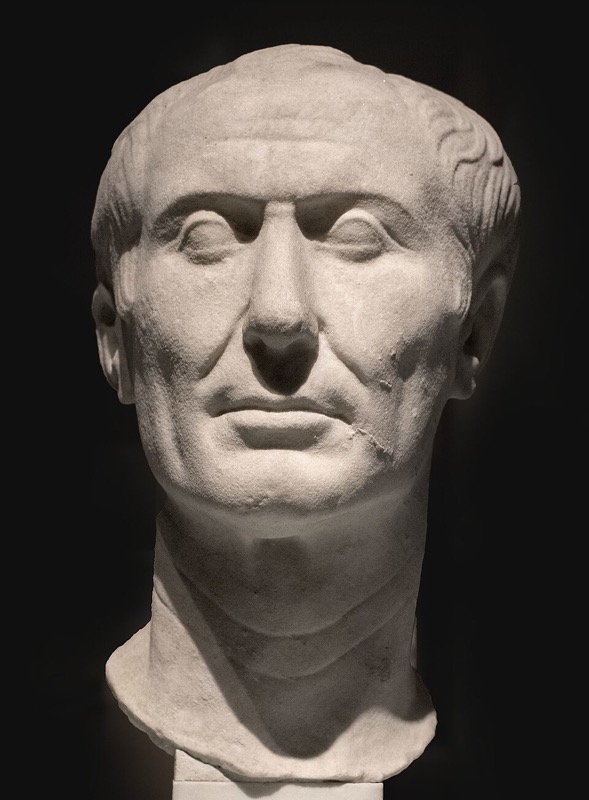
_(cropped).jpg)
Summary
Caesar's Commentarii de Bello Civili, in three books, narrate the first two years of the war he fought against Pompey and the senatorial party, from January 49 BCE to the beginning of the Alexandrian war in late 48. The work is unfinished, breaking off in Alexandria, and it is the most openly political of his writings: its constant task is to show that Caesar was forced into war by a faction of personal enemies, that he repeatedly sought peace, and that he treated defeated fellow citizens with a mercy his opponents never showed. Book I opens abruptly in the Senate, where the consuls refuse to debate Caesar's letter, the tribunes who defend him are driven out, and the emergency decree is passed. Caesar addresses his soldiers on the injury to his dignity and the violation of the tribunes, and moves south. The crossing of the Rubicon, made famous by later writers, is not mentioned. At Corfinium he captures Domitius Ahenobarbus and the senators with him and releases them unharmed, even returning their money. Pompey escapes from Brundisium to Greece. Caesar turns west, leaves a siege at Massilia, and in Spain outmanoeuvres the Pompeian generals Afranius and Petreius near Ilerda, cutting them off from water until their army surrenders without a pitched battle; Caesar presents his refusal to fight as both good generalship and compassion for citizens. Book II follows the fall of Massilia, weakened by hunger and pestilence, the surrender of Varro in Further Spain, and the disaster in Africa, where Caesar's young lieutenant Curio is lured into an ambush by King Juba and dies fighting rather than face Caesar after losing his army. Book III takes Caesar across the Adriatic in winter despite Bibulus's blockade. At Dyrrachium he attempts to wall Pompey's larger army against the sea with miles of entrenchments; his own soldiers live on bread made from a root called chara, while Pompey's men suffer from foul air, dead animals and lack of water. Pompey breaks the lines and inflicts a serious defeat, and Caesar retreats into Thessaly. At Pharsalus on 9 August 48 BCE Pompey's cavalry is routed by a fourth line of infantry, the veteran centurion Crastinus leads the charge and dies, and Pompey's camp, decked out for a victory banquet, is taken. Pompey flees to Egypt and is murdered by the young Ptolemy's agents as he comes ashore. Caesar pursues him to Alexandria, becomes entangled in the dynastic quarrel there, and the narrative stops with the outbreak of fighting in the city. Continuations by other hands cover the Alexandrian, African and Spanish wars. The book is a masterpiece of controlled self-justification, and it is also a record of Romans killing and starving Romans across the Mediterranean.
Plot or Argument
- Book I: the Senate's decree and the march into Italy
Debate in the Senate in January 49 BCE, the expulsion of the tribunes, Caesar's address to his soldiers, the rapid advance through Picenum, clemency at Corfinium, and Pompey's evacuation of Italy from Brundisium.
- Book I: Ilerda and the bloodless victory in Spain
Floods nearly starve Caesar's army; he recovers, shadows Afranius and Petreius in the hills, refuses a battle his men want, cuts off their water and accepts their surrender, releasing the soldiers.
- Book II: Massilia and Further Spain
The Massilians, defeated at sea and weakened by famine and plague, surrender to Trebonius and Caesar; Varro's legions in southern Spain go over to Caesar.
- Book II: Curio in Africa
Curio wins an early success and holds a wavering army with a speech, then is drawn into a trap by Juba's general Saburra on the Bagradas and dies with most of his force.
- Book III: crossing to Greece and the lines at Dyrrachium
A winter crossing past Bibulus's fleet, failed peace overtures, Antony's arrival with reinforcements, and the vast siege works around Pompey's army, ending in Caesar's defeat when Pompey breaks through.
- Book III: Pharsalus
Retreat into Thessaly, Pompeian overconfidence and quarrels over the spoils, the battle in which Caesar's hidden fourth line breaks the cavalry, the storming of Pompey's camp, and the surrender of his army.
- Book III: Pompey's death and Alexandria
Pompey is murdered on landing in Egypt; Caesar arrives, intervenes in the quarrel between Ptolemy and Cleopatra, and is besieged in the palace quarter as the account breaks off.
Characters
- Julius Caesar, narrator (in the third person) and commander
Presents himself as wronged, reasonable and merciful, and as the faster, cooler general.
- Pompey the Great, opposing commander
Caesar's former son-in-law and ally, portrayed as vain, hesitant and captive to his aristocratic supporters.
- Lucius Domitius Ahenobarbus, Pompeian commander
Captured and pardoned at Corfinium, then fights again at Massilia and dies after Pharsalus.
- Afranius and Petreius, Pompeian generals in Spain
Outmanoeuvred at Ilerda; Petreius tries to stop his soldiers fraternising with Caesar's by executing them.
- Gaius Scribonius Curio, Caesar's legate in Africa
Brilliant young former tribune who dies fighting after losing his army to Juba.
- Titus Labienus, Caesar's former lieutenant, now Pompeian
Boasts before Pharsalus that Caesar's veteran army has been destroyed by battle and disease.
- Crastinus, veteran centurion
Volunteer who opens the charge at Pharsalus, promising Caesar gratitude living or dead, and is killed.
- Mark Antony, Caesar's legate
Brings the second wave of the army across the Adriatic to join Caesar.
- Marcus Calpurnius Bibulus, Pompeian admiral
Caesar's old consular colleague, who blockades the Adriatic and dies of illness at sea.
- Ptolemy XIII, Achillas and Pothinus, Egyptian court
The boy king and his advisers who order Pompey's murder and then fight Caesar.
Lessons
Starting a war while claiming to be its victim
Caesar opens not with his army but with the Senate's refusal to hear him, the violation of tribunes and the injustice of his enemies. The book is a case study in how an aggressor constructs a narrative of defence, and in what such narratives choose to leave out, such as the Rubicon.
- Why might Caesar have omitted the crossing of the Rubicon?
- How does the opening scene in the Senate shape your judgment of everything that follows?
- Which of Caesar's grievances seem strongest, and which most self-serving?
Clemency as strategy and as self-portrait
Caesar releases Domitius at Corfinium, spares the Pompeian army at Ilerda and asks his men to spare citizens at Pharsalus. His mercy wins defections and contrasts with Pompeian executions, but it is also a political advertisement written for Roman readers.
- Is Caesar's clemency at Corfinium generosity, calculation, or both?
- How does Petreius's slaughter of fraternising soldiers function in Caesar's narrative?
Winning without battle
At Ilerda Caesar refuses to attack an enemy he could defeat, choosing to cut off water and wait. He argues that a general should conquer by planning as much as by the sword, and that sparing his soldiers and fellow citizens is itself a victory.
- Why were Caesar's own soldiers angry at his restraint?
- Compare Ilerda with Dyrrachium: when does blockade succeed and when does it fail?
- How does Caesar connect compassion with military efficiency in Book I, ch. 72?
Morale is a physical force
Caesar criticises Pompey at Pharsalus for ordering his men to stand still, arguing that a natural ardour in soldiers should be kindled, not suppressed. Throughout the book shouting, rumour, speeches and shame decide outcomes as much as numbers.
- Is Caesar right that Pompey's tactic at Pharsalus was a psychological error?
- How do the speeches of Curio and Labienus reveal what each side believed about the other's morale?
Context
The alliance of Caesar, Pompey and Crassus collapsed after the death of Pompey's wife Julia, Caesar's daughter, in 54 BCE and of Crassus at Carrhae in 53. Caesar's enemies, led by Cato and the consuls of 49, insisted that he lay down his command before standing for a second consulship, exposing him to prosecution. When the Senate passed its emergency decree in January 49 BCE, Caesar's response turned a constitutional dispute into a war across Italy, Spain, Africa, Greece and Egypt.
Composition
Caesar probably wrote the three books in 47–46 BCE, and the work was left unfinished, ending mid-narrative at Alexandria; some scholars think it was published only after his death. Hirtius, author of the eighth book of the Gallic War, may have edited it. The Bellum Alexandrinum, Bellum Africum and Bellum Hispaniense, by other authors, continue the story. The McDevitte and Bohn translation used here was published in 1869 and later reissued in Everyman's Library.
Reception
Ancient readers recognised its partisanship; Asinius Pollio, who served under Caesar, accused him of inaccuracy. Lucan's epic Pharsalia (60s CE) answered it with a bitterly anti-Caesarian version of the same war. Modern historians rely on it heavily for military events while reading it as political literature, and its spare narrative of a general marching on his own capital has been read alongside every later case of a commander turning his army inward.
Comparisons
- the-conquest-of-gaul
The Gallic Commentaries narrate foreign conquest with little need for self-defence; the Civil War carries the same style into a domestic quarrel, where every paragraph must also prove that Caesar is not a tyrant.
- the-fall-of-the-roman-republic
Plutarch's Lives of Caesar, Pompey and Cato tell the same war from several sides, including the Rubicon crossing and Pompey's last hours that Caesar either omits or compresses.
- the-twelve-caesars
Suetonius supplies the famous words at the Rubicon and the tradition of Caesar's seizures, and judges the Commentaries as a historian a century later, after the Republic they claimed to defend had become an empire.
- the-annals-of-imperial-rome
Tacitus writes from inside the monarchy that Caesar's victory made possible, and his account of how liberty was lost under the emperors is the long sequel to the war narrated here.
- the-history-of-the-peloponnesian-war
Thucydides' account of stasis at Corcyra, where words changed their meanings in civil strife, is the classic analysis of the moral breakdown that Caesar's calm narrative of Romans fighting Romans conceals.
- personal-memoirs
Grant also narrates a civil war he won with conspicuous magnanimity toward the defeated, but writes after the fighting is over as a citizen, not as a commander still seeking legitimacy.
Quotes
“When Caesar's letter was delivered to the consuls, they were with great difficulty, and a hard struggle of the tribunes, prevailed on to suffer it to be read in the senate”
“When they were brought before him he protected them from the insolence and taunts of the soldiers; told them in few words that they had not made him a grateful return, on their part, for his very extraordinary kindness to them, and dismissed them all in safety”
“Why should he hazard the loss of any of his men, even in a successful battle? Why should he expose soldiers to be wounded; who had deserved so well of him? Why, in short, should he tempt fortune? especially when it was as much a general's duty to conquer by tactics, as by the sword”
“struggling moreover with a fatal pestilence, from their long confinement and change of victuals (for they all subsisted on old millet and damaged barley, which they had formerly provided and laid up in the public stores against an emergency of this kind”
“But Curio declared that he would never more appear in Caesar's sight, after losing the army which had been committed by Caesar to his charge, and accordingly fought till he was killed”
“There was a sort of root, called chara, discovered by the troops which served under Valerius. This they mixed up with milk, and it greatly contributed to relieve their want”
“that they themselves were not in good health from their confinement within so narrow a compass, from the noisome smell, the number of carcasses, and the constant fatigue to them, being men unaccustomed to work, and labouring under a great want of water”
“many fell victims to the autumnal pestilence in Italy, many returned home, and many were left behind on the continent. Have you not heard that the cohorts at Brundisium are composed of invalids”
“General, I will act in such a manner to-day, that you will feel grateful to me living or dead”
“for there is a certain impetuosity of spirit and an alacrity implanted by nature in the hearts of all men, which is inflamed by a desire to meet the foe. This a general should endeavour not to repress, but to increase”
“he embarked in a small boat with a few attendants, and was there murdered by Achillas and Septimius”
For Students
A reading companion for classical Christian high school students. See the student guide.
Reading Guide
Watch for
- The abrupt opening of Book I in the Senate, where the consuls barely allow Caesar's letter to be read. Notice that Caesar never mentions crossing the Rubicon.
- The release of Domitius and the senators at Corfinium (I.23) and the bloodless surrender at Ilerda (I.72-84). Watch how each act of mercy is also presented as good strategy.
- Curio's speech to his wavering troops in Africa and his choice to die fighting rather than face Caesar after losing his army (II.42).
- The siege lines at Dyrrachium in Book III, with Caesar's men eating bread made from the root chara while Pompey's men sicken from foul air and lack of water.
- The scenes before Pharsalus: Labienus's boast that Caesar's veterans are gone, the Pompeians quarrelling over offices they have not yet won, and Crastinus's promise to his general.
Key terms and names
- Senatus consultum ultimum
- The Senate's emergency decree of January 49 BCE directing the magistrates to see that the state took no harm. Caesar presents its passage as the act that drove him to war.
- Dignitas
- A Roman noble's standing, honour, and claim to office. Caesar tells his soldiers in Book I that his enemies have injured his dignity, and he treats its defence as a just cause.
- Clemency (clementia)
- Caesar's policy of sparing defeated fellow citizens, shown at Corfinium and Ilerda. He sets it against the severity of Pompeians such as Petreius, who executes soldiers caught fraternising with Caesar's men.
- Tribunes
- The magistrates whose persons were sacred and whose veto protected the people. The flight from Rome of the tribunes loyal to Caesar is one of his chief grievances in Book I.
- Corfinium
- The Italian town where Caesar captures Domitius Ahenobarbus and the senators with him early in 49 BCE and releases them unharmed, even returning their money.
- Dyrrachium
- The Adriatic port where Caesar tries to wall in Pompey's larger army with miles of entrenchments in 48 BCE. Pompey breaks through and inflicts Caesar's worst defeat of the war.
- Pharsalus
- The battle in Thessaly on 9 August 48 BCE where Caesar's hidden fourth line routs Pompey's cavalry and decides the war.
Seminar Questions
- Comprehension What happens in the Senate in the opening chapters of Book I, and what reasons does Caesar give his soldiers for marching on Italy?
- Comprehension How does Caesar win at Ilerda without a pitched battle, and what does he do with the surrendered army of Afranius and Petreius?
- Comprehension What happens to Curio in Africa, and why does he refuse to escape after his army is destroyed?
- Interpretation At Ilerda Caesar asks why he should hazard the loss of any of his men, even in a successful battle. Is this reasoning about tactics, about compassion for citizens, or about how Caesar wants to be seen in Rome?
- Interpretation Caesar describes the Pompeian camp at Pharsalus decked out for a victory banquet and its leaders quarrelling over priesthoods and offices. What is he trying to make the reader feel about his opponents, and does it work?
- Interpretation Caesar never mentions the Rubicon and says little of his own ambitions. What do these omissions reveal about his purpose in writing?
- Big Question Can a man who starts a civil war in defence of his own honour and rights be just, if he fights it with restraint and mercy?
Faith Connections
- James 4:1-2 (Scripture)
James asks where wars and fightings come from and answers that they come from desires that war within us. Caesar traces the war entirely to his enemies' envy and pride; James sends the reader back to ask what desires drove Caesar himself.
- Proverbs 16:32 (Scripture)
The proverb says that one who rules his spirit is better than one who takes a city. Caesar's refusal at Ilerda to give his eager soldiers the battle they wanted is his own best example of command over impulse, though he turns it to his advantage.
- Matthew 26:52 (Scripture)
Jesus warns that those who take the sword will perish by the sword. Book III ends with Pompey stabbed in a small boat off Egypt, and readers of Caesar have always known that the author himself would be killed in the Senate four years later.
- Augustine, City of God V (Church Fathers)
Augustine argues in Book V that the Romans restrained many vices through their great love of praise and glory, and that God granted them dominion as a temporal reward for those virtues. Caesar's concern for his dignity and reputation is a textbook case of the motive Augustine analyses.
Logic and Rhetoric
Central argument: A faction of personal enemies, by violating the tribunes and refusing Caesar's lawful claims, forced him to defend his dignity and the rights of the Roman people by arms. He repeatedly offered peace and was refused. He treated captured citizens with mercy while his opponents were cruel, and he won by speed, skill, and the loyalty of his soldiers rather than by bloodshed for its own sake. Therefore his cause was just and his victory deserved.
Rhetorical device: illeism with indirect speech. Caesar refers to himself throughout as Caesar and reports his own reasoning in indirect speech. At Ilerda (I.72) his decision not to fight appears as a series of questions put in the third person, ending with the claim that it was as much a general's duty to conquer by tactics as by the sword, so that self-justification reads like an impartial dispatch.
Debate: Resolved: Caesar's clemency at Corfinium was political calculation rather than mercy.
Memory Work
General, I will act in such a manner to-day, that you will feel grateful to me living or dead
Why should he hazard the loss of any of his men, even in a successful battle? Why should he expose soldiers to be wounded; who had deserved so well of him? Why, in short, should he tempt fortune? especially when it was as much a general's duty to conquer by tactics, as by the sword
Writing Prompts
Essay: Caesar presents himself throughout The Civil War as wronged, reasonable, and merciful. Using Corfinium, Ilerda, and his treatment of the Pompeians after Pharsalus, argue whether his account of his own clemency persuades a careful reader, and what evidence in his own narrative works against it.
Comparison with The Fall of the Roman Republic: Six Lives: Plutarch's Lives of Caesar and Pompey tell the same war from outside, including the crossing of the Rubicon that Caesar leaves out. Compare the two accounts of the outbreak of war and the death of Pompey, and argue what each author's choices reveal about his purpose.
Medical Lens
The Civil War is a war of blockades, and its medical interest lies in siege hygiene and supply. Massilia's pestilence is attributed to confinement and spoiled grain; Pompey's army at Dyrrachium sickens from crowding, carcasses and lack of water; Caesar's army survives on root bread; Labienus claims autumn fever in Italy has wasted Caesar's veterans. These passages are early examples of the link between military logistics, sanitation and epidemic disease that dominated army medicine until the twentieth century. Caesar repeatedly notes provision for the sick and wounded, such as sending them to Apollonia after Dyrrachium. Curio's death and Cato's later suicide at Utica (outside this text) show Roman honour cultures in which death was preferred to defeat. Caesar's own reported epilepsy, recorded by Suetonius and Plutarch, is absent from his self-portrait.
- Book I.48–52
Floods cut Caesar's army off from supply near Ilerda; famine prices and hardship in the camp until the bridges are restored.
- Book I.81–84
The Pompeian army in Spain, cut off from water and forage, kills its baggage animals and surrenders.
- Book II.22
Massilia's surrender after famine and a fatal pestilence attributed to confinement and old millet and barley.
- Book II.41–42
Curio's exhausted and wounded men cannot break out; Curio refuses flight and fights until killed.
- Book III.47–49
Dyrrachium: Caesar's troops eat chara bread and bark; Pompey's army suffers from foul smells, carcasses, hard labour and lack of water after Caesar dams the streams.
- Book III.75–78
After the defeat at Dyrrachium Caesar delays only to care for the sick and wounded and sends them to Apollonia before retreating.
- Book III.87
Labienus describes Caesar's veterans as wasted by autumn pestilence in Italy, with invalid cohorts at Brundisium.
Creative Prompts
- Fiction
Write the night at Corfinium from Domitius Ahenobarbus's point of view as he waits to learn whether Caesar will kill him.
- Dialogue
Stage an argument in Pompey's lines at Dyrrachium between a military physician and an officer about whether to break out before disease does Caesar's work for him.
- Essay
Compare Caesar's account of Pharsalus with Lucan's in the Pharsalia. How do the two writers make the same battle mean opposite things?
- Classroom
Have students list every claim in Book I that Caesar was forced into war, then reconstruct the case his enemies would have made from the same events.
Further Reading
- The Conquest of Gaul, Julius Caesar
The commentaries on the Gallic campaigns that preceded this war.
- Pharsalia (The Civil War), Lucan
The anti-Caesarian epic on the same war.
- The Roman Revolution, Ronald Syme
Classic account of the fall of the Republic.
- Rubicon: The Last Years of the Roman Republic, Tom Holland
- Caesar: Life of a Colossus, Adrian Goldsworthy
Verification notes
Narrative content and chapter numbers for quotations were checked against the stored McDevitte and Bohn text (Project Gutenberg #10657), whose Civil War section begins after Hirtius's Book VIII of the Gallic War. Quotations are copied from it with line breaks normalized and have not yet been run through scripts/verify-quotes.mjs. Dates of composition and publication are debated by scholars.
- Chapter ranges for unquoted passage pointers (I.48–52 floods, I.81–84 Pompeian thirst, III.75–78 sick and wounded).
- Date of the battle of Pharsalus as 9 August 48 BCE in the pre-Julian calendar.
- Whether the stored text includes any of the Alexandrian, African or Spanish War continuations (its index cites only Gallic and Civil War books).