Work record
The Histories
c. 430 BCE · Ancient · History · Ancient Greek
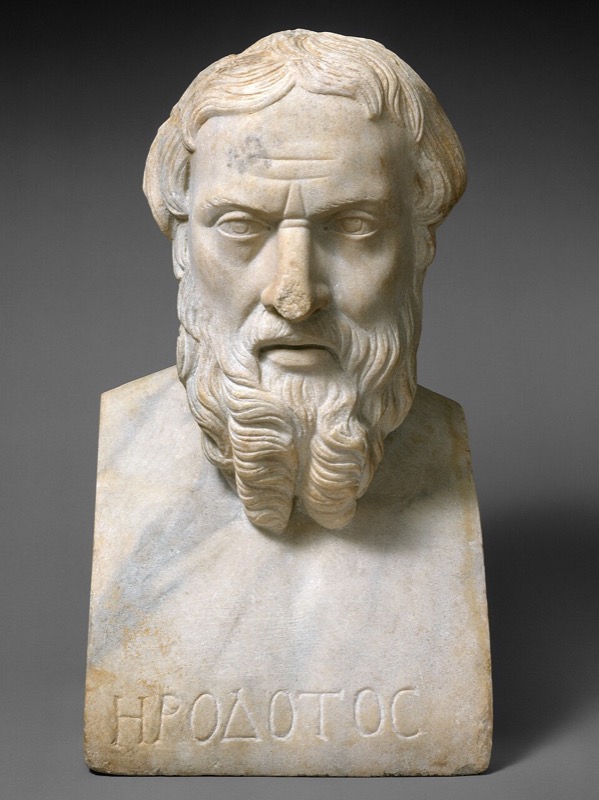
.jpg)
Summary
The Histories is the first great work of prose history in the Western tradition, an inquiry (historia) into the causes and course of the wars between the Greeks and the Persian Empire. Herodotus states his purpose in the opening: to preserve the memory of great and marvellous deeds of Greeks and barbarians, and especially the reason why they fought one another. Later divided into nine books named after the Muses, the work moves outward from this question into a vast panorama of the known world. Book One begins with legendary abductions of women, then turns to Croesus of Lydia, his conversation with the Athenian sage Solon about happiness and fortune, his misreading of the Delphic oracle, and his defeat by Cyrus the Great, whose rise and conquest of Babylon follow. Book Two is devoted to Egypt: its geography, the Nile's flooding, its religion, customs, animals, embalming practices and the history of its kings. Book Three covers Cambyses' conquest of Egypt and his madness, the usurpation of the false Smerdis, the debate among the Persian conspirators over the best form of government, and the accession of Darius. Book Four describes the Scythians and Libyans and Darius' failed invasion of Scythia. Book Five recounts the Ionian Revolt against Persia, supported by Athens. Book Six describes its suppression, the madness of the Spartan king Cleomenes, and the first Persian invasion of Greece ending at Marathon in 490 BCE. Books Seven to Nine narrate Xerxes' great invasion of 480–479: the bridging of the Hellespont, the review of the vast army, the stand of Leonidas and the three hundred Spartans at Thermopylae, the sack of Athens, the naval victory at Salamis, Xerxes' retreat, and the final Greek victories at Plataea and Mycale. Herodotus' method combines what he has seen, what he has heard, and his own judgement, and he often reports multiple versions of a story, sometimes saying which he believes. His narrative is enriched by digressions, anecdotes, oracles and dreams, and by a deep interest in the customs of other peoples, famously concluding that each people believes its own customs best. Underlying the whole is a moral and religious pattern in which excessive power and arrogance are followed by reversal, and in which human fortune never stays in one place.
Plot or Argument
- Book 1 (Clio): Croesus and Cyrus
Origins of the conflict, Croesus and Solon, the fall of Lydia, the rise of Cyrus and the conquest of Babylon.
- Book 2 (Euterpe): Egypt
The Nile, Egyptian customs, religion, medicine, embalming, and the history of the pharaohs.
- Book 3 (Thalia): Cambyses and Darius
Cambyses' conquest of Egypt and madness, the Magian usurpation, the constitutional debate and the accession of Darius.
- Book 4 (Melpomene): Scythia and Libya
Scythian customs and Darius' failed campaign; the peoples of Libya.
- Books 5–6 (Terpsichore, Erato): the Ionian Revolt and Marathon
The Ionian Revolt, the madness of Cleomenes, and the Athenian victory at Marathon.
- Books 7–9 (Polymnia, Urania, Calliope): Xerxes' invasion
Thermopylae, Salamis, Plataea and Mycale; the defeat of the Persian invasion.
Characters
- Croesus, king of Lydia
Rich king whose misunderstanding of fortune and oracles leads to his fall.
- Solon, Athenian lawgiver
Sage who warns Croesus that no one should be judged fortunate until the end of life.
- Cyrus the Great, founder of the Persian Empire
Conqueror of Lydia and Babylon, killed fighting the Massagetae.
- Cambyses, Persian king
Conqueror of Egypt whose madness Herodotus documents.
- Darius I, Persian king
Organizer of the empire and initiator of the first invasion of Greece.
- Xerxes, Persian king
Leader of the great invasion of 480 BCE.
- Leonidas, Spartan king
Commander of the stand at Thermopylae.
- Themistocles, Athenian statesman
Strategist of the naval victory at Salamis.
- Democedes, physician
Greek doctor from Croton who treats Darius and his queen Atossa.
- Cleomenes, Spartan king
King who goes mad and mutilates himself.
Lessons
Call no one happy until the end
Solon's warning to Croesus, that fortune is unstable and a life can only be judged when it is complete, frames the entire work. Human prosperity is precarious.
- How does the Croesus story prefigure Xerxes'?
- Is Solon's view wise, or merely pessimistic?
Custom is king
Herodotus records that Darius asked Greeks and Indians whether they would adopt each other's funeral customs, and both were horrified. His ethnography shows respect for cultural difference rare in his time.
- Where does Herodotus judge other peoples, and where does he suspend judgement?
- Is cultural relativism a strength or weakness of his history?
Inquiry and evidence
Herodotus distinguishes what he saw, what he heard and what he believes, sometimes reporting stories he doubts. His method invented history as a critical discipline.
- Why does Herodotus report stories he does not believe?
- How does his method compare with Thucydides'?
- Is he the 'father of history' or the 'father of lies'?
Context
The Persian Wars of 490 and 480–479 BCE preserved Greek independence and were followed by Athenian imperial expansion. Herodotus wrote during the tensions leading to the Peloponnesian War, which he alludes to, and drew on oral tradition, inscriptions, temple records and his own travels.
Composition
Probably composed over decades and completed in the 420s BCE. The division into nine books named for the Muses was made by later Alexandrian scholars.
Reception
Thucydides implicitly criticized his love of stories, and Plutarch wrote an essay 'On the Malice of Herodotus', but he remained a model historian. Modern archaeology and ethnography have confirmed some of his reports and corrected others.
Comparisons
- the-iliad
Herodotus begins with the abductions of women as causes of war, glancing at Helen; his epic scope and speeches owe much to Homer.
- the-agricola-and-the-germania
Tacitus' ethnography of the Germans continues Herodotus' tradition of describing other peoples' customs.
- persian-letters
Montesquieu reverses Herodotus' gaze, letting Persians describe the Greeks' heirs.
- in-patagonia
Chatwin's travel book, full of digressions, tall tales and odd customs, is often compared with Herodotus' method.
- the-age-of-alexander
Plutarch's Alexander conquers the Persian Empire whose rise Herodotus described.
Quotes
“This is the Showing forth of the Inquiry of Herodotus of Halicarnassos, to the end that neither the deeds of men may be forgotten by lapse of time”
For Students
A reading companion for classical Christian high school students. See the student guide.
Reading Guide
Watch for
- The opening statement of purpose in Book 1 and the quick dismissal of the Persian and Phoenician tales of stolen women, after which Herodotus turns to Croesus as the first man he knows to have wronged the Greeks.
- Solon's visit to Croesus in Book 1, his stories of Tellus the Athenian and of Cleobis and Biton, and the scene on the pyre when the defeated Croesus calls out Solon's name to Cyrus.
- Darius's experiment in Book 3.38, when Greeks and Callatians are each horrified by the other's funeral customs, and the debate of the Persian conspirators in Book 3.80-82 over democracy, oligarchy, and monarchy.
- Xerxes in Book 7: his dreams urging the invasion, his whipping of the Hellespont, his tears at Abydos over the shortness of life, and Demaratus telling him that the Spartans fear their law more than his subjects fear him.
- The oracle of the wooden wall in Book 7 and Themistocles' reading of it as the fleet, which leads to Salamis in Book 8.
Key terms and names
- Historia
- The Greek word Herodotus uses for his work, meaning inquiry or investigation. He presents his book as the publication of what he learned by seeing, hearing, and judging.
- Croesus
- The wealthy king of Lydia in Book 1 who believes himself the happiest of men, misreads the Delphic oracle that a great empire will fall if he attacks Persia, and loses his own. His fall is the pattern for later reversals in the work.
- Solon
- The Athenian lawgiver who tells Croesus that no one should be called happy until the end of his life is seen. His warning frames the entire Histories.
- Custom (nomos)
- The laws and usages of a people. In Book 3.38 Herodotus quotes Pindar that custom is king of all, after showing that every people judges its own customs best.
- Divine envy
- The idea, voiced by Solon in Book 1 and Artabanus in Book 7, that the divine strikes down what grows too great. Herodotus uses it to explain the fall of the powerful.
- Thermopylae
- The narrow pass in Book 7 where Leonidas and his Spartans, with their allies, hold back Xerxes' army until a traitor reveals a path around them. Herodotus records the epitaph set up for the fallen.
- Wooden wall
- The phrase in the second Delphic oracle to Athens in Book 7. Themistocles argues it means the fleet, persuading the Athenians to abandon their city and fight at sea.
Seminar Questions
- Comprehension Whom does Solon name as the happiest men he has known, and why does Croesus find his answer insulting?
- Comprehension In the Persian debate of Book 3.80-82, what arguments do Otanes, Megabyzus, and Darius each make, and which side wins?
- Interpretation Croesus misreads one oracle and the Athenians, guided by Themistocles, read another well. What makes the difference between them, and what does Herodotus suggest about how human beings should approach the divine?
- Interpretation Xerxes weeps at Abydos that none of his vast army will be alive in a hundred years, yet goes on with the invasion. What does this scene reveal about him, and how does it echo Solon's lesson to Croesus?
- Interpretation Demaratus tells Xerxes in Book 7 that the Spartans are free but have a master, the law. How does the Histories as a whole explain why a small number of free Greeks defeated a great empire?
- Interpretation Herodotus often gives two or more versions of a story and sometimes says he does not believe the one he reports. Does this make him a less reliable historian or a more honest one?
- Big Question Darius's experiment shows that every people thinks its own customs best. Does it follow that no custom is truly better than another? How would Herodotus answer, given his own praise of Greek freedom?
Faith Connections
- Isaiah 44:28-45:7 (Scripture)
Isaiah names Cyrus as the Lord's shepherd and anointed, whose right hand God holds to subdue nations. Herodotus tells the rise of the same Cyrus in Book 1 as a story of exposure, survival, and conquest, and the two accounts ask together who truly governs the rise of empires.
- Proverbs 16:18 (Scripture)
Pride goes before destruction and a haughty spirit before a fall. Croesus, Cambyses, and Xerxes all enact this proverb in Herodotus, though he explains their falls through fortune and divine envy rather than the justice of a personal God.
- Augustine, City of God V (Church Fathers)
Augustine argues that the one true God, not fortune or fate, grants kingdoms to whom he wills, including the Persians and the Romans. His account offers an alternative to the Herodotean pattern of a jealous divine power cutting down whatever grows too great.
- Boethius, Consolation of Philosophy II (Great Conversation)
When Lady Philosophy has Fortune defend herself, Fortune recalls how Croesus, king of the Lydians, was saved from the flames by a shower from heaven. Boethius takes Herodotus's story of the pyre into Christian reflection on the turning wheel of fortune.
Logic and Rhetoric
Central argument: Human fortune never remains in one place, and the divine strikes down what exalts itself beyond measure. Croesus, Cyrus, Cambyses, Darius, and Xerxes each sought more than was given them and each met reversal. The Persian invasion of Greece was the greatest example of such overreach, while the Greeks, who obeyed law rather than a master, defended their freedom. Therefore the deeds of both Greeks and barbarians should be remembered as a lesson that no one may be called happy until the end, and that power without measure prepares its own fall.
Rhetorical device: ring composition. Herodotus opens Book 1 by asking who first wronged whom between Asia and Europe and ends Book 9 with an anecdote in which Cyrus warns the Persians that soft lands breed soft men. The return to Cyrus at the end closes the circle begun with his rise, so that the whole history is framed by the founder of the empire whose fall it records.
Debate: Resolved: Herodotus is right that no one should be called happy until the end of his life.
Writing Prompts
Essay: Herodotus repeatedly stages a wise adviser warning a king: Solon and Croesus, Croesus and Cyrus, Artabanus and Xerxes, Demaratus and Xerxes. Choose two of these pairs and argue what the pattern teaches about power, counsel, and the limits of human knowledge in the Histories.
Comparison with The History of the Peloponnesian War: Thucydides begins his history by implicitly criticizing those who write to please the ear, and many readers take Herodotus as his target. Compare how each historian explains the cause of the war he narrates, Herodotus through the Croesus story and the pattern of overreach and Thucydides through Athenian power and Spartan fear, and argue which method gives the truer account of why nations go to war.
Medical Lens
Herodotus is a treasure-house for the history of medicine. He describes Egyptian medicine as highly specialized, with physicians for each part of the body, and gives the most detailed ancient account of mummification. He tells the story of Democedes of Croton, a Greek physician enslaved by the Persians who heals Darius' dislocated ankle when the Egyptian doctors fail, and later Queen Atossa's breast abscess. He reports Cambyses' madness and considers that he may have suffered from the 'sacred disease' from birth, a key early discussion of epilepsy and madness; likewise Cleomenes' madness, which the Spartans attributed to his drinking unmixed wine. He describes Scythians inhaling the vapour of hemp seeds thrown on hot stones in a felt tent and howling with pleasure, the earliest literary account of cannabis use. He mentions the Babylonians bringing the sick into the marketplace for advice from passers-by, and the Scythian 'Enarees' afflicted with a 'female disease'. Plague and dysentery ravage Xerxes' retreating army. These are reports, not verified facts, and modern diagnoses are retrospective.
- Book 1.105; 4.67
The Scythian Enarees, men afflicted by a 'female disease', said to be punishment for plundering a temple.
- Book 1.197
The Babylonians, having no physicians, carry the sick into the market so passers-by can advise them.
- Book 2.84–88
Egyptian medical specialization and the three grades of embalming, with removal of brain and viscera.
- Book 3.29–38
Cambyses' madness, his killing of the Apis bull, and Herodotus' suggestion that he had the 'sacred disease'.
- Book 3.129–137
Democedes of Croton heals Darius' dislocated ankle and Atossa's breast growth, then escapes to Greece.
- Book 4.73–75
Scythians purify themselves after funerals by inhaling hemp-seed vapour in felt tents.
- Book 6.75, 84
Cleomenes goes mad and mutilates himself with a knife; the Spartans blame his habit of drinking unmixed wine.
- Book 7.12–18
Xerxes' and Artabanus' recurring dreams urging the invasion, with a discussion of whether dreams are meaningful.
- Book 8.115
Plague and dysentery afflict Xerxes' army on its retreat through Thrace.
Creative Prompts
- Fiction
Retell the story of Democedes, the enslaved Greek doctor at the Persian court, as a historical short story.
- Classroom
Compare Herodotus' account of embalming with modern understanding of Egyptian mummification.
Further Reading
- History of the Peloponnesian War, Thucydides
- The Landmark Herodotus, Robert B. Strassler (ed.)
- Travels with Herodotus, Ryszard Kapuściński
- The Mirror of Herodotus, François Hartog
Verification notes
Structure, contents and medical episodes are well established; section numbers follow standard divisions and are approximate within a few sections. The single quotation is the opening of Macaulay's 1890 translation, cut at a natural clause break; its spelling ('Halicarnassos') and capitalization should be checked.
- Exact Macaulay wording and spelling of the opening (1.0).
- Macaulay's wording of Solon's advice to Croesus (1.32), omitted from quotes.
- Section numbers for Cleomenes' madness (6.75, 84) and the Enarees (1.105; 4.67).
- Whether Herodotus explicitly calls Cambyses' affliction the 'sacred disease' at 3.33.