Work record
Frankenstein
1818 (revised 1831) · 19th Century · Novel · English
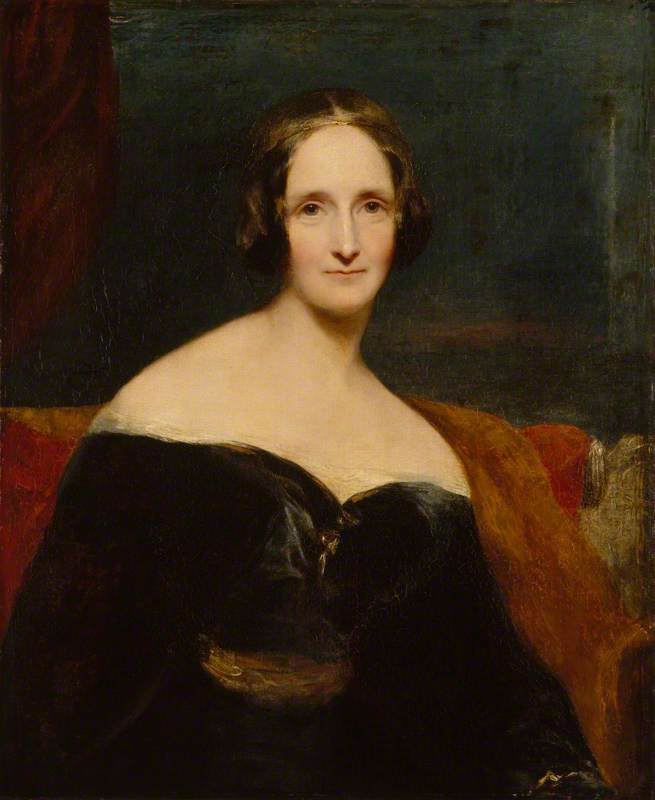
_-_Mary_Wollstonecraft_Shelley_-_NPG_1235_-_National_Portrait_Gallery.jpg)
Summary
Frankenstein; or, The Modern Prometheus is a frame narrative told through the letters of Robert Walton, an English explorer whose ship is trapped in Arctic ice. Walton rescues a dying stranger, Victor Frankenstein, who has been pursuing a gigantic figure across the frozen sea, and who tells his story as a warning to a man whose ambition resembles his own. Victor grows up in Geneva in a loving family that includes his adopted companion Elizabeth Lavenza and his friend Henry Clerval. As a boy he is captivated by the discredited natural philosophers Cornelius Agrippa, Paracelsus and Albertus Magnus. His mother dies of scarlet fever caught while nursing Elizabeth, just before he leaves for the University of Ingolstadt. There the chemist Waldman redirects his zeal toward modern science, and Victor, studying anatomy and the decay of bodies, discovers the secret of animating lifeless matter. Working in isolation for nearly two years, he assembles a human form of gigantic stature from materials gathered in charnel houses, dissecting rooms and slaughterhouses. When the creature opens its eyes, Victor is overcome with horror and flees. He collapses into a long nervous fever and is nursed back to health by Clerval. Months later his young brother William is murdered; the family servant Justine Moritz is convicted and executed, while Victor, certain that his creation is the killer, stays silent. In the Alps the creature confronts him and tells his own story. Abandoned at birth, he taught himself language and feeling by secretly observing the De Lacey family, and read Paradise Lost, Plutarch's Lives and The Sorrows of Werter. Every attempt at human contact ended in violent rejection, and his benevolence turned to rage. He demands a female companion and promises to withdraw with her from humanity. Victor agrees, but on a remote Orkney island he destroys the half-finished female, fearing a race of such beings. The creature vows revenge: he strangles Clerval, and on Victor's wedding night he kills Elizabeth. Victor's father dies of grief. Victor then devotes his life to pursuit, following the creature to the Arctic. He dies aboard Walton's ship; the creature appears over his body, voices remorse and despair, and departs on an ice raft, announcing that he will destroy himself on a funeral pyre. Walton, persuaded by his crew, turns back south.
Plot or Argument
- Walton's letters (frame)
Robert Walton writes to his sister Margaret Saville from St Petersburg and then the Arctic about his ambition to reach the pole. Trapped in ice, his crew takes aboard the exhausted Victor Frankenstein.
- Victor's education and the creation (Vol. I)
Victor recounts his Genevan childhood, his early fascination with alchemy, his mother's death, and his studies at Ingolstadt. Obsessive work in anatomy and chemistry culminates in the animation of the creature, from which he flees; a nervous fever follows.
- William and Justine (Vol. I–II)
William is murdered and Justine Moritz is tried and executed on circumstantial evidence. Victor, guilt-stricken and silent, sinks into despondency and seeks relief in the Alps.
- The creature's narrative (Vol. II)
On the Mer de Glace the creature tells how he learned to speak and read by watching the De Lacey cottagers, how his attempts at kindness were met with terror and violence, and how he killed William. He demands a companion of his own kind.
- The second creation and its destruction (Vol. III)
Victor travels to Britain with Clerval and works on a female creature in Orkney, then tears it apart. The creature murders Clerval; Victor is imprisoned in Ireland, falls ill, and is acquitted.
- Wedding night and pursuit (Vol. III)
The creature kills Elizabeth on her wedding night; Victor's father dies. Victor vows vengeance and chases the creature across Europe and Russia into the Arctic.
- Walton's conclusion
Victor dies on Walton's ship. The creature mourns over him, condemns himself, and leaves to die by fire, while Walton abandons his expedition.
Characters
- Victor Frankenstein, protagonist, narrator
Genevan student of natural philosophy whose obsessive ambition creates life and whose refusal of responsibility destroys his family.
- The Creature, antagonist, narrator
Victor's unnamed creation: eloquent, self-educated, initially benevolent, turned murderous by rejection and loneliness.
- Robert Walton, frame narrator
Arctic explorer whose ambition mirrors Victor's; recipient of the story.
- Elizabeth Lavenza, Victor's adopted sister and bride
Orphan raised by the Frankensteins; murdered on her wedding night.
- Henry Clerval, Victor's friend
Humane, literary companion who nurses Victor through his fever; murdered by the creature.
- Alphonse Frankenstein, Victor's father
Respected Genevan citizen who dies of grief after Elizabeth's death.
- William Frankenstein, Victor's youngest brother
Child whose murder is the creature's first killing.
- Justine Moritz, family servant
Wrongly convicted and executed for William's murder.
- M. Waldman, professor of chemistry
Ingolstadt teacher who inspires Victor toward modern experimental science.
- The De Lacey family, cottagers
Exiled French family whose life the creature secretly observes and who reject him when he reveals himself.
Lessons
Responsibility does not end at creation
Victor's crime is less making the creature than abandoning it. The novel argues that whoever brings a dependent being into the world owes it care, and that neglect breeds the very monstrosity it fears.
- At what moment does Victor's failure become irreversible?
- Does the creature's later violence cancel Victor's obligation to him?
- What modern technologies raise the same question of a creator's duty?
Ambition without companionship turns pathological
Victor and Walton both pursue glory in isolation. The book shows obsession eroding health, sleep and relationships, and presents friendship and domestic affection as checks on destructive single-mindedness.
- How does Walton's choice to turn back differ from Victor's choices?
- What signs of obsession does Victor describe in himself while working?
Monstrosity is made, not born
The creature narrates his own fall from benevolence to violence through repeated rejection. The novel invites readers to ask how much character is formed by treatment and how appearance governs moral judgment.
- Is the creature's account of himself reliable?
- Which rejection hurts the creature most, and why?
- Who is the real 'monster' of the novel, and is the question a fair one?
Silence and guilt compound harm
Victor lets Justine die rather than reveal what he has done. Shame and fear of being thought mad keep him silent, and his secrecy multiplies the deaths.
- Could Victor have saved Justine? What stops him?
- How does the novel connect secrecy with Victor's illnesses?
Context
Frankenstein emerged from the scientific and political ferment of the Romantic period: debates over vitalism and the nature of life, galvanic experiments on animal and human bodies, the expanding anatomy schools supplied by grave-robbers, and the aftermath of the French Revolution. The 1818 preface notes that the central event 'has been supposed, by Dr. Darwin, and some of the physiological writers of Germany, as not of impossible occurrence', invoking Erasmus Darwin.
Composition
Begun in June 1816 at the Villa Diodati on Lake Geneva, when Lord Byron proposed that each member of his circle (Byron, Percy Shelley, Mary Godwin, John Polidori) write a ghost story. Published anonymously in three volumes in January 1818 with a preface by Percy Shelley; a revised one-volume edition of 1831 added Mary Shelley's introduction describing the waking vision that inspired the book, and softened some elements (e.g. Elizabeth becomes an adopted foundling rather than Victor's cousin).
Reception
Early reviews were mixed, and some attributed the anonymous book to Percy Shelley. Stage adaptations began in 1823, and the story became a durable myth through theatre and later film, especially the 1931 Universal film. It is often regarded as a founding work of science fiction and is routinely invoked in debates on bioethics, artificial intelligence and genetic engineering.
Comparisons
- the-vampyre
Polidori's tale came from the same 1816 Villa Diodati ghost-story challenge; both turn Romantic figures into monsters, but Polidori's predator is aristocratic and seductive where Shelley's is abandoned and articulate.
- dracula
Both are epistolary Gothic novels anchored by doctors and scientists; Stoker's medicine (Seward's asylum, Van Helsing's transfusions) defeats the monster, while Shelley's science creates it.
- the-age-of-alexander
The creature learns ideals of public virtue from Plutarch's Lives; comparing Plutarch's heroes with the creature's self-education shows how reading shapes moral identity.
- wuthering-heights
Heathcliff and the creature are both outsiders raised into resentment by rejection, whose revenge consumes the families that excluded them.
- metamorphoses
Ovid's Prometheus shaping humanity from clay and his tale of Pygmalion frame the ancient myths of creation and animation that Shelley's subtitle evokes.
- Paradise Lost (John Milton)
The creature reads Milton and casts himself as both Adam and Satan; the 1818 title page quotes Adam's complaint to his Maker.
Quotes
Frequently cited
“Learn from me, if not by my precepts, at least by my example, how dangerous is the acquirement of knowledge and how much happier that man is who believes his native town to be the world, than he who aspires to become greater than his nature will allow”
Frequently cited
“I ought to be thy Adam, but I am rather the fallen angel, whom thou drivest from joy for no misdeed”
Frequently cited
“I am malicious because I am miserable”
“Did I request thee, Maker, from my clay / To mould me man? Did I solicit thee / From darkness to promote me?”
“You seek for knowledge and wisdom, as I once did; and I ardently hope that the gratification of your wishes may not be a serpent to sting you, as mine has been”
“To examine the causes of life, we must first have recourse to death”
“Life and death appeared to me ideal bounds, which I should first break through, and pour a torrent of light into our dark world”
“The dissecting room and the slaughter-house furnished many of my materials”
“It was on a dreary night of November that I beheld the accomplishment of my toils”
“I beheld the wretch—the miserable monster whom I had created”
“This was the commencement of a nervous fever which confined me for several months”
“I was benevolent and good; misery made me a fiend. Make me happy, and I shall again be virtuous”
“Beware, for I am fearless and therefore powerful”
“I saw the pale student of unhallowed arts kneeling beside the thing he had put together.”
For Students
A reading companion for classical Christian high school students. See the student guide.
Reading Guide
Watch for
- Walton's letters at the beginning and end. Walton's Arctic ambition mirrors Victor's, and Victor tells his story in Letter IV as a warning to him. Notice what Walton finally decides when his crew asks to turn south.
- The creation scene at the opening of Vol. I, Ch. IV (1818) / Ch. 5 (1831). Victor has labored for nearly two years, yet the moment the creature opens its eyes he flees to his bedroom and then into the streets. Ask what he expected to feel and why he feels the opposite.
- Justine Moritz's trial and execution for William's murder. Victor is convinced of her innocence and of the creature's guilt, and he says nothing in court.
- The creature's education while hidden beside the De Lacey cottage, and the three books he finds: Paradise Lost, Plutarch's Lives, and The Sorrows of Werter. Watch how each book shapes the way he understands himself.
- Victor tearing apart the half-finished female creature on the Orkney island while the creature watches from the window, and the threat that follows, which Victor misreads until his wedding night.
Key terms and names
- The Modern Prometheus
- The novel's subtitle. Prometheus stole fire from the gods for mankind and in some versions shaped human beings from clay; Victor, like him, seizes a power reserved to the gods and suffers for it.
- Natural philosophy
- The older name for the study of nature that included what we now call physics and chemistry. Victor moves from the outdated natural philosophers he read as a boy to the modern chemistry taught at Ingolstadt.
- Cornelius Agrippa, Paracelsus, and Albertus Magnus
- Renaissance and medieval writers on alchemy and occult science whom the young Victor reads with enthusiasm. His father dismisses Agrippa without explanation, and Victor later blames that careless dismissal for his continued fascination.
- Ingolstadt
- The Bavarian university town where Victor studies under Krempe and Waldman and where, in a solitary upper room, he builds and animates the creature.
- M. Waldman
- The chemistry professor whose lecture on the powers of modern science redirects Victor's ambition. Waldman praises what science has achieved; Victor resolves to go further and unfold the deepest mysteries of creation.
- Mer de Glace
- The glacier above Chamonix where the creature confronts Victor in Vol. II and persuades him to listen. The vast, cold Alpine setting frames the creature's narrative at the heart of the novel.
- The De Lacey family
- An exiled French family, the blind old father, Felix, Agatha, and later Safie, whom the creature watches for months and secretly helps. Their rejection of him when he finally reveals himself is the turning point of his life.
Seminar Questions
- Comprehension Why does Victor agree to tell his story to Walton, and what does he hope Walton will learn from it?
- Comprehension How does the creature learn to speak and read, and what does he do in secret for the De Lacey family while he watches them?
- Comprehension What bargain does the creature propose on the Mer de Glace, and why does Victor at first agree and later destroy the female creature?
- Interpretation The creature tells Victor that he ought to be his Adam but is rather the fallen angel. Using what the creature learned from Paradise Lost, explain why he identifies with both Adam and Satan, and which identification the novel finally supports.
- Interpretation The creature claims that he was benevolent and good and that misery made him a fiend. Does the novel endorse this explanation of his crimes, or does it hold him responsible for choosing vengeance?
- Interpretation Victor stays silent while Justine is condemned, and he hides the creature's threats from Elizabeth. What does this habit of concealment reveal about him, and how do they connect to his earlier secrecy at Ingolstadt?
- Big Question What does a maker owe to what he has made, and are there kinds of knowledge that human beings should refuse to pursue even when they could?
Faith Connections
- Genesis 1:26-31 (Scripture)
God makes man in his own image and, looking on all he has made, sees that it is very good. Victor is a maker who looks on his finished work with horror and abandons it at once, and the contrast throws light on how much of the creature's misery begins in that first look.
- Genesis 2:18-23 (Scripture)
God declares that it is not good for the man to be alone and makes a companion fit for him. The creature, who has read Paradise Lost, asks Victor for exactly this, and Victor's destruction of the female in Orkney makes the denial of companionship the hinge of the book's final tragedy.
- Augustine, City of God XIV.13 (Church Fathers)
Augustine argues that pride, the craving for a perverse kind of elevation, is the beginning of every evil will, as the angel and Adam turned from God toward themselves. Victor's resolve to pioneer a new way and become the source of a new species reads as a case study in that turning.
- Milton, Paradise Lost X.743-745 (Great Conversation)
Shelley's 1818 title page quotes Adam's complaint to his Maker that he never asked to be molded from clay. In Milton, Adam's complaint gives way to repentance and hope of redemption; in Shelley, the creature's complaint has no answer, which makes the comparison one of the best keys to the novel.
Logic and Rhetoric
Central argument: A creator who brings a living being into existence takes on a duty of care toward it; Victor gives the creature life but withholds recognition, guidance, and love, and humanity follows his example by meeting the creature with terror; rejected by both maker and neighbor, the creature turns his gifts of feeling and reason toward revenge; therefore the ruin of Victor's family is the fruit of an ambition for knowledge that refused the responsibilities of fatherhood, and the novel warns that power to create without love to sustain becomes destructive to maker and made alike.
Rhetorical device: allusion. In Vol. II, Ch. II (1818) / Ch. 10 (1831) the creature tells Victor, "I ought to be thy Adam, but I am rather the fallen angel, whom thou drivest from joy for no misdeed." The line draws on Paradise Lost, which the creature has read, and casts Victor as a god who has failed his own creation.
Debate: Resolved: Victor Frankenstein bears greater guilt than the creature for the deaths of William, Clerval, and Elizabeth.
Memory Work
I am malicious because I am miserable
I ought to be thy Adam, but I am rather the fallen angel, whom thou drivest from joy for no misdeed
Writing Prompts
Essay: Walton, Victor, and the creature each tell part of the story, one inside another. Argue how this nested structure shapes the reader's judgment of Victor and the creature, paying particular attention to the creature's narrative at the center of Vol. II and to Walton's choice at the end.
Comparison with Metamorphoses: In Book I of the Metamorphoses Ovid tells how Prometheus mixed earth with water and shaped human beings in the image of the gods, and later books tell of other makers whose creations come alive, such as Pygmalion in Book X. Compare one of these Ovidian makers with Victor Frankenstein, and argue what Shelley's subtitle, The Modern Prometheus, adds to or changes in the ancient story.
Medical Lens
A founding text for literature-and-medicine teaching. Victor's project draws on anatomy (dissection, charnel houses), galvanism and the London vitalism debate of 1816–1819 between John Abernethy and William Lawrence (Percy Shelley's physician). Victor's repeated 'nervous fevers' after shock and guilt read as psychosomatic collapse; his secrecy, insomnia and fixed purpose fit the 19th-century category of monomania. The creature's plea frames the creator's duty of care, a touchstone in bioethics on experimentation and consent. Mary Shelley's own history (her mother's puerperal death, the loss of her premature first child in 1815) is often read into the novel's preoccupation with birth, reanimation and death.
- Vol. I, Ch. I–II (1818) / Ch. 2–3 (1831)
Victor's youthful reading of Agrippa, Paracelsus and Albertus Magnus; his mother dies of scarlet fever caught while nursing Elizabeth.
- Vol. I, Ch. III (1818) / Ch. 4 (1831)
Studies in anatomy and decay; gathering materials from charnel houses, dissecting rooms and slaughterhouses; secretive, sleepless labour that damages his health.
- Vol. I, Ch. IV (1818) / Ch. 5 (1831)
Animation of the creature, Victor's nightmare of Elizabeth turning into his mother's corpse, flight, and months-long nervous fever nursed by Clerval.
- Vol. II, Ch. I (1818) / Ch. 9 (1831)
After Justine's execution, Victor's despondency, sleeplessness and thoughts of drowning himself in the lake.
- Vol. III, Ch. IV (1818) / Ch. 21 (1831)
Imprisoned in Ireland after Clerval's death, Victor suffers prolonged fever and delirium; on the voyage home he relies on laudanum to sleep.
- Vol. III, Ch. VII (1818) / Ch. 23–24 (1831)
Alphonse Frankenstein dies of grief; Victor is confined for months as a madman before beginning his pursuit.
Creative Prompts
- Fiction
Write the scene the novel never shows: the creature's first hours alone after Victor flees, told in close third person from the creature's senses.
- Dialogue
Stage a bioethics hearing in 1818 where Victor must answer to a review board including Erasmus Darwin, a surgeon who buys bodies, and the creature.
- Essay
Argue for or against: Victor Frankenstein suffers from a diagnosable condition. Use his own descriptions of fever, insomnia and obsession as evidence, and reflect on the risks of retrospective diagnosis.
- Poetry
Write a sonnet in the voice of the unfinished female creature destroyed in Orkney.
Further Reading
- The Last Man, Mary Shelley
Shelley's 1826 novel of a world-ending plague.
- Paradise Lost, John Milton
The creature's key text.
- Mary Shelley: Her Life, Her Fiction, Her Monsters, Anne K. Mellor
- The Age of Wonder, Richard Holmes
Romantic science, including galvanism and vitalism.
Verification notes
Plot, characters and composition history are well established. Quotes were selected from famous passages; wording follows the 1831 text from memory and should be spot-checked for punctuation. 1818 vs 1831 chapter mapping: 1831 splits 1818 Vol. I Ch. I into two chapters, so 1831 numbering runs one ahead within Vol. I and continues 9–17 (Vol. II) and 18–24 (Vol. III).
- Punctuation/spelling of all quotes against a reliable 1831 text (e.g. 'slaughter-house' hyphenation; 1818 has 'Every where').
- Exact chapter of Victor's laudanum use on the voyage from Ireland (listed as 1831 Ch. 21) and the wording of that passage, omitted from quotes.
- Exact location of Victor's thoughts of suicide by drowning after Justine's death (listed as 1831 Ch. 9).
- Epigraph line numbers (Paradise Lost X.743–745) per standard Milton editions.