Work record
Sts. Roch and Sebastian: Plague Saints
c. 1260; Roch tradition c. 1478 · Medieval · Hagiography · Latin and Middle English

Summary
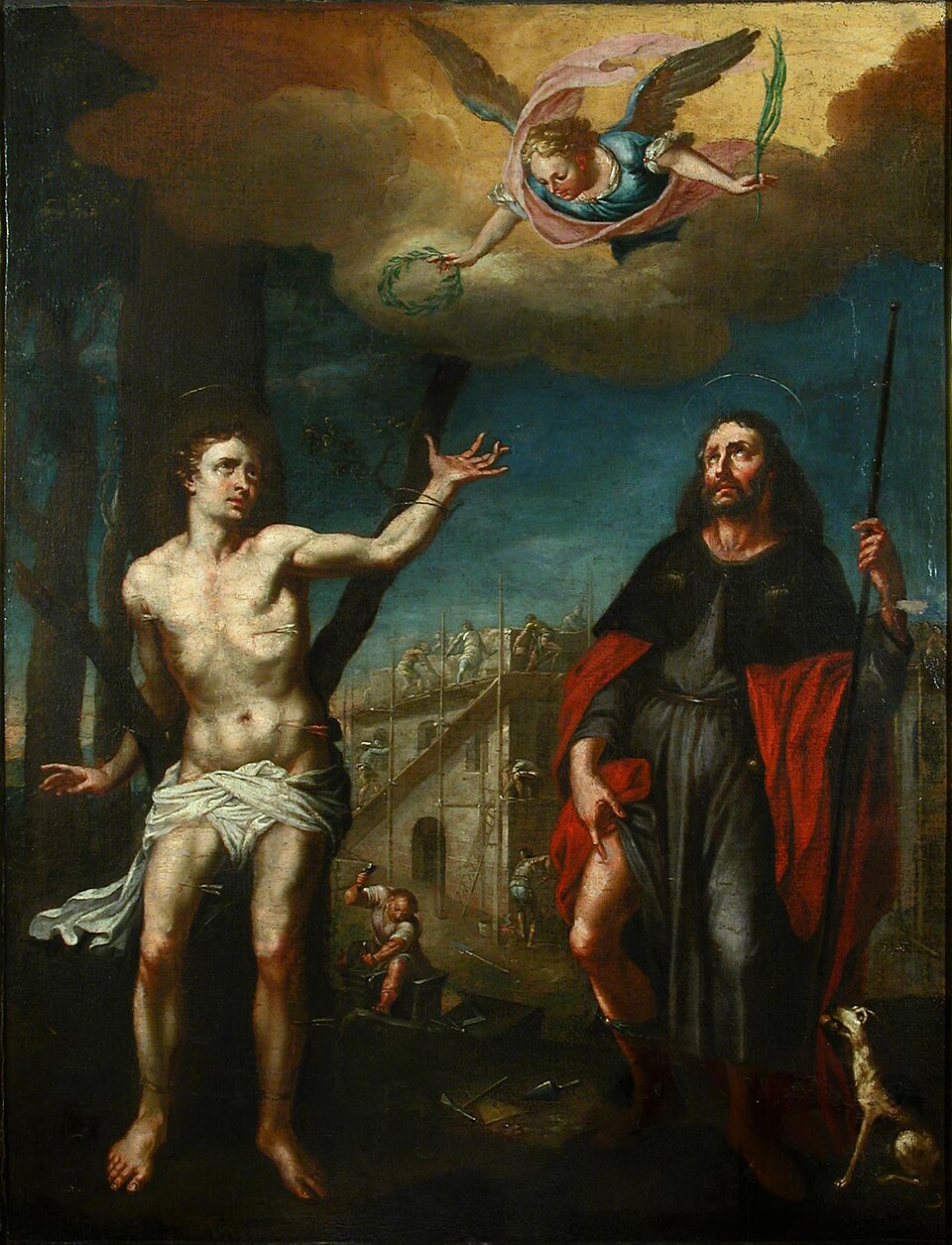
Sts. Roch and Sebastian became plague saints through two different imaginative routes. Sebastian is an older martyr of the Roman persecution tradition. In the Golden Legend he is tied to Diocletian, military rank, Christian witness, arrows, survival, renewed confrontation, and final martyrdom. The arrows mattered. Medieval and Renaissance viewers could read plague as invisible divine arrows striking a city; Sebastian's arrow-pierced body therefore became a visual intercessor against epidemic assault. Roch is later and more specifically plague-shaped. His legend makes him a pilgrim from Montpellier who gives away wealth, travels into plague-stricken Italian towns, heals by prayer and the sign of the cross, contracts plague himself at Piacenza, withdraws with a sore on his thigh, is sustained in isolation, returns home unrecognized, is imprisoned, and is identified after death. The dog bringing bread and the exposed bubo on Roch's thigh made his iconography almost diagnostic: viewers saw not abstract sanctity but quarantine, contagion, hunger, and the lesion of plague. Together the two saints show how epidemic devotion worked. Cities organized processions, vows, altars, confraternities, hospitals, and images when ordinary medicine and civic sanitation seemed overwhelmed. Their cults did not replace practical measures such as flight, isolation, burial regulation, or quarantine; rather, they shared the same anxious landscape. Roch's story speaks to caregiving and infection risk, since the healer becomes sick. Sebastian's story speaks to collective vulnerability, since the pierced body turns epidemic into a visible target for prayer. Both saints also made epidemic memory portable across paintings, badges, chapels, and hospital dedications. A medical reader should resist treating plague saints as irrational leftovers. They are evidence for how communities explained contagion, guilt, punishment, public fear, and mutual aid before bacteriology. They also expose the ethical strain of epidemics: who tends the sick, who flees, who is blamed, who is isolated, and what images make mass death bearable.
Plot or Argument
- Sebastian's arrows become epidemic signs
The Golden Legend martyr is shot with arrows, healed by Irene, confronts imperial power again, and dies. Later plague devotion transforms the arrows into symbols of epidemic blows falling on a community.
- Roch enters plague cities
Roch gives away wealth and moves as a pilgrim into Italian towns afflicted by plague. The legend presents him as both healer and vulnerable traveler.
- The healer becomes infected
At Piacenza Roch contracts plague and withdraws from society. His thigh sore, solitude, and miraculous sustenance make his body a plague icon.
- Confraternities organize devotion
Roch and Sebastian altars, processions, vows, hospitals, and brotherhoods turn saintly intercession into civic epidemic practice.
- Plague art teaches recognition
The arrow-pierced Sebastian and bubo-bearing Roch give communities memorable images for invisible contagion, divine danger, and hoped-for cure.
Characters
- St. Sebastian, martyr and plague intercessor
Roman soldier-saint whose arrow wounds became an emblem of plague's invisible assault.
- St. Roch, pilgrim healer
Late medieval plague saint remembered for tending sufferers, contracting plague, and displaying a sore on his thigh.
- Irene, caregiver in Sebastian legend
Widow who finds Sebastian alive after the arrows and heals him in her house.
- Gothard, helper in Roch legend
Figure linked with Roch's forest retreat and miraculous sustenance during illness.
- Plague confraternities, civic devotional bodies
Groups that organized prayer, care, hospitals, and ritual response under plague patronage.
Lessons
Epidemics need images as well as explanations
Sebastian's arrows and Roch's bubo gave visible form to invisible plague. In a world without germ theory, images helped communities locate fear, blame, hope, and intercession.
- Why might arrows be a persuasive symbol for epidemic disease?
- What does Roch's visible sore communicate that a sermon might not?
The caregiver is also exposed
Roch's legend does not keep the healer safely above disease. His own infection dramatizes the risk borne by nurses, clergy, family members, physicians, and neighbors during epidemic care.
- How does Roch differ from saints who heal without becoming vulnerable?
- What epidemic ethics appear in the figure of the infected caregiver?
Devotion and public health overlap
Processions and confraternities were not bacteriology, but they were organized communal responses. Plague devotion belongs beside quarantine, hospital care, burial practice, and civic regulation in the social history of epidemic disease.
- Where might ritual response support practical care?
- Where might it intensify danger by gathering crowds?
Plague stories remember social triage
These legends encode who is touched, avoided, fed, isolated, or honored. They are therefore evidence not only for belief but for the social sorting that epidemics force on frightened communities.
- Who receives care in the Roch legend, and who gives it?
- What do plague saints reveal about the fear of abandonment?
Context
Sebastian's cult predates the Black Death, but his arrow imagery made him a major plague intercessor. Roch's cult flowered later, especially in fifteenth-century Italy, where recurring plague, hospitals, confraternities, and civic vows shaped devotional practice.
Composition
Sebastian's chapter comes through the Golden Legend's medieval compilation of earlier martyr material. Roch's legend was stabilized in late medieval hagiography associated with Francesco Diedo and expanded through printed lives, confraternities, and art.
Reception
Both saints became central to epidemic art and civic devotion. Sebastian appears in countless plague altarpieces; Roch is recognized by pilgrim dress, dog, and thigh bubo. Their images remained useful through repeated plague cycles.
Comparisons
- golden-legend-popular-saints
The earlier Golden Legend entry explains the mechanics of popular patronage; Roch and Sebastian narrow that mechanism to epidemic fear, visual diagnosis, and civic plague ritual.
- early-franciscan-sources
Roch's pilgrim poverty and possible Franciscan associations echo mendicant ideals, but plague caregiving rather than voluntary poverty is the center of this entry.
- wesley-sermons-and-primitive-physick
Wesley joins practical remedies to religious exhortation in the eighteenth century; plague saints show an earlier blend of bodily crisis, devotion, and communal care.
- The Decameron (Giovanni Boccaccio)
Boccaccio's plague frame emphasizes flight, social breakdown, and storytelling, while Roch and Sebastian show urban devotion trying to hold frightened communities together.
- A Journal of the Plague Year (Daniel Defoe)
Defoe's London watches bills, quarantine, rumor, and commerce; plague-saint traditions reveal an older iconographic and intercessory grammar for similar civic fear.
- The Plague (Albert Camus)
Camus secularizes epidemic ethics around duty and solidarity, while Roch keeps the infected caregiver inside a specifically devotional world.
Quotes
“At Piacenza, he himself was stricken with the plague”
“Everywhere the terrible scourge disappeared before his miraculous power”
“Diocletian, cruel emperor of Rome, commanded that Sebastian should be led into the middle of a field and there bound to a stake, and that his archers should shoot at him till he was as full of arrows as an urchin is full of pricks”
For Students
A reading companion for classical Christian high school students. See the student guide.
Reading Guide
Watch for
- Sebastian's first martyrdom in the Golden Legend: he is bound to a stake in a field and shot full of arrows on Diocletian's order, yet he does not die there. Notice that the story needs him to survive and confront the emperor again.
- Irene, the widow who finds Sebastian alive and nurses him in her house. She is the first caregiver in either legend, and her quiet work sits between two scenes of imperial violence.
- Roch's choice at the start of his legend to give away his inheritance at Montpellier and walk as a pilgrim into Italian towns where plague is raging, instead of away from them.
- The turn at Piacenza, where the healer himself is stricken. Watch how the legend handles his withdrawal into the forest, the sore on his thigh, and the dog that brings him bread through Gothard.
- Roch's return home unrecognized and his death in prison, identified only afterward. Ask why a plague saint's story ends with him unknown to his own people.
Key terms and names
- Golden Legend
- Jacobus de Voragine's thirteenth-century collection of saints' lives arranged by the church calendar. It is the main source for the popular story of Sebastian's arrows, survival, and second martyrdom.
- Diocletian
- The Roman emperor whose persecution forms the setting of Sebastian's legend. In the Golden Legend he is the one who orders the archers to shoot Sebastian.
- Piacenza
- The northern Italian town where, in the Roch legend, the pilgrim who had healed so many contracts plague himself and leaves the town to suffer alone.
- Bubo
- The swollen, painful lymph node typical of bubonic plague. Roch is painted lifting his robe to show one on his thigh, so that his very image identifies the disease he protects against.
- Intercession
- Prayer offered on behalf of others, here asked of a saint believed to stand before God. Cities facing plague asked Sebastian and Roch to intercede for them through vows, altars, and processions.
- Confraternity
- A lay brotherhood organized for devotion and works of mercy. Roch confraternities, especially in Italy, ran processions and supported hospitals and care for the sick under the saint's patronage.
- Gothard
- The figure in Roch's legend connected with his forest retreat, through whom the dog's daily bread reaches the sick pilgrim. He turns the story of isolation into a story of being fed.
Seminar Questions
- Comprehension What happens to Sebastian after the archers leave him in the field, and how does his life finally end in the Golden Legend?
- Comprehension Trace Roch's journey from Montpellier through the Italian plague towns to Piacenza, his forest retreat, and his imprisonment at home. Who helps him at each stage?
- Comprehension What objects and details let a viewer recognize Roch in a painting, and what lets a viewer recognize Sebastian?
- Interpretation Sebastian was not originally a plague saint. Why might arrows, which strike suddenly and from a distance, have made his pierced body a fitting image for an epidemic falling on a city?
- Interpretation The Catholic Encyclopedia says the scourge disappeared everywhere before Roch's miraculous power, yet he himself is struck at Piacenza. Why would the legend keep both facts instead of letting the healer stay untouched?
- Interpretation Roch is fed by a dog in the forest and later dies unknown in a prison in his own country. What do these two scenes of isolation say about the place of the sick and the stranger in a frightened town?
- Interpretation Plague cities answered epidemics with processions and vows, and also with quarantine, burial rules, and hospitals. Does the legend of Roch present these as rivals or as parts of one response?
- Big Question When a deadly contagion is loose, what does a Christian owe to the sick stranger, and how much risk to one's own life does that duty require?
Faith Connections
- Psalm 91:5-6 (Scripture)
The psalmist promises that the faithful need not fear the arrow that flies by day or the pestilence that walks in darkness, setting arrow and plague side by side. Sebastian's arrow-pierced body gives that pairing a face, which helps explain how an old Roman martyr became the patron of plague-struck cities.
- Matthew 25:31-46 (Scripture)
Christ counts care for the sick and the prisoner as care for himself. Roch's legend runs through both categories: he tends the sick in the Italian towns, becomes one of the sick at Piacenza, and dies as a prisoner whom no one recognizes.
- 1 Kings 17:1-6 (Scripture)
Elijah, hidden by the brook Cherith in time of drought, is fed bread and meat by ravens. The dog that carries bread to the stricken Roch in his forest retreat belongs to this biblical pattern of God feeding a servant cut off from human help.
- Eusebius, Church History VII.22 (Church Fathers)
Eusebius preserves a letter of Bishop Dionysius of Alexandria describing a third-century plague in which Christians nursed the sick without regard to danger, and many caught the disease and died. Roch's story at Piacenza is a later, legendary version of the same pattern: the caregiver who takes on the illness of those he serves.
Logic and Rhetoric
Central argument: A plague kills from outside and from within, and a frightened city needs both an image of the blow and an image of the sufferer. Sebastian's arrows show disease as an assault falling on the community, and his survival of the archers shows that such blows need not be final. Roch's sore, his isolation, and his feeding by the dog show the sufferer himself, including the healer who catches what he treats. Since both saints passed through their wounds into holiness, a city that prays to them, keeps their feasts, and imitates Roch's care for the sick can face epidemic without despair. Therefore devotion to the plague saints teaches both trust in God's protection and the duty to tend the sick at personal cost.
Rhetorical device: homely simile. In the Golden Legend's account of Sebastian, Diocletian orders the archers to shoot until he is as full of arrows as an urchin is full of pricks. The everyday image of a hedgehog makes the martyrdom vivid and almost familiar, and the excess of arrows is exactly what later plague art seized upon.
Debate: Resolved: Roch's decision to walk into plague-stricken towns was an act of virtue, not of reckless imprudence.
Memory Work
At Piacenza, he himself was stricken with the plague
Writing Prompts
Essay: Roch heals others and then catches plague himself; Sebastian survives the archers only to die later at the emperor's command. Using the arrows, the sore, Irene, and the dog, argue what these two legends teach about the meaning of a wound that does not end in a cure.
Comparison with Sts. Cosmas and Damian: Physician Saints: Cosmas and Damian are physician saints who heal without payment, while Roch is a pilgrim who heals and then falls sick himself. Compare how the two legends present the Christian healer, and argue which offers the better pattern for someone who cares for the sick during an epidemic.
Medical Lens
Roch and Sebastian are essential for epidemic history because their cults reveal how communities visualized plague before microbiology. Roch's bubo and withdrawal belong to infection, isolation, and caregiver risk; Sebastian's arrows make epidemic strike legible as divine or cosmic assault. The entry should be used to discuss devotion alongside quarantine, hospitals, confraternities, burial, and blame.
- Roch at Aquapendente and Piacenza
Roch tends plague victims and then contracts plague himself, making the healer's exposure central to the legend.
- Sebastian's arrows
Arrow wounds become a plague symbol, translating invisible epidemic danger into an image a viewer can recognize and pray before.
- Council of Constance plague procession
The Roch tradition links public prayers and processions to epidemic cessation, showing ritual as civic plague response.
Creative Prompts
- Essay
Compare Sebastian's arrows and Roch's sore as two different visual grammars for plague: strike from outside and infection within.
- Classroom
Have students map plague responses into four columns: flight, quarantine, hospital care, and saintly intercession.
Further Reading
- The Golden Legend, Jacobus de Voragine
Primary medieval source for Sebastian's popular legend.
- St. Roch, Gregory Cleary
Catholic Encyclopedia public-domain summary of the Roch legend and cult.
- The Black Death, 1346-1353, Ole J. Benedictow
Modern demographic and epidemiological history of the Black Death.
- The Black Death and The Dancing Mania, J. F. C. Hecker
Nineteenth-century medical-historical account useful for plague mentality and epidemic interpretation.
Verification notes
Sebastian's Golden Legend tradition and plague iconography are secure. Roch's early biography is late, legendary, and mediated by Diedo-shaped tradition; the entry treats it as plague devotion rather than biography. No complete PD English Diedo Vita was attached.
No verification flags recorded.