Work record
St. Patrick's Writings
5th century; later legends 7th century · Ancient · Hagiography · Latin
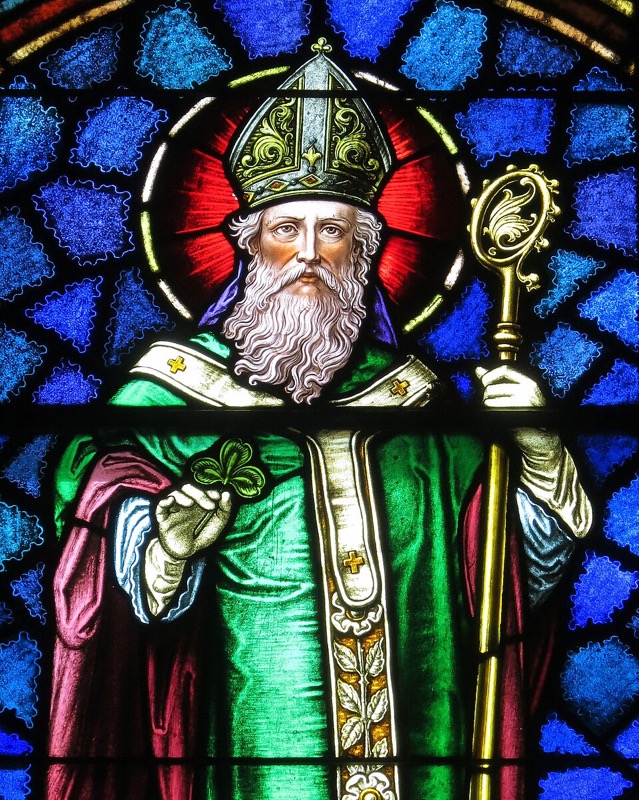
_-_stained_glass,_Saint_Patrick_-_detail.jpg)
Summary
Patrick's own writings are the narrow bridge between the global St. Patrick's Day figure and a real late Roman Christian voice. The Confessio begins with a self-portrait of abasement: Patrick calls himself a sinner, unlearned, rustic, and contemptible to many. He says he was captured at about sixteen and taken to Ireland, where captivity turned him toward prayer. The text is not a chronological autobiography so much as a defense of vocation. Patrick writes as a man answering critics, explaining why he returned to the land of his enslavement, and insisting that the mission was God's work rather than his own competence. The Letter to Coroticus is sharper and more public. It denounces soldiers who killed and enslaved newly baptized Christians, and it treats slave-raiding as a scandal inside a supposedly Christian world. Around these two first-person texts later Irish tradition built a larger saint. Muirchu gives Patrick confrontations with kings and druids, especially the Paschal fire at Tara. Tirechan helps map Patrick's foundations and claims across Irish places. These writers are valuable, but they are not the same kind of evidence as Patrick's own urgent Latin. The snakes and shamrock, now central to greeting cards, pub signs, and schoolroom retellings, are not the historical core. They belong to the long afterlife in which Patrick becomes an emblem of Irish Christianity, migration, national identity, and seasonal celebration. The medical and psychological interest lies partly in captivity and trauma, partly in the rhetoric of vocation, vision, and inner hearing, and partly in public memory: a text about enslavement and return becomes a holiday often detached from slavery, penitence, and ecclesiastical conflict. Reading Patrick carefully means letting the saint be stranger, harsher, and more vulnerable than the modern green festival image. That deep strangeness is precisely what makes the source worth preserving.
Plot or Argument
- Confessio: captivity and conversion
Patrick introduces himself as socially and intellectually lowly, recounts his capture as a teenager, and describes prayer during his years as a herdsman in Ireland. Captivity becomes the place where his religious life begins.
- Confessio: the call to return
After escape and return to Britain, Patrick reports a night vision in which voices from Ireland ask him to come back. He frames the return as obedience to a divine summons rather than adventurous missionary ambition.
- Confessio: defense of an episcopate
The later portions answer unnamed ecclesiastical critics, defend Patrick's integrity with money and converts, and insist that his work among the Irish came through grace despite poor education and social humiliation.
- Letter to Coroticus
Patrick condemns the killing and enslavement of baptized converts by Coroticus's soldiers. The letter exposes violence, trafficking, and church discipline at the frontier of Roman and post-Roman Christian worlds.
- Muirchu and Tirechan
Seventh-century writers enlarge Patrick's memory with royal encounters, contests with druids, foundation stories, and Armagh-centered geography. Their Patrick is already a saint of institutions and places.
- Festival afterlives
Later tradition adds snakes, shamrock catechesis, green national symbolism, diaspora parades, and secular celebration. The modern holiday preserves Patrick's name while often obscuring the captive, bishop, and polemicist.
Characters
- Patrick, missionary bishop and narrator
A British captive turned Irish bishop whose surviving writings defend his vocation and condemn violence against converts.
- Coroticus, British ruler or war leader
The addressee behind Patrick's denunciation of soldiers who killed and enslaved newly baptized Irish Christians.
- Victoricius, visionary messenger
The figure in Patrick's dream who carries letters from Ireland, initiating the famous call to return.
- Muirchu, seventh-century hagiographer
Author of a life that dramatizes Patrick's contests with pagan authority and helps form the national apostle image.
- Tirechan, seventh-century collector of Patrick traditions
Writer whose notes connect Patrick to churches, journeys, and claims in the Irish landscape.
Lessons
The earliest Patrick is not the holiday mascot
Patrick's own Latin texts foreground capture, prayer, return, church conflict, and anti-slaving outrage. The later green festival image is real cultural history, but it should not be mistaken for the oldest source layer.
- Which parts of Patrick's own writings disappear most completely in modern St. Patrick's Day?
- What does the Confessio gain by beginning with self-abasement?
Captivity can become vocation without becoming harmless
Patrick interprets enslavement as the setting of conversion, but the Letter to Coroticus shows that he does not romanticize captivity. He can find providence in his own suffering and still condemn slave-raiding as a Christian scandal.
- How does Patrick's response to his own captivity differ from his response to the captives taken by Coroticus?
- Where should a modern reader resist turning trauma into a neat origin story?
Institutional memory reshapes charismatic memory
Muirchu and Tirechan preserve valuable traditions while also making Patrick useful to churches, territories, and Armagh's authority. The saint becomes a map of claims as well as a remembered person.
- How do later hagiographers make Patrick more public and political?
- What signs show that a saint's life is also an institutional argument?
A vision narrative needs historical tact
Patrick's voices and dreams are central to how he explains mission. A medical reader can compare them with later psychology of religious experience, but should avoid flattening them into a retrospective diagnosis.
- How does Patrick present visionary experience as a source of authority?
- What would be lost if the vision were treated only as symptom?
Context
Patrick belongs to the fifth-century world after Roman Britain had begun to fragment and before Ireland was organized into the later medieval Christian landscape. His writings are precious because so few first-person missionary texts survive from this frontier setting.
Composition
The Confessio was probably written late in Patrick's life as an apologia for his mission and conduct. The Letter to Coroticus responds to a specific raid against newly baptized Christians. Muirchu and Tirechan wrote roughly two centuries later in an Ireland where churches were already competing over Patrick's memory.
Reception
Patrick's cult became inseparable from Irish Christian identity, Armagh's claims, medieval and early modern national memory, diaspora celebration, and finally a global holiday. Modern snakes and shamrocks are later symbols, not the secure basis of Patrick's own voice.
Comparisons
- confessions
Augustine and Patrick both use confession to interpret a life before God, but Augustine writes a philosophically shaped autobiography while Patrick writes a defensive missionary apologia.
- early-christian-lives
Jerome and Athanasius construct saintly lives from outside; Patrick's Confessio is rarer because the missionary saint speaks in his own rough self-defense.
- the-history-of-the-church
Eusebius narrates Christianity from imperial and episcopal vantage points, whereas Patrick's texts reveal frontier conversion through captivity, poverty, and local violence.
- the-varieties-of-religious-experience
James offers a modern psychological vocabulary for conversion and voices; Patrick shows a premodern writer using dreams and calls as public evidence of vocation.
- the-bible
Patrick saturates his defense with Pauline and prophetic language, making his life legible through scripture rather than through secular biography.
- the-rule-of-st-benedict
Benedict imagines stable monastic discipline, while Patrick's writings belong to mission, captivity, movement, and improvised frontier authority.
Quotes
“Ego Patricius peccator, rusticissimus et minimus omnium fidelium, et contemptibilissimus apud plurimos”
“Annorum eram tunc fere sedecim”
“Rogamus te, sancte puer, ut venias et adhuc ambules inter nos”
“Ego Patricius peccator indoctus scilicet Hiberione constitutus episcopum me esse fateor”
For Students
A reading companion for classical Christian high school students. See the student guide.
Reading Guide
Watch for
- The first sentence of the Confessio, where Patrick names himself a sinner, most rustic, and least of the faithful, and then gives his family: a father Calpornius who was a deacon and a grandfather Potitus who was a priest. Notice how he admits he did not know the true God despite that household.
- Patrick's six years as a captive herdsman in Ireland, when he says he prayed many times by day and night in snow, frost, and rain, and the voice that tells him a ship is ready for him far away.
- The escape: a hard voyage, a journey with the sailors through deserted country, hunger, and Patrick's prayer that is followed by a herd of pigs appearing on the road. Watch how the pagan sailors respond to him.
- The dream of Victoricius, who arrives from Ireland with letters, and the voices of those near the Wood of Foclut calling the holy boy back to walk among them. Compare the dream to Paul's vision of the man of Macedonia.
- The Letter to Coroticus, where Patrick learns that newly baptized converts, still in their white baptismal garments, have been killed or carried off to be sold, and he writes to cut the raiders off from the fellowship of Christians.
Key terms and names
- Confessio
- Patrick's Latin account of his life, written late in his career. Confessio here means both confession of sin and confession of praise to God, and the work is also a defense of his mission against critics.
- Bannavem Taburniae
- The village in Roman Britain where Patrick says his father had a small estate and where he was captured at about sixteen. Its exact location is unknown.
- Victoricius
- The man Patrick sees in a dream, coming from Ireland with many letters, one of which carries the voice of the Irish asking him to return. The dream is the hinge of Patrick's vocation.
- Coroticus
- A British ruler whose soldiers raided Ireland, killed newly baptized converts, and sold others into slavery. Patrick's letter declares that the raiders have cut themselves off from the Church until they repent and free the captives.
- Neophytes
- The newly baptized. Patrick's grief in the Letter to Coroticus is sharpened by the fact that the victims had just received baptism and were still wearing their white garments.
- Muirchu and Tirechan
- Seventh-century Irish writers who expanded Patrick's story. Muirchu tells of Patrick lighting the Paschal fire at Slane in defiance of King Loegaire at Tara, a scene found nowhere in Patrick's own writings.
- Rusticitas
- Patrick's word for his own lack of polished education. He returns to it often, contrasting his rough Latin with the learning of his critics, and turns it into evidence that his mission came from God rather than from skill.
Seminar Questions
- Comprehension How old was Patrick when he was captured, what was his family's standing in the Church, and what does he say his spiritual state was at the time?
- Comprehension What did Patrick do during his captivity in Ireland, and how did he escape and come home to Britain?
- Comprehension What had Coroticus's soldiers done, and what does Patrick require of them in his letter?
- Interpretation Patrick calls himself unlearned and rustic again and again, yet he writes a careful defense full of Scripture. Why does he dwell on his lack of education, and how does it serve his argument?
- Interpretation Patrick sees his own captivity as the place where God found him, yet he condemns the captivity of the converts taken by Coroticus without any such softening. Is he consistent? How does he hold both views?
- Interpretation Compare the Patrick of the Confessio with Muirchu's Patrick, who defies the king at Tara with the Easter fire. What does each portrait emphasize, and why might later writers have needed the second?
- Big Question Can suffering that was truly unjust become the means of a person's calling without ceasing to be unjust?
- Big Question Why would someone return freely to serve the people who once enslaved him?
Faith Connections
- Acts 16:6-10 (Scripture)
Paul sees in a night vision a man of Macedonia begging him to come over and help them, and he goes at once. Patrick's dream of Victoricius and the voices of the Irish follows this pattern closely, and Patrick reads his own mission as a continuation of the apostles'.
- Genesis 50:15-21 (Scripture)
Joseph tells the brothers who sold him into slavery that they meant it for evil but God meant it for good. Patrick, carried off as a slave and later returning to save those among whom he served, reads his own captivity in the same providential way.
- 2 Corinthians 11-12 (Scripture)
Paul defends his apostleship against critics by boasting of his weaknesses and sufferings rather than his gifts. Patrick's Confessio is built on the same strategy, answering those who doubted him by pointing to his rusticity and to what God did through it.
- Augustine, Confessions (Church Fathers)
Augustine, writing a generation earlier in polished Latin, also confesses both his sins and God's praise. Setting the two side by side shows two ways of telling a converted life: Augustine's searching philosophical memory and Patrick's urgent, plain self-defense from the edge of the known world.
Logic and Rhetoric
Central argument: The Confessio argues: Patrick was an unlearned sinner who did not know God when he was taken captive; in captivity God turned him to prayer, delivered him, and called him back by visions; the conversion of thousands of Irish followed, which no rustic could have accomplished by his own skill; therefore his mission is God's work, and the critics who question his learning, motives, or past sins are questioning what God has done.
Rhetorical device: modesty topos (humility formula). Both the Confessio and the Letter to Coroticus open with Patrick naming himself a sinner and unlearned (Ego Patricius peccator, quote 0, and the episcopal confession of quote 3). The lowered self becomes the foundation of his authority, since whatever was accomplished must be credited to God.
Debate: Resolved: Patrick's own writings are a better guide to his holiness than the later legends of Muirchu and Tirechan.
Memory Work
Ego Patricius peccator, rusticissimus et minimus omnium fidelium, et contemptibilissimus apud plurimos
Rogamus te, sancte puer, ut venias et adhuc ambules inter nos
Writing Prompts
Essay: Patrick was enslaved in Ireland as a youth, escaped, and returned of his own will as a bishop. Using his account of captivity, the dream of Victoricius, and the Letter to Coroticus, argue how Patrick understands the relation between his own suffering and his mission to the Irish.
Comparison with Confessions: Augustine and Patrick both wrote confessions in Latin within roughly a century of each other, and both tell of a youth far from God and a call that changed everything. Compare the occasion, audience, style, and argument of the two works, and argue what each reveals about what it means to confess before God and before others.
Medical Lens
Patrick matters medically through captivity, forced migration, visionary experience, and the social violence of slave-raiding. His voices should be presented as religious experience in a fifth-century theological frame, not as a diagnosis. The later festival afterlife is also useful for public-health writing because it shows how collective memory can detach celebration from traumatic origins.
- Confessio I
Patrick's capture at roughly sixteen provides a rare late antique first-person account of adolescent enslavement.
- Confessio X
The voice from Ireland is a central religious experience that later psychology might compare with conversion and vocation narratives.
- Letter to Coroticus
Patrick's denunciation of killing and trafficking baptized captives preserves a moral response to slave-raiding and communal trauma.
Creative Prompts
- Essay
Compare Patrick's dream call with William James's cases of vocation, keeping one paragraph on the dangers of retrospective diagnosis.
- Dialogue
Write a conversation between Patrick and a modern parade organizer about what a symbol owes to its source.
- Classroom
Have students separate Patrick's own claims from Muirchu's later legends and from modern snakes-and-shamrock folklore.
Further Reading
- The Life of St. Patrick and His Place in History, J. B. Bury
- The Patrician Texts in the Book of Armagh, Ludwig Bieler
- Saint Patrick, Maire B. de Paor
- How the Irish Saved Civilization, Thomas Cahill
Verification notes
Patrick's own writings are secure primary anchors. The precise chronology of his life, the location of Bannavem Taburniae, and details of Muirchu and Tirechan's sources remain debated. Snake and shamrock traditions are treated as later folklore rather than fifth-century evidence.
- A future fuller entry should import complete public-domain texts for Muirchu and Tirechan if a clean source is selected.